Reconsidering Drummond Street Three Artists at the End of Modernism, 1965–1974
Between 1966 and 1974, Australian artists Michael (Mike) Brown (1938–97), Guy Stuart (1942–2023), and Trevor Vickers (b. 1943) spent meaningful, though intermittent, time at a Victorian terrace house on Carlton’s Drummond Street. While their artistic styles and themes varied greatly, the Drummond Street house served as a nexus—a place where their diverse interests converged. This house became a space where they challenged modernist assumptions about art and the artist’s role, with each artist interpreting this mission in uniquely local terms. More broadly, Drummond Street represented a microcosmic platform to explore whether Australian art history could be viewed outside the usual art historical frameworks and instead through a sociological lens. As Terry Smith observes, “art history is very much a product of the social relations in which it is formed—and within which it struggles for autonomy or distinctiveness.”1
This paper reexamines the social context of three avant-garde artists during modernism’s waning years, from 1966 to 1974, offering a revisionist perspective on a complex period in Australian art history. Rather than analysing the era in terms of influence or progression, the paper presents a narrative of this history, arguing that Australian art history can be approached from the bottom up. This method challenges the dominant Euro-American perspective in art history, bringing the Australian periphery into focus as a vibrant centre of localism.
By invoking a sociological lens, this paper draws loosely on cultural sociology and micro-social approaches to artistic production, especially the idea that meaning emerges not solely from aesthetic objects, but from the everyday interactions, spatial conditions, and informal networks that shape them. Rather than apply a single model or theorist, I adopt a situated approach akin to what Pierre Bourdieu might call “a field of relations,” where practice is embedded in habitus, proximity, and material constraint.2 In this sense, the Drummond Street house functions as a social infrastructure as much as an architectural site, shaping not only the production of work but the conditions of reception and exchange.
The emphasis here is on the close relationships and contingencies that shape artistic creation. Rather than following traditional studies of provincialism’s impact on art, this paper highlights the social dynamics that underpin art-making and artistic collaboration.3 It avoids a sweeping meta-narrative, opting instead for an intimate account of modernism, artistic mobility, friendship, and shared knowledge. The aim is not to recount events (although at times it may do so) but to offer a new interpretation of this period’s complexity, advancing the argument that informal networks can play a significant role in propelling ideas and creative energies forward. Further, it argues that informal narratives can be a means of rewriting and reconsidering art historical accounts.
Art in 1960s Australia
In 1965, the twenty-five-year reign of expressionistic painting in Australia, both abstract and figurative in form, was coming to a close.4 It was challenged by a new non-figurative style (most commonly known as hard-edge or colour-field painting), devoid of tone, line or the illusion of spatial depth. Bernard Smith, recognising this break within local artistic milieus, observed in Australian Painting that “most [artists now] painted as if they believed that the work of art was a self-contained object and not as a vehicle of expression.”5 According to Smith, painting no longer sought to embody gestural or emotive impulses; rather, it exclusively sought to exploit the aesthetic qualities of the visual surface.6 This shift propelled Trevor Vickers to adopt simple artistic conventions relating to the structure and organisation of painting. His Untitled work of 1965 privileges the experience of pure colour—specifically, unmodulated colour, separated from compositional systems and a hierarchy of dominant and subordinate parts.7 The painting consists of a deep turquoise hue surrounded by a thin band of yellow. The band runs along the surface area in a straight line, bordering the composition. This margin of sorts emphasises the painting’s flat surface and its geometric form. There is no variation in tone, so external light becomes the focus. It bounces off the composition, imbuing flat and naturally subdued areas of colour with luminosity. This gleam prevents the work from becoming tedious or dull. It arrests the viewer’s eye and enables them to approach the work as a concentrated experience. Nothing interferes with its effect of a pure encounter with paint on canvas.
Unlike Untitled, most painting in Australia in the late 1960s, especially those sold in commercial galleries, were linked by the infinite thread of a sophisticated tonalism, developed by the French in the nineteenth century, which encouraged fine intricate brushwork and a rich palette dominant in pinks, blues, and greens.8 Australia’s enduring engagement with tonal painting techniques prompted spirited discussions between Vickers and his friend and colleague Mel Ramsden, whom he met shortly after Ramsden moved to Melbourne in 1963. Questioning this well-liked ‘Capital A’ art, Ramsden and Vickers took to experimenting with untextured, monotone colour that did not suggest spatial depth.9 Ramsden’s work of 1965, Two Black Squares, exemplifies this exploration.10 Completely rejecting tonal variation, Ramsden covered the entire surface area with a thick layer of black enamel paint. A grey outline demarcates this dark abyss and encloses the composition in a two-dimensional square format. Ramsden’s painting, though void of fine brushwork and decorative compositions, still intends to stimulate visual sensation and sentiment for the spectator. Further, it seeks to convey the “real power” of painting;11 that is, the complete experience inspired by a reductive use of colour, line, and form.
Intrigued by Ramsden’s artistic position, Vickers subsequently constructed a series of ten reductive paintings. In 1966, Vickers exhibited these works at Sweeney Reed’s Strines Gallery for his first solo show. Vickers first met the Reed family in 1964 at the Museum of Modern Art and Design of Australia (MOMAD) in Tavistock Place, Melbourne. After presenting John Reed—MOMAD’s founder and director—with two recent examples of his abstract cityscapes, Vickers was invited to show his work in the Young Minds exhibition in August 1964 and the New Generation exhibition of 1965.12 Both exhibitions celebrated the many young Australians actively and professionally involved in painting and sculpture at the time.13 Despite MOMAD’s closure in early 1966, John Reed maintained his friendship with Vickers—often showing him his vast collection of Australian art at his home in Heidelberg. Vickers first met Sweeney Reed, the adopted son of John and his wife Sunday, in September 1966, upon his return to Melbourne. Having just worked at London’s Institute of Contemporary Arts for a year, Reed was very interested in starting a gallery of his own in Melbourne. John Reed suggested he look at Vickers’ paintings as potential exhibits.14 Thereafter, the two formed a close friendship, with Reed often dropping off gifts of beer to Vickers’ apartment in Milton Street, West Melbourne.15
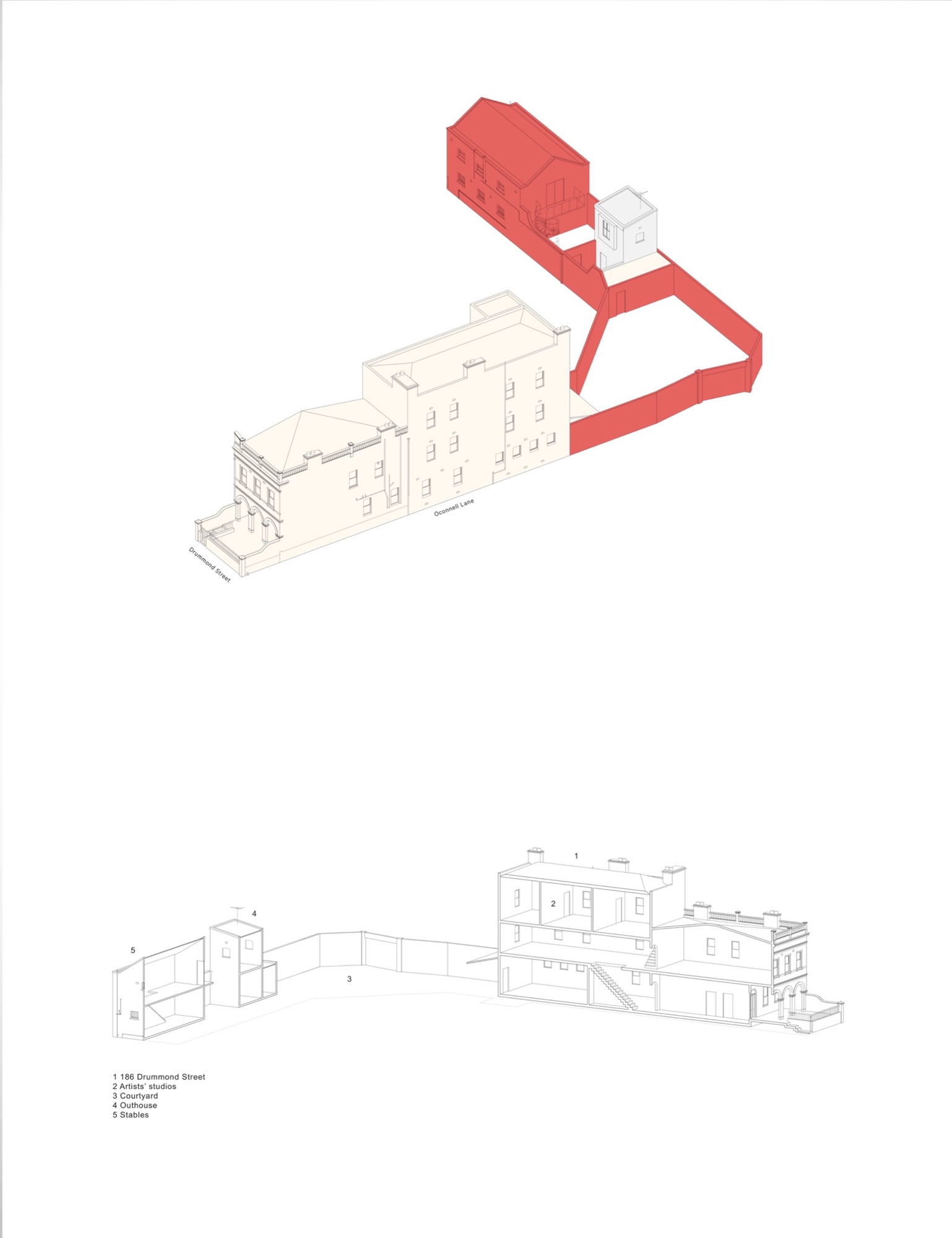
Neighbouring the Queen Victoria Market, in one of the oldest parts of Melbourne, Vickers’ house was old and very small, with very little room to work on or store his paintings. In an attempt to solve Vickers’ space problem, Sweeney Reed invited him to look at a property in Carlton North in October 1966. This three-storey Italianate villa, located at 186 Drummond Street, was part of Denver Terrace (first known as Carolina Terrace), an imposing row of six villas each three storeys high.16 As the most southerly villa in the group, 186 stood proudly at the corner of Oconnell Lane, west of Rathdowne Street and south of Grattan Street (fig. 1).17 The main house had sixteen rooms, four kitchens, and about a dozen bathrooms, all in derelict condition.18 At the rear of the main house was a large two-storey stable and a small outbuilding, formerly occupied by groomsmen. The house made a great first impression on Vickers, and Reed offered him the keys to both the house and its adjoining stables to use as a living and studio space. Vickers soon moved in and undertook, with the assistance of two itinerant friends, a complete rewiring of the main building, upgrading all the essential services, removing the kalsomine paint from the walls and repainting the interior.19
After recovering much of the property’s lost integrity, Vickers recouped some of the weekly rent by subletting the house to artists and friends Kevin McMurtry, John Campbell, Michael Fitzjames, Doug Keane, Guy Stuart, and Stuart’s future wife Carol Stuart.20 Before moving into the outbuilding at 186, Stuart had been living with Carol at 999 Drummond Street, where he began experimenting with commonplace objects, namely, bowls, vats, and discs. Inspired by the volume and depth of these spherical forms, Stuart started to mould wax maquettes (for casting in bronze) in the shed behind the property. As a trained draughtsman, the maquettes were a significant shift away from his two-dimensional drawing and painting practice. At 999, he also taught himself to weld and constructed the large Stainless Steel Sculpture (1967).21 Over two metres high, the assemblage of consists of discarded aircraft fragments (found in a scrap metal yard along the Maribyrnong River at Yarraville) including wire, mesh, nickel, zinc, chrome, rubber, cast iron, aluminium, metal, and steel.22 Each part is precariously balanced on what seems to be a jet engine frame, which serves as the base for the entire composition. In May 1967, Stainless Steel Sculpture was exhibited at Gallery A, Melbourne, in an exhibition tilted Larger Works Suitable for Public Space alongside work by Charles Reddington, Peter Clarke, Leonard Hessing, Robert Klippel, Colin Lanceley, and Janet Dawson. In March 1968 it was sent to New Zealand to feature in the group show, Form in Action, at Auckland Art Gallery Toi o Tāmaki. Upon its return to Melbourne, in November 1967, the sculpture was sent to the courtyard of 186 Drummond Street, where it remained until its purchase by the National Gallery of Australia.23
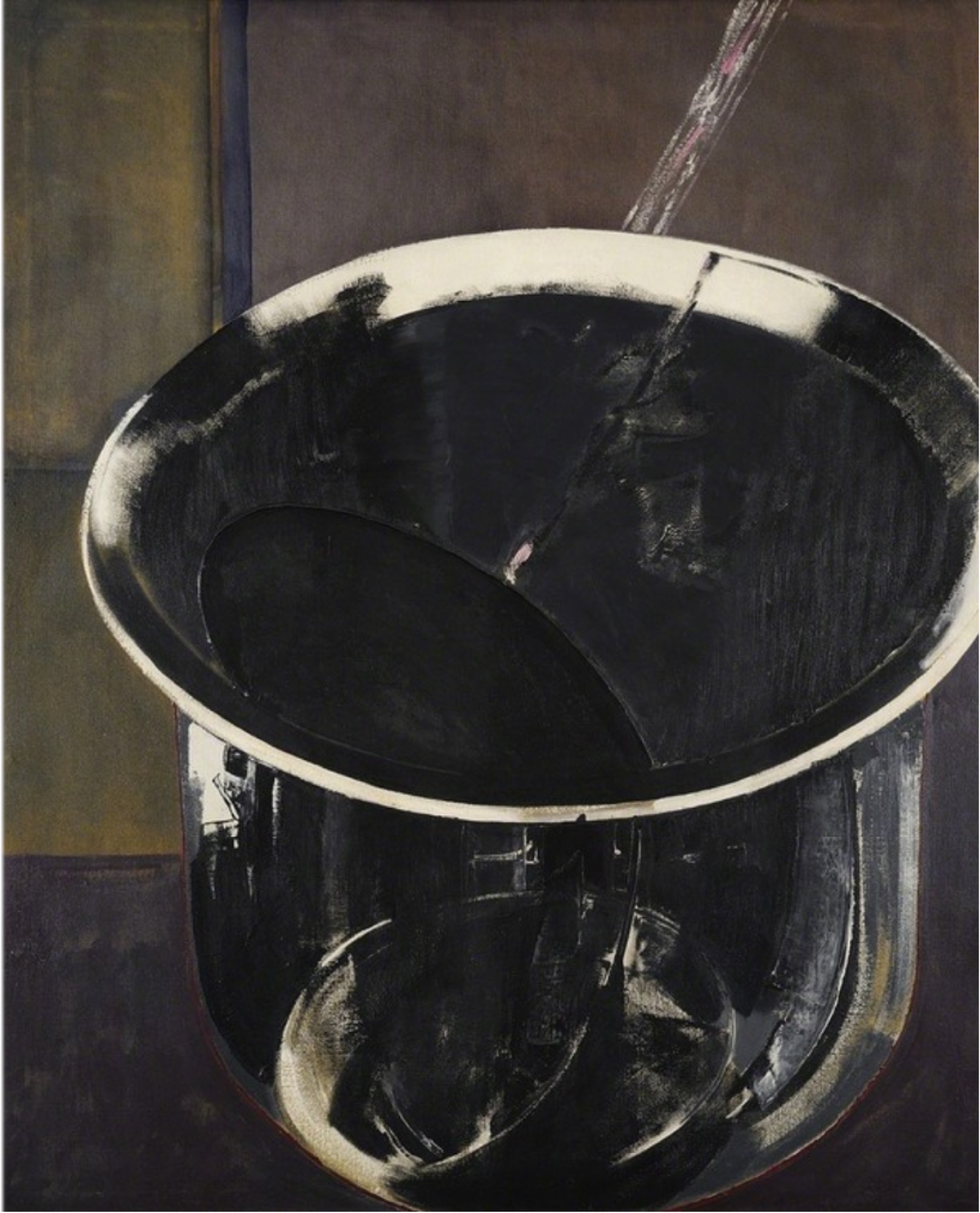
In the large stables adjacent to the courtyard, Stuart embarked on an extensive period of figurative drawing and painting. With little to no light, he would construct canvases on the second floor and then bring them down to the first floor to paint (where he could access electricity from the main house using a long extension cord).24 Stuart produced hundreds of large pastel drawings and dozens of oil paintings, experimenting with the shapes and forms of bowls, vats, and discs. One such painting, Vat and Disc 1 (1968) (fig. 2) depicts a singular vat with multiple shiny discs sitting along the inner rim. Whilst the foreground of the painting is organic, with elliptical shapes and crisp circular lines, the background is flat, comprised of two geometric blocks shaded in gloomy hues of grey, green, black, and brown. Another painting on the same theme, Thermal Tableaux (1968), depicts nine vats arranged in rows and columns of three.25 Unlike Vat and Disc 1, the colours in this diptych are bright, with vivid yellows, greens, and blues saturating the entire surface. The colours are so brilliant that the overall palette appears to have been deliberately inverted: with little to no shade, points of highlight and midtone dominate the composition. This transposition of light distorts our perception of the vats’ volume and depth. Further, it generates a tension between the container and the contained, the opened and the closed.26
Structurally, the large scale of Thermal Tableaux speaks to the environment in which it was constructed. The 2.31 x 3.17-metre canvas panels reflect the open space provided by the Drummond Street stables. Like Stuart, the stables enabled Vickers individually to fabricate and paint comparatively large canvases. In October 1967, at his second solo show at Strines Gallery, six of these large-scale paintings were exhibited. Compositionally, each painting was basic: all were painted in flat tones of silver or white and framed with thin bands of black paint. One particular work, entitled Painting ‘10’ (1966) is composed of two simple rectangular shapes separated by a thin black line.27 The same line traces the entire surface area, forming a window-like structure. The painting is an exercise in two-dimensionality, rigid symmetry, monotonous colour, and flatness. In a review of the exhibition, Patrick McCaughey deemed Vickers’ work “the first sign of minimal art in Australian painting.”28 For McCaughey, Vickers’ use of simple geometric shapes and non-representational compositions reflected the surge of reductive abstract art in North America and Europe; specifically, paintings that challenged existing structures for making, disseminating, and viewing art.
Ramsden’s artistic position and Vickers’ reductive aesthetic are arguably linked, not only through shared conversations in Melbourne but also through mutual engagement with broader artistic currents. By flattening the canvas and removing gestural variation, Vickers produced a frontal painterly space that bore clear similarities to Ramsden’s formal restraint. While McCaughey situated Vickers within the frame of American minimalism, it is important to view these connections as both proximate and porous. Artists such as Ramsden were indeed attuned to developments overseas, presumably reading Artforum, referencing the language of minimalism, and responding to American and European precedents by extension. Yet what distinguishes this moment is how these influences were refracted through intensely local circumstances: informal discussions, conversations, and the socio-material limitations of the artists’ immediate environment. Rather than presenting internationalism and localism as opposed poles, it is more accurate to see these artists negotiating both registers simultaneously. Their practices were embedded in lived experience, marked by exchange with peers, shaped by Australian institutional conditions, and informed by international debates. Their work was poised not just to influence the broader art world but to establish an avant-garde movement in Australia, a striking step away from the country’s previous provincial standing.29 This layering of influence calls for a more integrated historical account, one that attends to the complex interplay of endogenous dialogue and exogenous models of art theory.
Mike Brown Appears
Around November 1967, following Vickers’ second solo exhibition at Strines, he travelled with Sweeney Reed to Sydney to assist Mike Brown, who had been convicted on obscenity charges in June that year.30 In a white Chevrolet van, Reed and Vickers collected all of Brown’s paintings from Sydney and relocated them to 186 Drummond Street. Soon after, Brown took up a room in the Drummond Street house, using the big rooms on the third floor—legally unusable because there was no fire escape—to store and construct his large-scale works.31
Once Brown moved in, the artists began to exchange ideas concerning the limits and extent of painting. “The great thing was,” Vickers explained, “because of the different ways each of us worked there was no competition.”32 With completely disparate styles and distinct techniques, the shared living and working spaces afforded each artist the mental and physical space to contemplate and evolve their artistic sensibility freely. For Brown especially, after an arduous two years in Sydney, this time was an opportunity to reset and regroup—a long-awaited unwind that culminated in the burning of his infamous painting Mary-Lou (1962) (fig. 3).
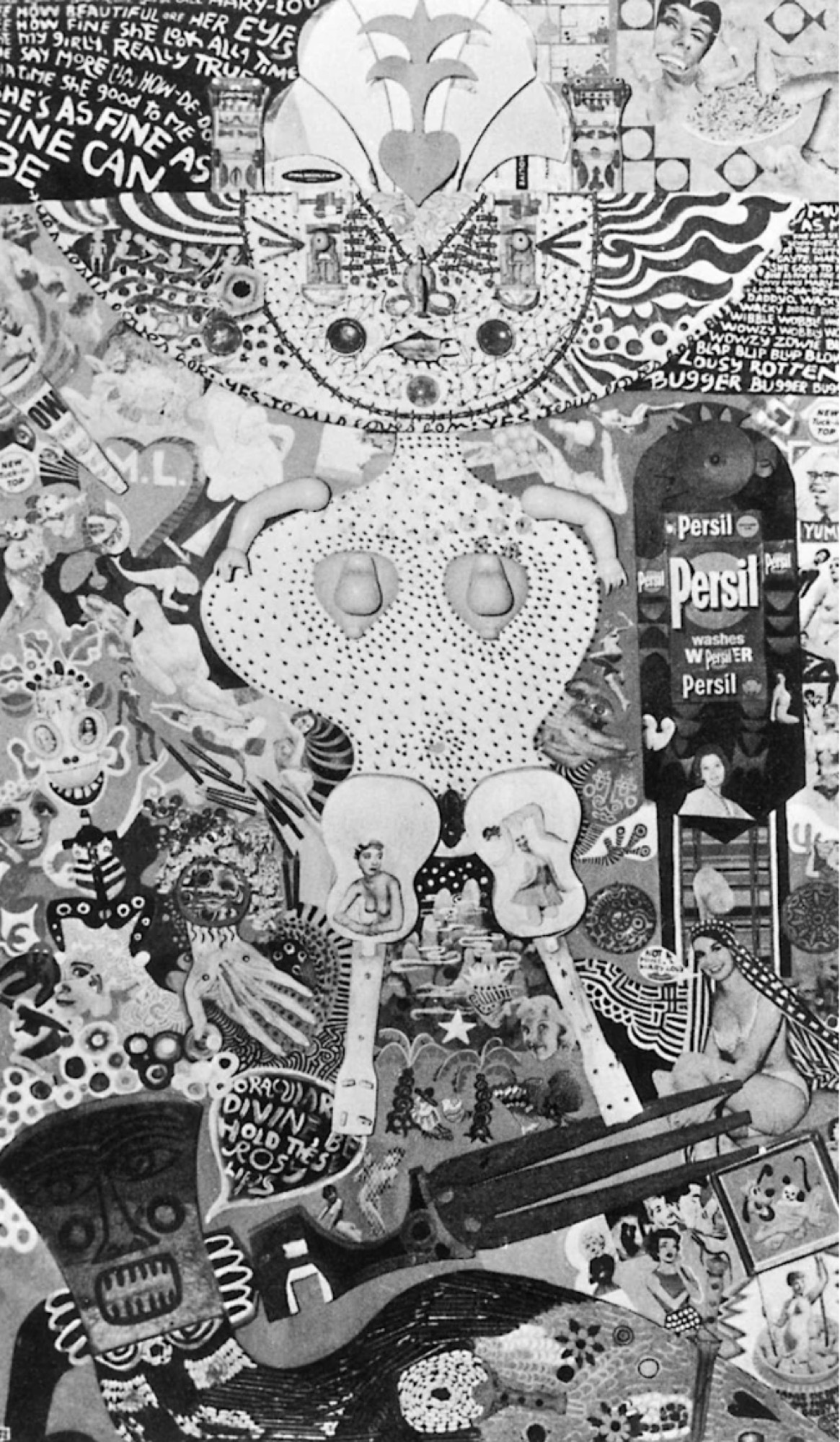
Over two metres high and brilliantly coloured, Mary-Lou consisted of found objects, tacky décor, and Woolworths-bought knickknacks. The scarlet lips of her mouth were represented by tropical seashells; the nose was a coat hook; the hair streamed out in a series of red and white striped ribbons; the eyes were plastic toy go-carts in fluorescent green, yellow, and pink; the arms were those of plastic dolls; and her legs a pair of ukuleles.33 The figure’s body ballooned over a background of more plastic toys, stars, speech bubbles, advertising logos and a montage of images using about one-hundred and fifty young pin-up girls. Although aesthetically amusing, Douglas Pratt, a member of the Commonwealth Art Advisory Board, deemed the work “completely disgusting” and it was subsequently rejected in 1963 from Australian Painting Today at Queensland Art Gallery and condemned on grounds of obscenity. 34
In response, Brown removed Mary-Lou (which had arrived with Vickers and Reed) from the hallway of 186 Drummond Street and threw it, alongside unsold sculptures, onto a fire burning in the Drummond Street house’s courtyard.35 According to Vickers, Stuart had started the fire to burn some preparatory drawings that did not satisfy him. After watching Stuart from the third floor, Brown decided to join in. As Vickers stated, “he chucked [Mary-Lou] in the fire. It was Mike: if he was going to do something, he would do it and by that point he had already done it.”36 The burning of Mary-Lou alleviated Brown’s emotional strain and, to the residents of the Drummond Street house, exposed the artist’s uncontrollable sensibility. Moreover, perhaps unknowingly, burning Mary-Lou prompted Brown to establish a renewed artistic sensibility, separate from the work created in Sydney.37
*
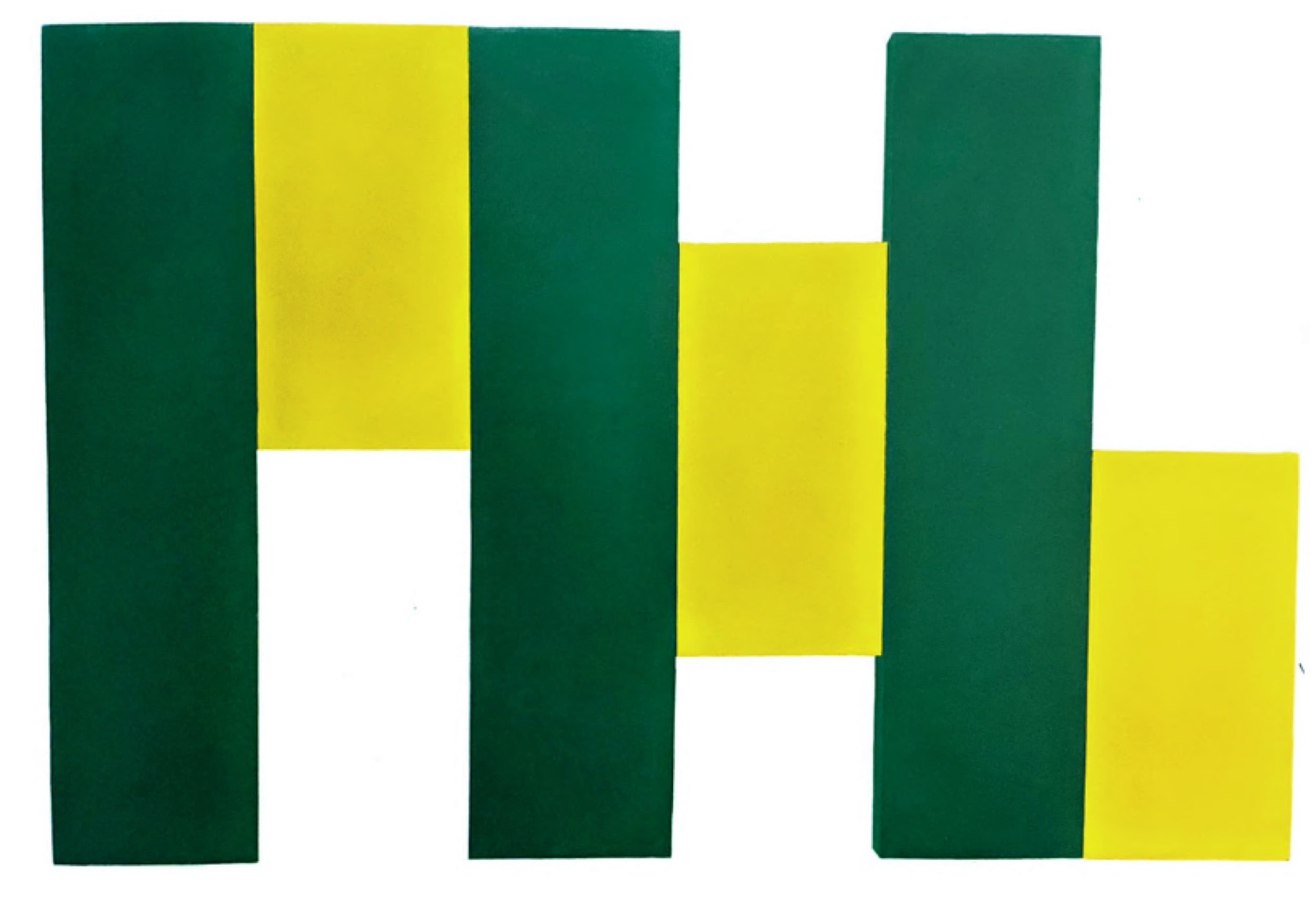
Similarly, moving to 186 Drummond Street heralded a change in Vickers’ own art-making process. Artist and friend Peter Booth, who regularly visited the house, instigated this change by lending Vickers a mitre saw from his workshop to cut and carve large canvas panels. Around the same time, Paul Partos had donated some L-shaped stretchers, prompting Vickers to fabricate large geometric paintings using multiple singular canvas modules.38 One such painting, Untitled (1967) (fig. 4), consisted of six individual rectangular stretchers clamped together to form one horizontal line. From a formal perspective, Untitled is arranged in a sequence that creates visual tension between repetition and variation. The alternating panels of green and yellow set up a pattern that shifts subtly, in that the three green panels are of consistent height and width, while the yellow ones vary in height. The intervals between the yellow panels also differ; like a staircase, the spaces above or below each panel ascend or descend (depending on the angle).39 Although the work is constructed so that each colour functions as a distinct shape, the entire painting remains within the strict discipline of the overall rectangle. By restricting the visual elements of the painting to simple geometric structures, the two secondary colours are given maximal strength and potency.40 This provides the painting with enough vigour to thrust forward off the wall and assert its presence in the surrounding space.
To comprehend the significance of Untitled and Vickers’ work of this time more broadly, the parochial factors informing his artistic practice cannot be ignored. Specifically, his personal interactions and conversations with Booth and Partos seem likely to have incited the construction and production of his shaped canvases. This framework for considering Vickers’ art is counter to strategies that attempt to see modernity and modernism as inherent and exclusive developments of Euro–American art. A key example of this literature can be found in the writing of Bernard Smith, who constructed an art history on the basis of an Australian separation from and belatedness regarding other cultures. Smith’s ideas about dependency, principally his assertion that the provincial Australian artist is always at a time lapse behind the European centre, disregards the diffusion of knowledge from one local artist to another, as well as the immediate circumstances that fostered each artist’s creative direction. Place, Taste, and Tradition (1945) begins by examining the relationship between Australian art and European influences, noting how heavily Australian art has drawn from European movements.41 Criticising local artists and writers for downplaying these connections, Smith argues that an authentic Australian tradition could only emerge through a gradual adaptation of international styles influenced by Australian social, political, moral, and aesthetic conditions.42 He observes that modern art is trending toward an “international fusion” of national styles, suggesting that an Australian art tradition should develop organically from the country’s evolving societal characteristics rather than attempting to create an entirely unique form, as with Aboriginal art.43 By 1962, in Australian Painting 1788–1960, Smith acknowledges some progress, shifting from his earlier focus on external influence. He then asserts that Australian art, though rooted in European origins within a Southeast Asian context, has been shaped by the unique social structure of Australia, resulting in distinct artistic qualities comparable to Australian social norms and language. Smith underscores the necessity of contextualising Australian art within European developments, pointing to modern art’s stylistic evolution.
In the introduction to Australian Painting 1788–1960, Smith emphasises two main themes: Australian art as a European art adapted to the Southeast Asian setting and the distinctive characteristics that have emerged as Australian art has developed.44 He argues that Australian artists navigate two essential traditions—the European and a distinctly Australian variant. He implies that by “tradition”, he is referring specifically to artistic conventions, primarily in painting, rather than intellectual or institutional frameworks.45 The function of these traditions—whether as rigid, selective, or fluid influences—remains central to understanding the development of Australian art.
In direct response to Smith’s position, in 1983 Terry Smith argued that the periphery, more alive and alert than the decaying, exhausted centre, “restores power to it by revitalising its traditions, expanding its achievement.”46 Smith builds on the previous critique by suggesting that cultural vitality often stems more from the periphery than the centre, which he sees as stagnant and depleted. He argues that the peripheral regions, like Australia, breathe new life into the centre by revitalising and expanding its traditions. Smith emphasises the importance of recognising Australia’s unique local factors, its dramatic achievements, its adaptability, and its resilience. Selective perspective, he notes, is unavoidable in historical writing, and this paper is no exception; in fact, selective positioning is its focus. However, concentrating on individual artworks and artists in specific contexts risks losing sight of two essential types of generalisations: those that reveal historical developments over time (diachronic structures) and those that capture the production of meanings across various social signifying practices. These discussions broaden the scope, suggesting a need for a “social history of seeing” or of “imaging” beyond just art history.47 This approach would consider not only fine art but the full range of visual practices that influence how social meaning is constructed, how images are interpreted, and how certain social relationships are reproduced or modified. When we acknowledge these lived experiences, the links between artists become entry points for considering and discussing more localised perspectives.48 Such a pluralistic historical account—one that attends to both structure and specificity—enables us to consider Australian modernism not as a delayed echo but as an active site of negotiation.
The Calm Before the Storm: 1968–71
Between 1968 and 1971, Brown, Stuart, and Vickers each pursued distinctly individual artistic approaches. Though they lived and worked in close proximity to each other at the Drummond Street house, there was no unified aesthetic or shared conceptual agenda. Rather, their cohabitation created a dynamic in which difference became a productive force. For Stuart, it offered the opportunity to test and expand his visual language. For Brown, it provided both physical and psychological space to construct immersive, experimental environments. For Vickers, it allowed the time and stability to refine and articulate his painterly method. The Drummond Street house, then, did not foster collaboration in the formal sense, but facilitated independent artistic development through adjacency and daily contact.
Importantly, the group’s commitment to local scenes and contexts did not preclude a broader ambition. Each artist expressed a desire to engage with global art discourse on their own terms. Vickers understood his reductive canvases as part of a wider conversation in abstract painting and approached his early solo exhibitions with a clarity and professionalism reflective of this alignment. Brown’s maximalist environments, though materially rooted in the everyday and idiosyncratically local, drew from—and responded to—international traditions of Pop and assemblage. Their awareness of these overseas movements signals a generative tension: the work remained grounded in the immediate social and spatial conditions of Melbourne, while also aiming to hold its own within a global discourse.
What distinguished 186 Drummond Street from artist colonies like Heide was not a shared aesthetic project, but a shared domestic arrangement—tenants who happened to be artists, paying equal rent, navigating the claustrophobic logistics of inner-city terrace life. This microcosm of domesticity presumably fostered incidental artistic interactions: conversations over dinner, impromptu critiques whilst passing through shared studio spaces, or observing works mid-production in the stables or courtyard. The house operated as an informal residency, not by design but by necessity, where artistic exchange was embedded in the rhythms of daily life. Unlike institutional residencies or collaborative workshops, there was no formal structure for dialogue, yet the very proximity generated mutual influence. Art history, then, can be written not just through movements or manifestos, but through the microcosm of a single residence, considering its physical limitations, its architectural affordances, and the porous boundaries between personal space and creative production. This model reframes the Drummond Street house not only as a site of endogenous cultural development, but as a spatial and social infrastructure that shaped the art itself.
In the fluid surface of Light Violet Wall (1968), for example, Stuart once again limns commonplace objects—bowls, discs and baffles—in an idiosyncratic formal composition.49 The large oil painting depicts a pleated or baffled wall impressed with remnants of bowls, the basins of which seem to have sunk into the surface over time. These imprinted superficial shapes are at variance with replete forms of incomplete vats and discs in the bottom register of the painting. As an aggregate composition, Light Violet Wall is unified and balanced, with each corner of the painting formally bound by a synchronic colour palette of pink, cream, and violet. Stuart handles each colour differently: whereas the violet is thickly applied, the cream and pink are loosely stroked across the canvas. By varying the paint in this way, Stuart emphasises the agility of light—how it moves and transitions through the surface area, shadowing some forms whilst illuminating others. It is this light which ceases the edges, corrugated planes, seams, pleats, lips, and discs in Stuart’s shallow pictorial space.
In March 1969, Light Violet Wall was exhibited at Gallery A in Stuart’s first solo show, A Five Finger Exercise for Two Ideas and Drawings for Metal Casts. The exhibition consisted of thirteen paintings and ten drawings in monochrome pastel.50 Stuart painted all twenty-three works on the third floor of the Drummond Street house and framed each one in the stables.51 Vickers, working in the adjacent room, recalls being “absolutely stunned” by these paintings.52 “I was just thinking ‘wow look at that’, it wasn’t something I would do but I could see it was impressive and important.”53 Although the artists were working in entirely different directions at this time, the shared living and working space deepened their understanding of each other’s styles and sensibilities. Moreover, the domicile enabled the artists to explore and expand their own aesthetic tangents. Interactions unfolded not through formal collaboration, but through shared routines. This was not a site of retreat or planned community, but one of incidental artistic influence, enabled by enforced proximity, ultimately dissolving the boundaries between living and working life. Rather than framing the house within a centre–periphery dialectic, it is more productive to view it as a microcosm: a spatial and social infrastructure that generated its own logic of artistic production.
Taking to the Walls
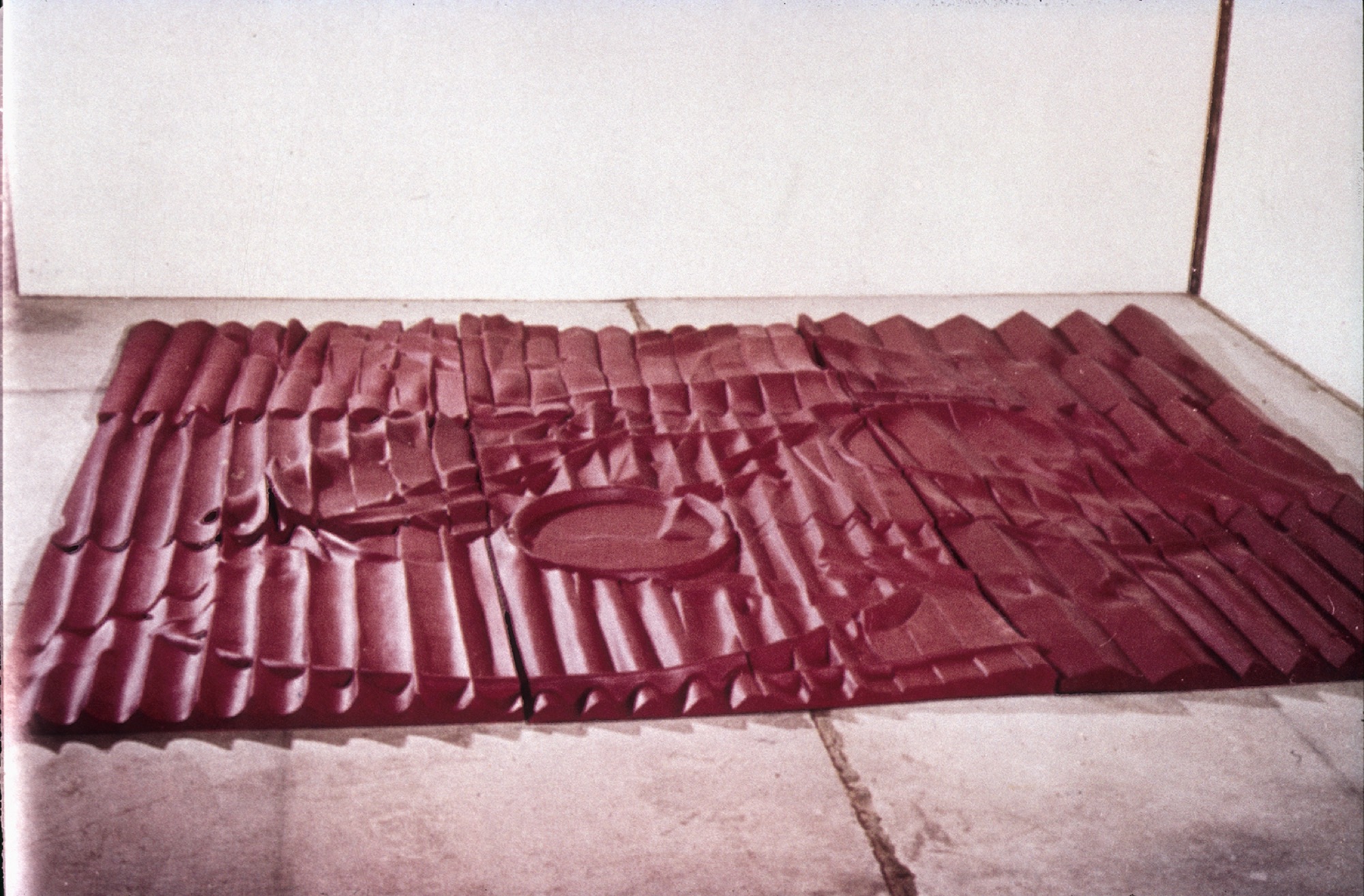
After the success of Stuart’s sell-out solo exhibition at Gallery A, he and his wife Carol decided to rent their own place, a shop and dwelling at 666 Smith Street, Clifton Hill.54 With this large and private studio, Stuart’s previous insistence upon symbolic forms gave way to a new kind of representation. Soft Red Baffles (1970) (fig. 5) was a product of this development. The sculpture consists of nine fibreglass panels, fused together to create a single corrugated structure.55 With the help and advice of Stuart’s friend, sculptor Peter Corlett, Soft Red Baffles was pieced together, cast, moulded, and then spray-painted in a soft red oxide automotive duco on the concrete floor of the shopfront.56 In constructing this sculpture, Stuart sought to liberate the assiduous motifs of two previous paintings: Kindergarten and Soft Rolled Sound Baffles (1969–70).57 Both paintings are consistent with Stuart’s endeavour to strip objects of their utilitarian value and present them in magnified proportions. Both also elucidate Stuart’s increasing tendency to disrupt his own style and cancel the implications of his earlier work.
In 1970, as Stuart reconsidered his artistic direction, Brown focused much of his artistic energy on large-scale murals.58 With accents on shock, humour, and heterodoxy, these constructions would cover everything in their path, sprawling over the walls, floors, windows, and blinds of the Drummond Street house. Of his process, Vickers remarked:
He would go into a room, put in a piece of masonite, probably with a rugged edge and a hole in it, lean it up against the wall. Sit on the floor and start painting. If paint dripped onto the floor, he would pick it up and put it back on the wall. Then he’d notice the paint brush on the floor, and he’d start, and he’d end up painting the whole room. The board would still be leaning up against the wall. The bit behind the board would probably be the only part not painted.59
Vickers’ comment provides insight into Brown’s methods and modes of art-making—specifically, his self-possessed sensibilities and his unrestrained approach to painting. No surface in the house, as Vickers reveals, was out of Brown’s range. There were no limits or codes of conduct. The house served as an open container from which Brown’s paintings could emerge.
Brown’s murals had their origin in Auckland, New Zealand, where the artist, unable to afford or construct his own canvases, took to the walls of his home.60 This obsessive desire to cover vast areas with painting culminated in a joint exhibition, Bloodlust in the Boondocks, with local artist Murray Grimsdale at the Barry Lett Gallery, Auckland, in 1968. Most of Brown’s exhibited works were prepared on unstretched canvases, using only the cheapest of materials, most of which began to disintegrate even before they could be displayed.61 As Brown himself noted at the time, they were “materials so awful that no-one would want to buy [my work] whatever its artistic merit.”62 The centrepiece for the exhibition was a large mural entitled Everyone Must Get Stoned (1968).63
Brown and Grimsdale’s collaborative piece consisted of magazine cut-outs of girls, caricatured figurines, and symbols of spirals, swirls and stars. Bold typography relieved the doodled surface, with Bob Dylan’s candid verse “everybody must get stoned!” penned across the left register of the wall. After Brown returned to Melbourne in 1968, he similarly blanketed the opaque green walls of Sweeney and Pamela Reed’s Heide 1, where he stayed upon arrival. The Heide 1 mural, titled It Ain’t Necessarily So!!! (1969), had its genesis in the kitchen—where Brown had first begun repainting Mary Boyd’s cat tiles over the old woodstove—then extended into the dining room, where he smeared the walls with red stars, moon-like faces, Hawaiian figurines, rainbows, and bold exclamation marks.64 Shortly after an angry Sweeney and Pamela Reed discovered their newly decorated interior, Brown reconnected with Vickers and returned to Drummond Street.
Upon returning to the Drummond Street house, Brown quietened, choosing not to disturb or disconcert his co-tenants (as he had done at Heide). In the upstairs studio, he created works that would eventually be exhibited at Bruce Pollard’s new Pinacotheca gallery in Richmond.65 Since its first iteration in 1967, at 1 Fitzroy Street in St Kilda, Pinacotheca had cultivated an intense circle of artists, many of whom had no sympathy for each other but were nonetheless part of Melbourne’s burgeoning artistic community. This endogenous element, that is the immediate environment in which the artists lived and worked, had a large impact on Brown and Vickers. For both artists, the gallery provided a space not only for exhibiting their work, but for fostering an artistic community outside of their home environment.
The concept for the second iteration of Pinacotheca emerged out of conversations between Vickers, Pollard, and Robert Hunter on Friday nights at the original St Kilda gallery. After being needled about Pinacotheca’s ‘bourgeois’ gallery setting, Pollard purchased Bedggood’s Shoe Factory at the end of a cobblestoned lane in Waltham Place, Richmond. With assistance from Vickers and Hunter, Pollard renovated the building, removing an “inch thick” layer of dust, discarding racks of rubbish, refurbishing the windows, painting the walls, and repairing the floorboards.66
In June 1970, Pollard opened Pinacotheca with an inaugural group show of works by Kevin Mortenson, Dale Hickey, Robert Rooney, Rollin Schlicht, Peter Davidson, Peter Booth, Robert Hunter, Ti Parks, Bill Gregory, Brown, and Vickers—a group that henceforth formed the backbone of the gallery’s exhibitions and determined its focus.67 All the works displayed, Terry Smith observed, “commanded the areas around them,” which was “made uniquely possible by the properties of the gallery space.”68 Robert Hunter exhibited his illusionistic grid painting, whilst Vickers adhered to his “flatly-coloured geometric shapes, placed in objective colour-relationships”.69
Brown’s single contribution, entitled Mary-Lou Painting (c. 1969–70), was a reworking of the Mary-Lou theme prominent during his Sydney years. With its Kandinsky-like construction, the work employed a wealth of colour and chaotic detail, including an assemblage of social iconography and fragments of pop–cult magazine clippings.70 “Unlike all the other works in the exhibition,” Smith noted:
this one demands that we change our viewing distance. And, again unlike the others, it does not settle in our perception at a certain moment as a complete statement … we can begin and cease to see the painting at any point.71
As documentary images of Brown’s Mary-Lou Painting no longer exist, Smith’s comments here are valuable. From them we can sense how straightforward Brown’s painting was; specifically, how each element of the work—its construction and composition—compelled the spectator into a state of suspense, such that comfort and complacency were unattainable in the viewing process.
Brown’s next major exhibition at Pinacotheca, Welcome to Planet X (1971), elicited public bewilderment. The exhibition was a declaration of the artist’s eccentric attitude and uninhibited approach to art-making. It saw Brown, with the assistance of Vickers and a heavily pregnant Jan Lucas (Brown’s partner at the time), festoon the gallery with colourful paintings, sculptural assemblages, loud music, and flashing lights. Brown and his two assistants worked night and day for an entire month, buoyed up by Brown’s obsessive desire to create “an environmental freak-out in the name of art.”72 Collaboration was very important to Brown at this time. Whilst he had all the ideas for his large-scale installations, he struggled to actualise them in a feasible, practical way. Although Vickers’ aesthetic style was entirely different, his friendship and alliance with Brown made for a strong working relationship. Attesting to this, Vickers remarked, “we had known each other for so long, he could get my wavelength and I could get his.”73 Vickers’ understanding of Brown’s creative needs enabled his logistical support and collaboration.
On the opening night of the exhibition, queues of people lined up outside Pinacotheca and tailed down Waltham Place. When finally allowed to enter, they were directed through a cubby-like door, with a ‘predestination’ mobile dangling directly above their heads. Thereupon was the ‘Amazing Maze of Meaningless Memories’, which contained miscellaneous objects like table lamps and an empty mantel radio case. To the right of the Maze was the ‘Mind-Bending Mystery Room’, a tent-like structure complete with a pair of lavatory ventilators and various types of ribbons. Ross Lansell, who reviewed the exhibition at the time, described the Mystery Room as a “kind of psychedelic chapel complete with gnarled wooden Christian crosses above, presumably a lilliputian parody of the birth in the manger.”74 Lansell’s description provides valuable insight into the heterogeneous aspects of Brown’s aural and visual work, confirmed by Wes Placek’s photographs of the installation.75
Out of the Mystery Room sprawled Ye Olde Paling Fence, a rickety yellow fence on which a saucepan, Monopoly money, and female pinups hung. The most prominent component of the exhibition was a large-scale mural entitled Giant 100ft Magic Mural. At the mural’s centre was an explosion of forms with blue, red, and yellow shapes blasting from its core. Surrounding the flash were Brown’s archetypal icons and symbols. These included lyrics from pop songs, comic devices, abstract landscapes, and nonsensical dialogue incorporating words like “Bonk” and “Splatch.” The memos in the painting were sundry; each revolved around dichotomies of chaos and order. This was made evident with the overpainting of Robert Hunter’s checkerboard grids which had been seen in the group exhibition of the previous year. Brown’s ability to incorporate Hunter’s reductive wallpaper into his overwhelmingly maximalist mural positions Pinacotheca as a centre of endogenous transmission. Like the Drummond Street house, the gallery allowed a diverse group of artists to work alongside one another, collaborate on ideas, and, in Brown’s case, appropriate their work. Although Pinacotheca was also a conduit for exogenous impacts—with international art magazines regularly present on Pollard’s coffee table and the movements of overseas artists pertinent in conversations—the gallery was never dominated by this international dialogue. It remained closely linked with the local: the ideas, thoughts and movements of each exhibiting artist and their social circles.
Realising the Periphery: 1972–76
By 1972, with drugs increasingly prevalent and accessible, the mood in Carlton shifted and wild behaviour became the norm. Flooded with an interminable succession of unwanted guests and unsolicited parties, the quasi-Edenic harmony of the Drummond Street house petered out. The house was becoming uninhabitable and no longer a productive place for the artists to work. To escape the growing anarchy at Drummond Street, Vickers, and Brown relocated to the distant artistic periphery of Foster, Gippsland. Turning away from the institutions of art, the artists re-established themselves in a small yet thriving artistic community.
By the end of 1974, the atmosphere at Foster shifted. The artists who travelled from Melbourne to work in Mike Brown’s house began causing havoc in the town centre, often shoplifting from the local convenience store. Having experienced similar issues at the Drummond Street house two years earlier, Vickers felt that their open-door communal policy was being abused.76 The self-realised work and living space, which both artists embraced initially, lost its attraction. Consequently, Vickers decided to relocate to Perth, where he continues to live today; Brown stayed in Foster until 1975, when he relocated to a share house with artist and friend Daryl Tilson in Duke Street, Woollahra, Sydney.
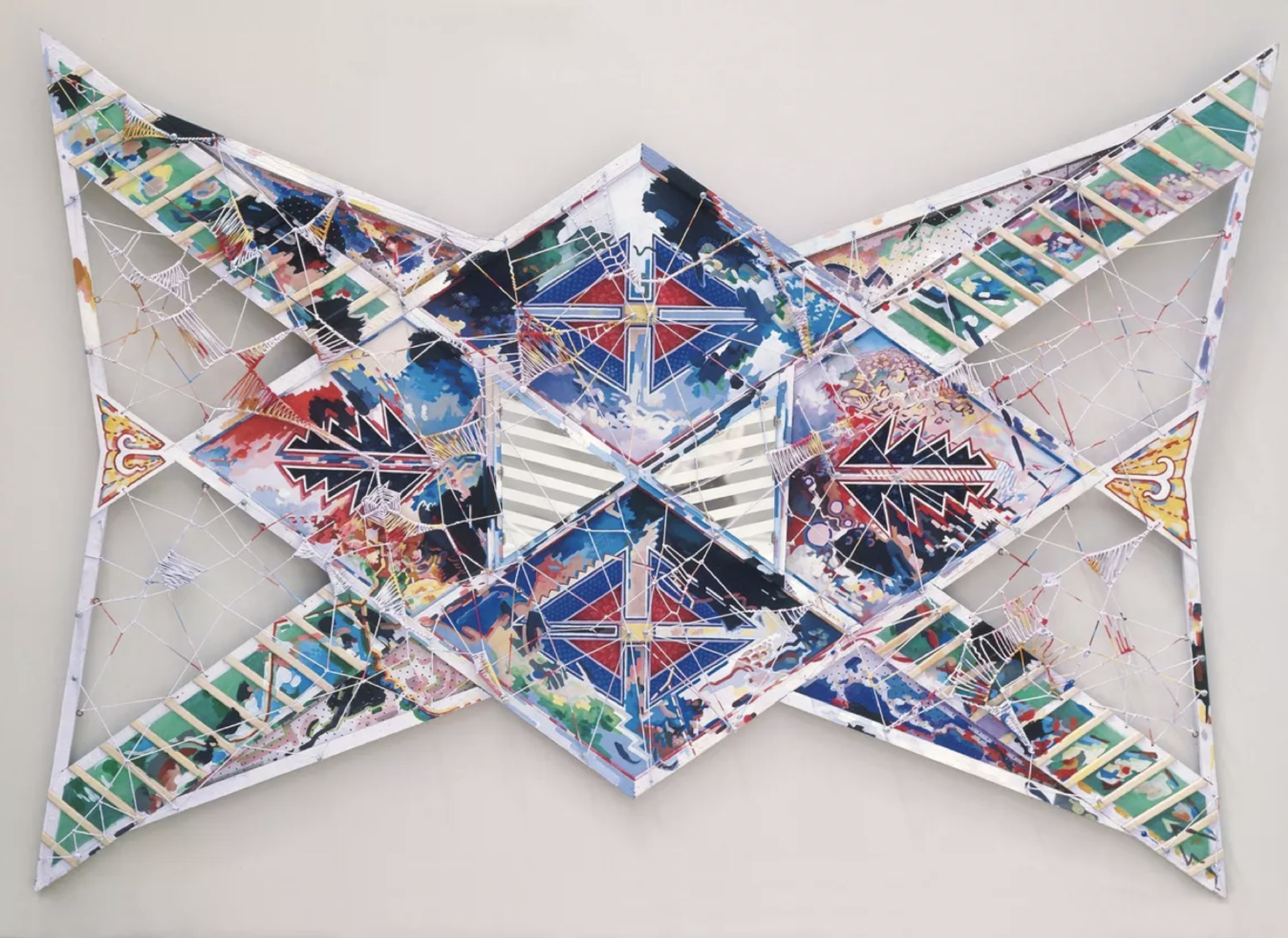
Before moving to Sydney, Brown constructed Drummond Street, Mon Amour (1976) (fig. 6). Compositionally, the assemblage is a network of vertical and horizontal lines, fashioned out of wood, masonite, metal, string, and mirror glass. The central point of the assemblage is a symmetrical diamond, divided equally into four. Spilling off the edges of the central diamond are four equally proportioned triangles. Each section of the overall composition contains an assortment of abstracted forms, all painted in a high-key colour palette of purple, blue, red, pink, and green. As art historical research on Drummond Street, Mon Amour is almost non-existent (and the artist long deceased), we can only conjecture about its fruition, meaning, and purpose.77 For instance, where was this work constructed? What, if any, role did the legacy of living at Drummond Street play in its construction? Is the work a ‘love letter’, an elegiac recollection of the Drummond Street house? Does it reflect Brown’s specific domicile—the shared working and living situations that he chose? These questions remain to be answered by future researchers, but it can be argued that the assemblage sums up the Drummond Street house’s tenants and their movements between 1965 and 1974 and draws the curtain on a period of deep exploration and discovery.
In tracing this epoch of exploration, I have described the lives and domiciles of Brown, Vickers, and Stuart. Emphasising domestic and social context, I established that there was a relationship between these artists’ base of operations, friendships, communities, and artwork. Moreover, through examination of primary documents and interviews with the artists, I determined that the artwork produced during this time did not, perhaps unexpectedly, fit within the parameters of relevant art movements and received stylistic trends. Neither did the artists intend that their works would fit the labels of minimalism, hard-edge abstraction, post-object, or conceptualist art. Rather, the art they produced reflected specific domiciles and social parameters—the shared spaces in the Drummond Street house and Guy and Carol Stuart’s Clifton Hill home. These environments enabled each artist to develop locally specific aspects of their oeuvre and produce successively more complex, even hybrid artworks. Moreover, these spaces offered a platform for each artist to challenge conventional assumptions about their art and discover their position as artists in determinedly local terms.
Just as we all understand Heide as a place where many artists came and went in the 1940s, the Drummond Street house can be seen as a nexus point for artists of the late 1960s and early 1970s to connect their divergent concerns and interests.78 It was a location, rather like Heide, that served as a site for endogenous exchange and transmission. Although this paper revises only a small portion of Australian art history, it provides material that might be useful in further art historical inquiry into neglected artistic activities in western art history, helping others to shed light on changes in other local artistic milieus and the artists instigating them.
-
Terry Smith, “Writing the History of Australian Art: Its Past, Present and Possible Future,” Australian Journal of Art 3 (1983): 2; Terry Smith, “The Provincialism Problem,” Artforum 13, no. 1 (September 1974): 54-59. ↩
-
See Pierre Bourdieu, The Field of Cultural Production: Essays on Art and Literature, ed. Randal Johnson (Columbia University Press, 1993), especially 30-34, for a discussion of artistic production as a field of relations structured by social, spatial, and institutional forces. ↩
-
For studies of provincialism’s impact on Australian art see Ian Burn, “Provincialism,” Art Dialogue 1 (October 1973): 3-11; Ian McLean, “Provincialism Upturned,” Third Text 23, no. 5 (October 2009): 625-632, https://doi.org/10.1080/09528820903184906; Heather Barker and Charles Green, “The Provincialism Problem: Terry Smith and Centre-Periphery Art History,” Journal of Art Historiography, no. 3 (December 2010): 1-17, https://arthistoriography.wordpress.com/wp-content/uploads/2011/02/media_183176_en.pdf; Jennifer Allen, “The Provincialism Solution,” Frieze d/e, no. 1 (28 April 2011): https://www.frieze.com/article/wie-ein-provinzler; and Rex Butler and A.D.S Donaldson, “Against Provincialism: Australian-American connections 1900–2000,” Journal of Australian Studies 36, no. 3 (August 2012): 291-307. https://doi.org/10.1080/14443058.2012.703221 ↩
-
Bernard Smith, Australian Painting 1788–1970 (Oxford University Press, 1971, 2^nd^ edition), 418. ↩
-
Smith, Australian Painting 1788–1970, 419. ↩
-
Smith, Australian Painting 1788–1970, 418. ↩
-
Trevor Vickers (1943–), Untitled (Melbourne), 1965, synthetic polymer paint on canvas, 137.5 x 137.5 cm, purchased 1996, The State Art Collection, The Art Gallery of Western Australia. https://collection.artgallery.wa.gov.au/objects/14401/untitled-melbourne ↩
-
Smith, Australian Painting 1788–1970, 418. ↩
-
Trevor Vickers, telephone interview by Rachel Weinberg, Perth, WA, 19 July 2021. ↩
-
Mel Ramsden (1944–2024), Two Black Squares, 1965, enamel paint on wood, 31.7 × 31.4 × 2.5 cm, Tate, purchased with funds provided by the Nicholas Themans Trust 2013. https://www.tate.org.uk/art/artworks/art-language-two-black-squares-t13893 ↩
-
Vickers, telephone interview by Rachel Weinberg. ↩
-
See Young Minds (Museum of Modern Art and Design of Australia, 1964) and New Generation 1965 (Museum of Modern Art and Design of Australia, 1965). ↩
-
New Generation 1965. ↩
-
For a full account of Sweeney Reed’s career and movements, see Brooke Babington, Sweeney Reed and Strines Gallery (Heide Museum of Modern Art, 2018). ↩
-
Vickers, telephone interview. ↩
-
For a discussion of the history of 186 Drummond Street, see Alan Willingham, ‘Who do you think you are?’ in Andrew Gaynor, Felicity Johnston, Alex Selenitsch and Allan Willingham, Trevor Vickers: Untitled Painting (Art Collective WA, 2016), 16-20, especially 17. According to Willingham, Denver Terrace was likely designed by the Italian architect Alessandro Martelli, and erected in 1897 for Carolina D’Araujo Fonceca, paramour to Francis Louis Nompar de Caumont la Force, the Consul-General for France. ↩
-
Oconnell Lane separates 186 Drummond Street from two neighbouring primary schools: Corpus Christi College and Carlton Gardens Primary School. ↩
-
Vickers, telephone interview. ↩
-
For a detailed discussion of the renovation of 186 Drummond Street, see Willingham, “Who do you think you are?” 17–18. ↩
-
Willingham, “Who do you think you are?” 17-18. ↩
-
Guy Stuart, paginated letter to Rachel Weinberg, 14 July 2021, 4. ↩
-
Guy Stuart, email correspondence with Rachel Weinberg, 25 September 2021. ↩
-
Guy Stuart (1942–2024), Assembled Construction, 1967, stainless mild steel, wire, mesh, hose, plating nickel, zinc, chrome, rubber hose, cast iron, aluminium, enamel paint, monel metal, welded, assembled, 201.9 h x 156 w x 121.7 d cm, National Gallery of Australia, purchased 1969, https://searchthecollection.nga.gov.au/object/41401 For a discussion of Stuart’s sculptural endeavours, see Graeme Sturgeon, The Development of Australian Sculpture 1788–1975 (Thames and Hudson, 1978), 184. ↩
-
Stuart, letter to Rachel Weinberg, 5. ↩
-
Guy Stuart (1942–2024), Thermal Tableaux, 1968, oil on two canvases, each 228.6 x 157.5 cm, National Gallery of Australia, purchased 1969. https://searchthecollection.nga.gov.au/object/41515 ↩
-
Ronald Millar, Civilized Magic: An Interpretative Guide to Australian Paintings (Sorrett, 1974), 142. ↩
-
Trevor Vickers (1943–), Painting ‘10’, 1966, synthetic polymer paint on canvas, 142.0 x 146.4 cm. National Gallery of Victoria, purchased 1977.https://www.ngv.vic.gov.au/explore/collection/work/3158/ ↩
-
Patrick McCaughey, “Diverse and Uneven Group Showing,” review, The Age, Melbourne, 1 November 1967, 6. ↩
-
Patrick McCaughey, “Diverse and Uneven Group Showing,” review, The Age, Melbourne, 1 November 1967, 6. ↩
-
For a full account of Brown’s conviction see Smith, Australian Painting 1788–1970, 393-398. ↩
-
Vickers, telephone interview by Rachel Weinberg. ↩
-
Vickers, telephone interview by Rachel Weinberg. ↩
-
Vickers, telephone interview by Rachel Weinberg. ↩
-
For a full account of the Mary-Lou debacle, see Smith, Australian Painting 1788–1970, 393-397; and “A letter to the editor,” Sydney Morning Herald, 6 January 1964. In a reserved decision, Judge Levine dismissed the appeal and confirmed Brown’s conviction but revoked the jail sentence, imposing a $20 fine and a good behaviour bond. ↩
-
Vickers, telephone interview by Rachel Weinberg. ↩
-
Vickers, telephone interview by Rachel Weinberg. ↩
-
For a discussion of Brown’s artistic direction, see Ann Lewis quoted in Rosalie Higson, “The A List,” The Weekend Australian, 28 February – 1 March 2009, 17. ↩
-
Willingham, ‘Who do you think you are?’, 18. Alongside Booth and Partos, the Drummond Street house often hosted a loosely knit group of artists, photographers and students, a fluid and sundry population including Robert Hunter, Brian Snowden, Alex Selenitsch, and Allan Willingham. ↩
-
Sue Cramer, Less is More: Minimal + Post-Minimal Art in Australia (Heide Museum of Modern Art, 2012). ↩
-
Patrick McCaughey, “Art’s defenders battle it out,” review, The Age, Melbourne, 27 August 1969, 2. ↩
-
Bernard Smith, Place, Taste and Tradition: A Study of Australian Art Since 1788 (Oxford University Press, 1979, 2nd edition revised), 5. ↩
-
Smith, Place, Taste and Tradition: A Study of Australian Art Since 1788, 10. ↩
-
Smith, Place, Taste and Tradition: A Study of Australian Art Since 1788, 10. ↩
-
Bernard Smith, Australian Painting 1788–1970, 20. ↩
-
Bernard Smith, Australian Painting 1788–1970, 20. ↩
-
Smith, “Writing the History of Australian Art: Its Past, Present and Possible Future,” 14. ↩
-
Smith, “Writing the History of Australian Art: Its Past, Present and Possible Future,” 16. ↩
-
Smith, “Writing the History of Australian Art: Its Past, Present and Possible Future,” 23. ↩
-
Guy Stuart (1942–2024), Light Violet Wall, 1968, oil on canvas, 198.6 x 157.4 cm, National Gallery of Victoria, purchased 1969, https://www.ngv.vic.gov.au/explore/collection/work/3077/ ↩
-
After earning high critical praise from Patrick McCaughey, every work exhibited in Stuart’s show sold. See Patrick McCaughey, “A Compelling New Thesis in Show,” review, The Age, Melbourne, 5 March 1969, 11. ↩
-
Stuart, letter to Rachel Weinberg, 9. ↩
-
Vickers, telephone interview by Rachel Weinberg. ↩
-
Vickers, telephone interview by Rachel Weinberg. ↩
-
Stuart, letter to Rachel Weinberg, 10. After selling all his works in Bowls & Walls. Drawings for Metal Casting, Stuart and his wife Carol decided to move out of 186 Drummond Street. In comparison to the shared living environment in Carlton, their new house in Collingwood provided the couple with much needed privacy and space. ↩
-
Guy Stuart, email correspondence with Rachel Weinberg, 1 August 2021. ↩
-
Stuart, letter to Rachel Weinberg, 11. Between 1960 and 1980, Peter Corlett primarily constructed full-figure portrait sculptures in bronze as well as ‘supra-realist’ works in concrete and fibreglass. Alongside Corlett, Stuart sustained friendships with Michael Shannon and Ross Grounds, all living outside the Drummond house. Stuart’s friendships highlight the depth and range of Australia’s artistic communities. ↩
-
Guy Stuart (1942–2024), Soft Rolled Sound Baffles, 1969–1970, oil on canvas, 228 x 172 cm, collection of the artist’s estate. ↩
-
See Michael Shannon, “Guy Stuart,” Art and Australia 14, no. 2 (Spring 1976): 164-171. It is clear that by 1972, Guy Stuart’s production of art had fallen away. According to Shannon, Stuart chose to earn a living as a carpenter working on local building sites, abandoning his art for two years. It may well be that he, like many artists, had become uncertain about where his work would go next. Whilst some artists overcame this problem by referring to exogenous influences, Stuart reduced his work to a smaller scale and chose to engage with more toned-back and elusive compositions. ↩
-
Vickers, telephone interview by Rachel Weinberg. ↩
-
In 1967, after a year in the Drummond Street house, Brown relocated to Auckland, New Zealand, where he remained until 1968. ↩
-
Richard Haese, Permanent Revolution: Mike Brown and the Australian Avant-Garde 1953–1997 (Miegunyah Press, 2011), 161. ↩
-
Mike Brown to John Reed, 27 December 1968, Papers of John and Sunday Reed, MS 13186, State Library of Victoria. ↩
-
Mike Brown (1938–1997) and Murray Grimsdale (1943–), Everyone Must Get Stoned, 1968, mural, Barry Lett Gallery, Auckland, reproduced in Haese, Permanent Revolution, 162. ↩
-
Richard Haese, Permanent Revolution, 165. ↩
-
For a history and overview of Pinacotheca’s artists, exhibitions, achievements and defeats, see Charles Green, Peripheral Vision: Contemporary Australian Art 1970–1994 (Craftsman House, 1995), particularly 32-33; Charles Green, “Pinacotheca: a private art history,” Art and Australia 34, no. 4 (1997): 484-489; and Jonathan Sweet, Pinacotheca: 1967–1973 (Prendergast Publishers, 1989). ↩
-
Vickers, telephone interview by Rachel Weinberg. ↩
-
Haese, Permanent Revolution, 167. ↩
-
Terry Smith, “Pinacotheca Group Exhibition, June, Melbourne,” review, Other Voices 1, no. 2 (August–September 1970): 45. ↩
-
Ann Galbally, “Avant-garde in new HQ,” The Age, Melbourne, 10 June 1970, 10. ↩
-
Smith, “Pinacotheca Group Exhibition, June, Melbourne.” ↩
-
Smith, “Pinacotheca Group Exhibition, June, Melbourne.” ↩
-
Brown quoted in Ross Lansell, “Pioneer popster,” Nation, 15 May 1971, 20. ↩
-
Vickers, telephone interview by Rachel Weinberg. ↩
-
Lansell, “Pioneer popster.” ↩
-
Wes Placek, “Mike Brown, ‘Welcome to Planet X,’ 1971 (three images of the exhibition from a series of 24)”, https://www.wesplacek.com/welcome-to-planet-x-mike-brown-show-1971/ See also Haese, Permanent Revolution, 168–9. For a full review of the exhibition, see Terry Smith, “Good exhibitions were rare in 1971,” The Review, Melbourne, 18–24 December 1971. ↩
-
Vickers, telephone interview by Rachel Weinberg. ↩
-
For a brief discussion of Drummond Street, Mon Amour see Haese, Permanent Revolution, 199–200. ↩
-
For a full account of the Heide period, see Lesley Harding and Kendrah Morgan, Modern Love: The Lives of John & Sunday Reed (Miegunyah Press, 2015). ↩
Rachel Weinberg is a Melbourne-based writer and editor, currently serving as Editor-in-Chief of to Be magazine and Editor of Union magazine. In these roles, Rachel has interviewed and collaborated with artists, designers and curators including Campbell Addy, Tom Sachs, Jeppe Ugelvig, Harry Nuriev, Elaine Constantine, Norbert Schoerner, Lucy Orta and David Lane, among others. Rachel began her career as an art gallery associate while completing a BA and Honours in Art History at the University of Melbourne. Her research interests include art, fashion, architecture, and journalism, with a particular focus on provincialism and the transmission of artistic knowledge. She holds a Masters in Publishing and Communications from the University of Melbourne and has contributed to publications such as Vault, to Be, and Union.
Bibliography
- Allen, Jennifer. “The Provincialism Solution.” Frieze d/e, no. 1 (28 April 2011): https://www.frieze.com/article/wie-ein-provinzler
- Babington, Brooke. Sweeney Reed and Strines Gallery. Heide Museum of Modern Art, 2018.
- Barker, Heather, and Charles Green. “The Provincialism Problem: Terry Smith and Centre-Periphery Art History.” Journal of Art Historiography, no. 3 (December 2010): 1-17. https://arthistoriography.wordpress.com/wp-content/uploads/2011/02/media_183176_en.pdf
- Bourdieu, Pierre. The Field of Cultural Production: Essays on Art and Literature. Edited by Randal Johnson. Columbia University Press, 1993.
- Burn, Ian. “Provincialism.” Art Dialogue 1 (October 1973): 3-11.
- Butler, Rex, and A.D.S Donaldson. “Against Provincialism: Australian-American connections 1900–2000.” Journal of Australian Studies 36, no. 3 (August 2012): 291-307. https://doi.org/10.1080/14443058.2012.703221
- Cramer, Sue. Less is More: Minimal + Post-Minimal Art in Australia. Heide Museum of Modern Art, 2012.
- Green, Charles. Peripheral Vision: Contemporary Australian Art 1970–1994. Sydney: Craftsman House, 1995.
- Green, Charles. “Pinacotheca: A private art history.” Art and Australia 34, no. 4 (1997): 484-489.
- Haese, Richard. “She’s as fine as fine can be.” Art and Australia 30, no. 1 (Spring 1992): 80-85.
- Haese, Richard. Permanent Revolution: Mike Brown and the Australian Avant-Garde 1953–1997. Miegunyah Press, 2011.
- Harding, Lesley and Kendrah Morgan. Modern Love: The Lives of John & Sunday Reed. Miegunyah Press, 2015.
- McLean, Ian. “Provincialism Upturned.” Third Text 23, no. 5 (October 2009): 625-632. https://doi.org/10.1080/09528820903184906
- Millar, Ronald. Civilized Magic: An Interpretative Guide to Australian Paintings. Sorrett, 1974.
- New Generation 1965. Museum of Modern Art and Design of Australia, 1965.
- Reed, John. Papers of John and Sunday Reed, 1924–1981. MS 13186. State Library of Victoria.
- Shannon, Michael. “Guy Stuart.” Art and Australia14, no. 2 (Spring 1976): 164-171.
- Smith, Bernard. Place, Taste and Tradition: A Study of Australian Art Since 1788. Oxford University Press, 1979, 2nd edition revised.
- Smith, Bernard. Australian Painting 1788–1970. Oxford University Press, 1971, 2nd edition.
- Smith, Terry. “The Provincialism Problem.” Artforum 13, no. 1 (September 1974): 54-59.
- Smith, Terry. “Pinacotheca Group Exhibition, June, Melbourne.” Review. Other Voices 1, no. 2 (August–September 1970): 45.
- Smith, Terry. “Writing the History of Australian Art: Its Past, Present and Possible Future.” Australian Journal of Art 3. (1983): 10-29.
- Stuart, Guy. Paginated letter to Rachel Weinberg. 14 July 2021, 1-12.
- Sturgeon, Graeme. The Development of Australian Sculpture 1788–1975. Thames and Hudson, 1978.
- Sweet, Jonathan. Pinacotheca: 1967–1973. Prendergast Publishers, 1989.
- Vickers, Trevor. Telephone interview by Rachel Weinberg. Perth, WA, 19 July 2021.
- Willingham, Alan. “Who do you think you are?” In Trevor Vickers: Untitled Painting. Edited by Andrew Gaynor, Felicity Johnston, Alex Selenitsch and Allan Willingham. Art Collective WA, 2016.
- Young minds. Museum of Modern Art and Design of Australia, 1964.