Queering the Colony Merioola and its Artists, Sydney 1945–1949
Demolished in the early 1950s, Merioola was once an imposing Victorian mansion in Sydney’s eastern suburbs occupied by resident owners until the early 1940s. The next occupants incorporated the so-called Merioola Group, the young artists whose tenancy in what became a studio arts hub was instigated by the mansion’s chatelaine Chica Lowe and whose joint exhibitions in Melbourne and Sydney in 1947 established the term Merioola Group.1 Modern and mercurial within their expansive, cosmopolitan and culturally diverse circle, some artists at Merioola including Loudon Sainthill, Justin O’Brien, Jocelyn Rickards, photographer Alec Murray and writer and entrepreneur Harry Tatlock Miller all looked to live and work in England and Europe after the Second World War. It was not a case of if to go, but when and how.
Sainthill and Tatlock Miller had been to England before, when they both travelled in May 1939 to London with Colonel de Basil’s Ballets Russes de Monte Carlo after its tour of Australia, for an exhibition of Sainthill’s portraits of costumed ballet dancers held at the Redfern Gallery, directed by the expatriate New Zealander Rex Nan Kivell. Returning to Australia with the Ballets Russes in late 1939 because of the outbreak of war in Europe, Miller was quick to organise exhibitions of theatre arts and costume designs by Australian artists through the agency of the British Council.2 These endeavours brought together many young contemporary Australian artists, some of whom became a part of the Merioola scene.
Altogether queer
Recently, Rex Butler and A.D.S. Donaldson claimed a theoretical space for Australian-born male queer artists living, working, and exhibiting in London. Demonstrating how their shared homosexuality with gallerists, entrepreneurs and art historians in London, between 1930 and 1961, created a collaborative commonality, Butler and Donaldson’s analysis challenged the myth of Australian art and artists as being foreign, exotic, or isolated during these decades in England and suggested the possibility of another “Australian” art history.3 This article, then, highlights some of the artists’ creative activities before their own much-anticipated departures from Sydney in the late 1940s. It considers the history and imaging of Merioola and emphasises the queer and cosmopolitan spirit of some of the creative and interdisciplinary activities of the resident artists. In so doing, it may add further weight to Butler and Donaldson’s claims of the queer space shared between Australian male artists and their counterparts later working and living in England.
A queer collective of individual artists, the Merioola group lived apart from mainstream society, rejecting so-called respectable middle-class values and aspirations and—in Donald Friend’s case—privilege and position.4 These artists of diverse sexual orientation defied conventions and societal norms, creating and decorating their respective studio environments as settings for work and queer sociability. Curator Angela Hesson has recently observed that: “Imagination and fantasy have long existed as sites of queer possibility, within which queerness is figured through transformation, ambiguity, surfaces and symbols, rather than merely through real-world acts or identities.”5 In many ways, the Merioola colony of artists did both: setting the scene and acting within it and from it, for a wider—even, ultimately, for some, international—audience.
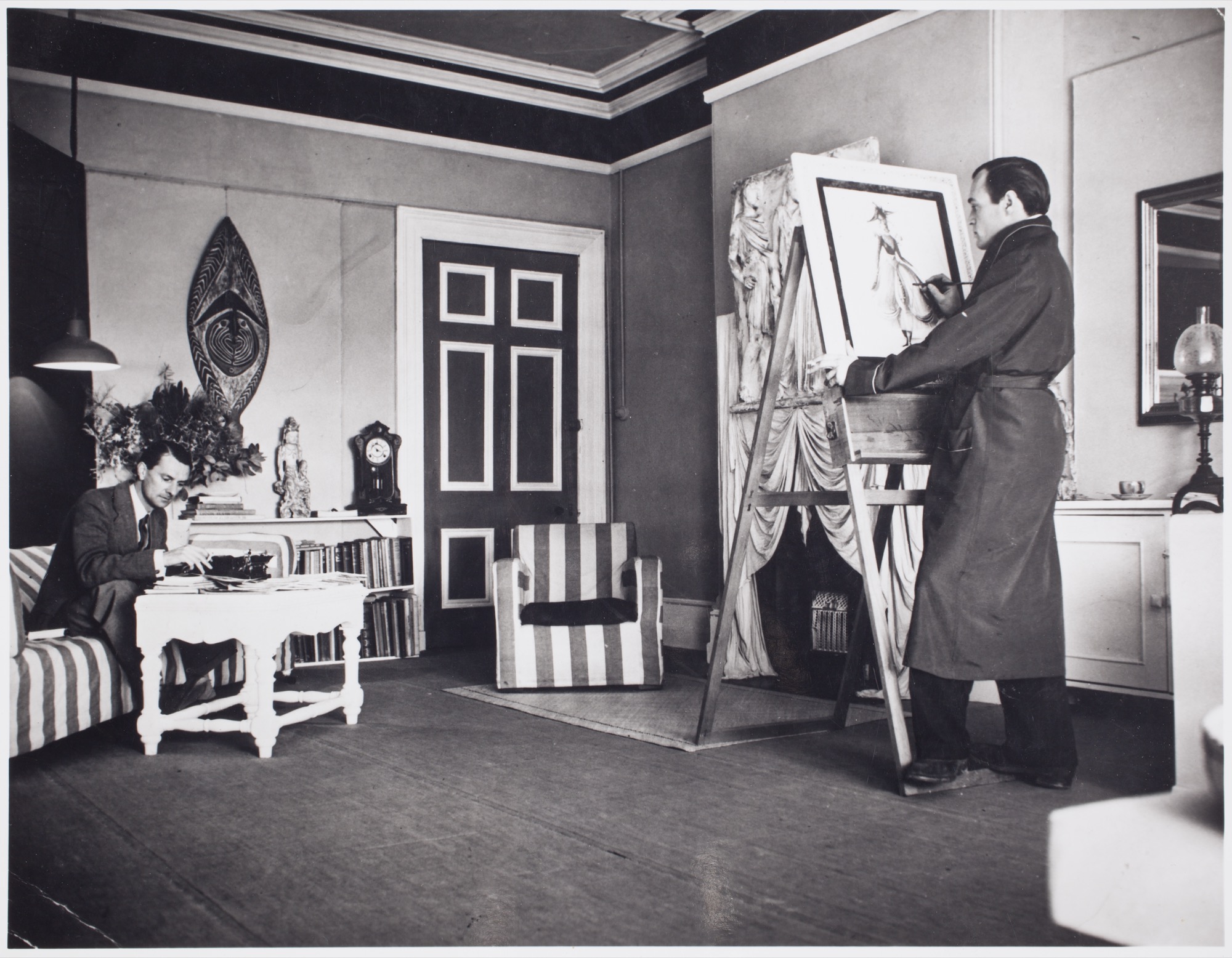
Some creatives living at Merioola were young queer men including Tatlock Miller, his lover Loudon Sainthill (fig. 1), and their friends Donald Friend, Justin O’Brien, Edgar Ritchard—the artist brother of Cyril Ritchard, whom Noël Coward referred to as “queer as a coot”—and, for a while, the writer Hector Bolitho.6 As the young resident Jocelyn Rickards, then fresh out of the East Sydney Technical art school, recalled decades later: “We lived a very, very open life there. Harry and Loudon lived together, and it was a time when neither homosexuality nor two people just living together was openly accepted.”7 Gary Wotherspoon in his history of gay Sydney asserted that Merioola was contemporaneously referred to as “Buggery Barn.”8 This was not an altogether new moniker, as Donald Friend’s biographer Ian Britain has recently pointed out; the term had been given to one of Friend’s cheap, resident dives in the early 1930s, the cellar of a large, near-derelict building from early colonial Sydney located in the old Rocks area, inhabited by artists.9
Merioola’s beginnings
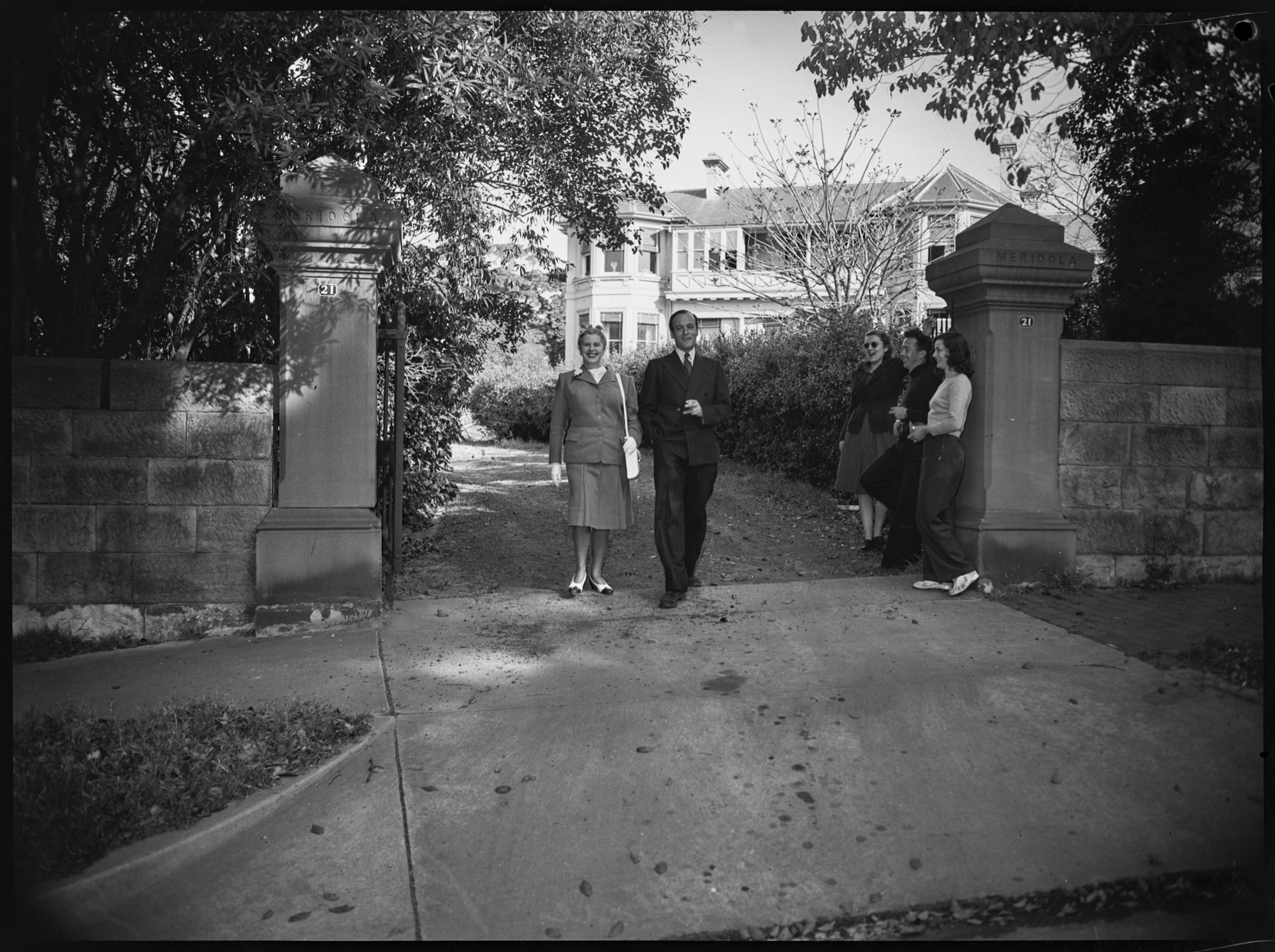
With sweeping views of Sydney Harbour, Merioola itself was built in the late 1850s, remodelled during the later Victorian era and then again in the late Edwardian years when a large ballroom and supper room were added. The estate mansion was owned by the socially prominent, wealthy solicitor and businessman Arthur Wigram Allen and his family.10 He died in late 1941, and the house’s contents of antiques and art were auctioned in early 1942. The house was then openly discussed as being a large, run-down white elephant representing a bygone era of grandeur that awaited sale and the subdivision of its rambling grounds, and “in its place blocks of flats to match the neighbouring congeries [that] would blot out completely its identity”—and its history.11
During the interwar period in Sydney the suburbs of Edgecliff, Woollahra, Double Bay, Potts Point and Kings Cross were rapidly transforming through the demolition of large villas and mansions and the subdivision of estate properties for multi-storey flat developments, some architecturally designed in the Moderne, Mediterranean and Spanish mission styles.12 Merioola awaited this fate, but, in the interim, the rent was significantly cheaper for the resident artists than leasing new apartments from unsympathetic landlords. Its faded grandeur and large size were also appealing and added bohemian atmospheric appeal to this creative, community enclave, removed from the bustle of the city yet very accessible to it by car and public transport.
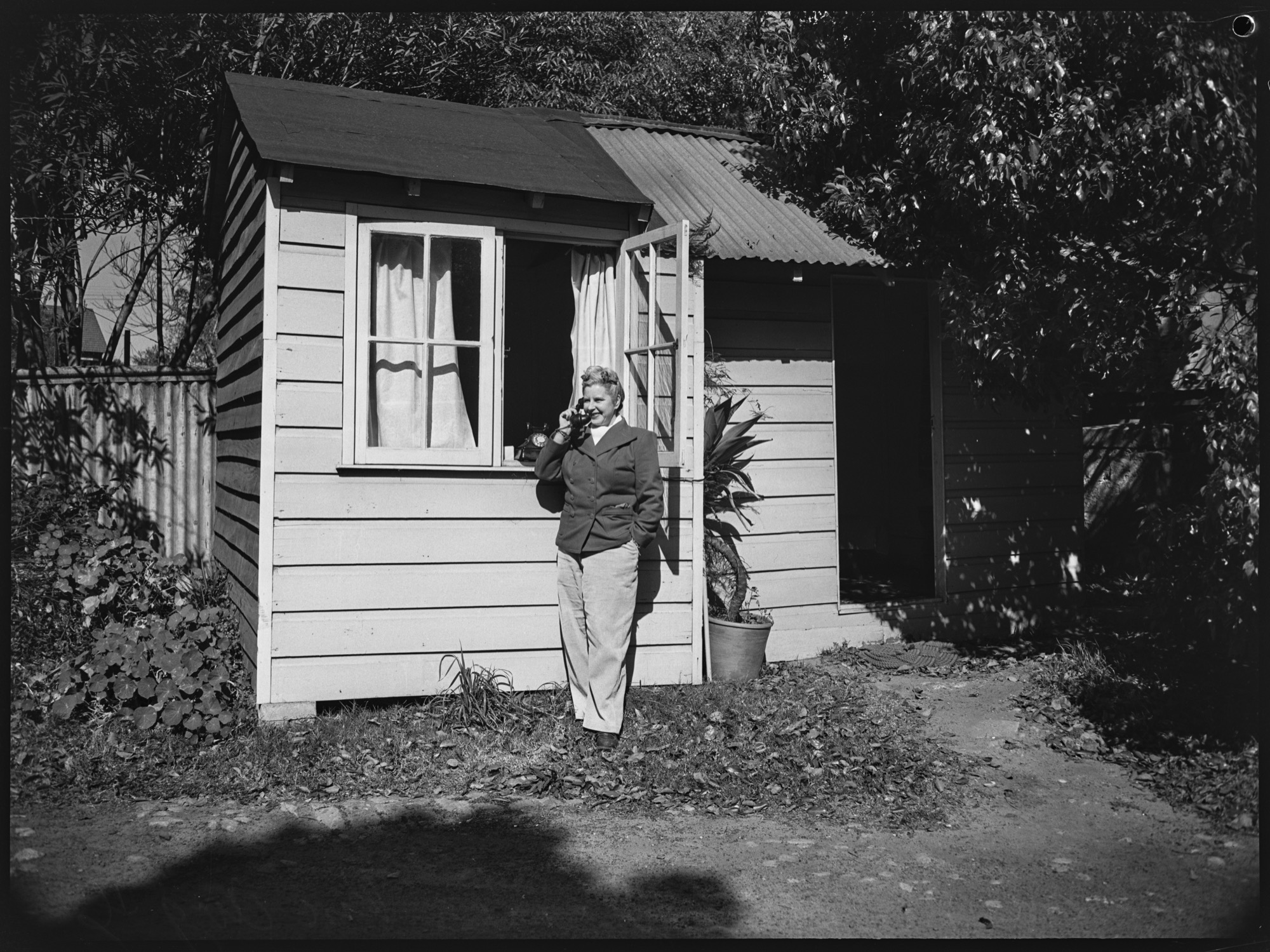
After Allen died, the colourful Chica Lowe (fig. 2) had leased the mansion from the family and through her screening and selection of creative tenants it was transformed into this resident haven for dancers, artists, writers, architects and designers. Lowe had no issue with queerness and moved easily in her dress from conventionally tailored, smart chic to fashionably “mannish” and baggy trousers, collecting the rent from the little office in the large garden that was painted a lolly pink and called “Lolly Lodge” by her and Merioola residents.13 When Donald Friend took a room at Merioola in early 1946, just prior to his demobilisation as an official war artist, Lowe had known him for several years when he lived in digs near Kings Cross. The Cross was a drawcard for Australian and American sailors and army personnel, performers, dancers, jazz musicians, artists, male and female sex workers, trans, and cross dressers. Between themselves Chica was “Chickadee” and he was “Donald-dinny.” “I have some lovely words too,” she had jostled Friend in the early 1940s, “like sodomartade, but who, if not you, will applaud.”14
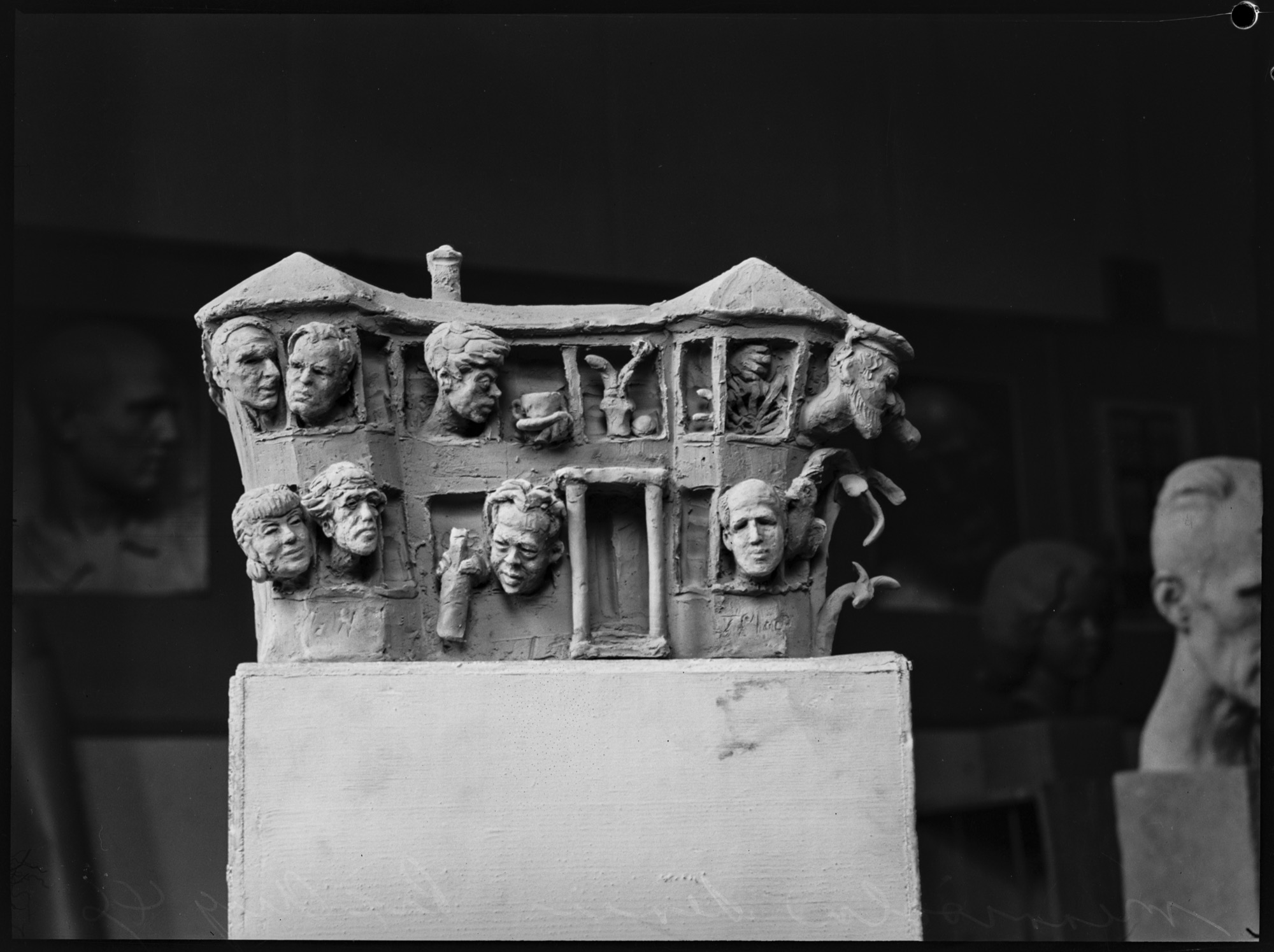
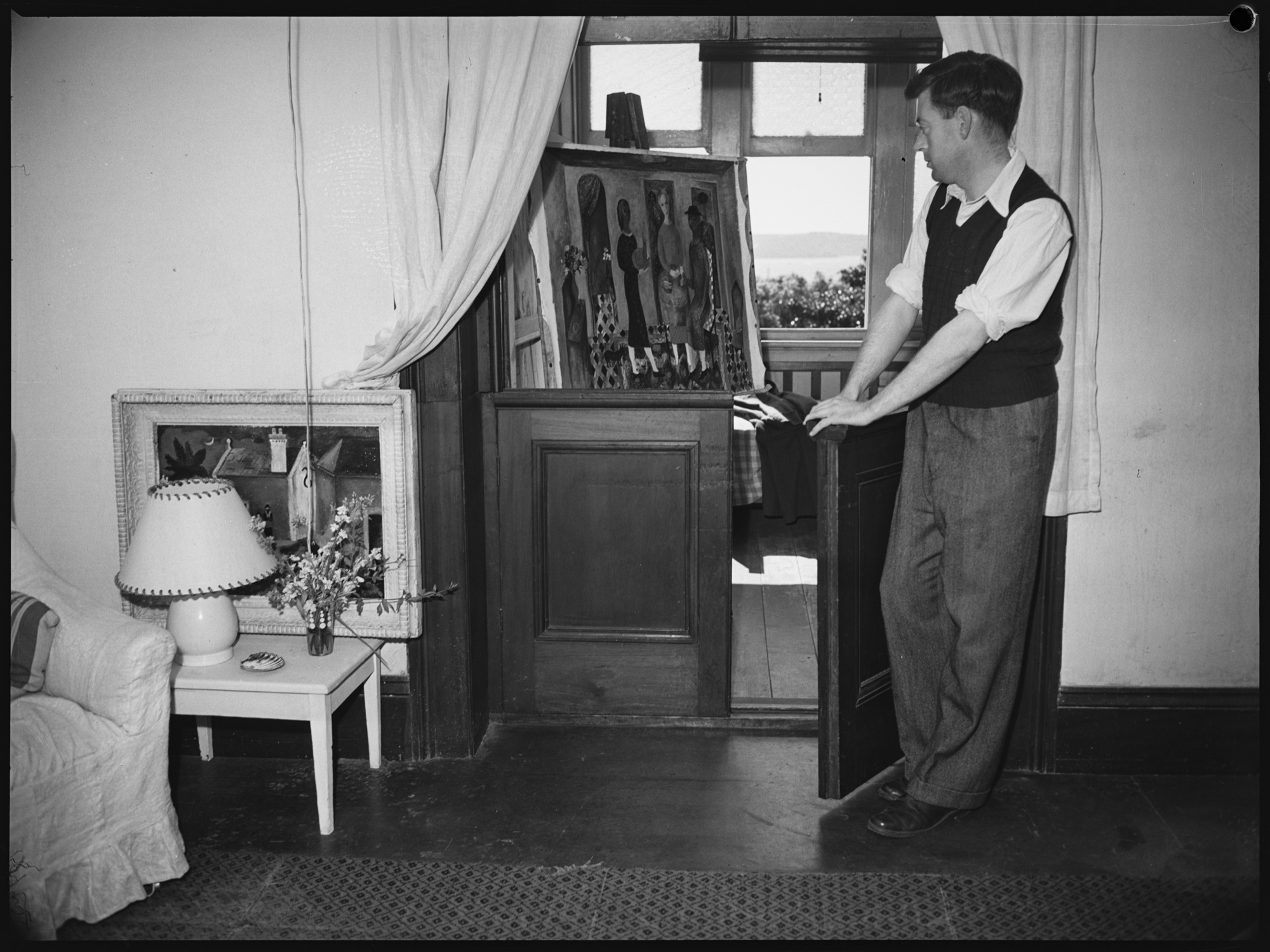
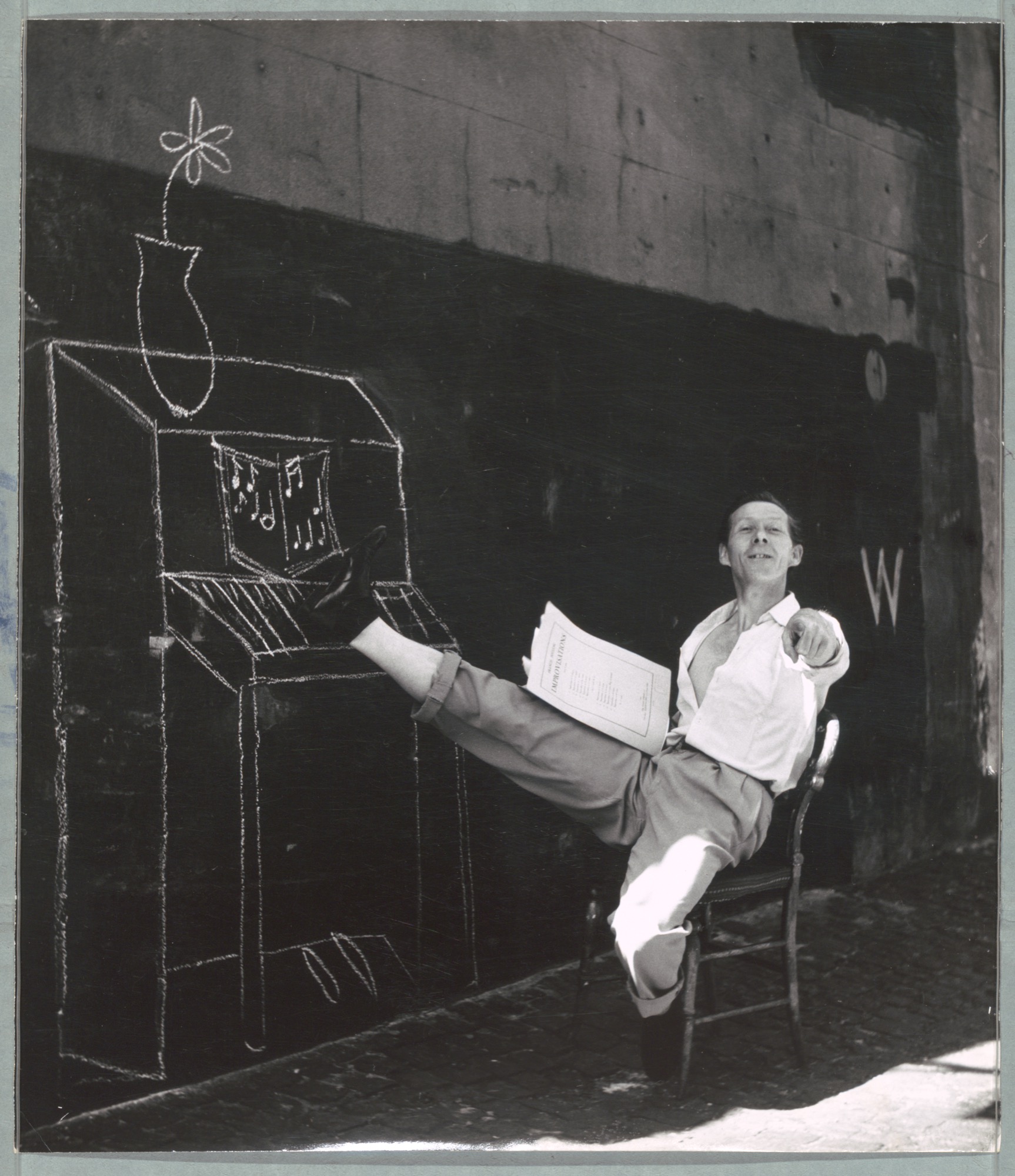
Merioola attracted European émigré artists, such as the Bratislava-born sculptor Arthur Fleischmann who was one of the earliest residents, from the beginning of the 1940s, after fleeing Europe and living and working in Bali for several years (fig. 3). It also attracted many Australian-born artist residents, some of the latter joining its ranks at the end of World War II, just before demobilisation from the army and air force in which they served and experienced atrocities, carnage and suffering. Artist Justin O’Brien (fig. 4) was a prisoner of war in Greece and then Poland and had first met Tatlock Miller and Sainthill—then working as hospital ship orderlies during World War II—when O’Brien embarked at Port Tewfik in Egypt as an exhausted repatriated prisoner of war, in late 1943, and showed Tatlock Miller some of his art.15
By the mid-1940s, Merioola inhabitants formed a cosmopolitan artists’ colony of queerness. It was never a school, let alone a Charm School of artists as it was derogatively referred to by Robert Hughes, who belittled the mythological and the poeticising of imaginary subjects in some of the art.16 All residents knew that after the mansion’s sale in 1947 it would be demolished. But when? Defiantly, they created their private and often public artistic worlds and made their dreams tangible in many art projects.
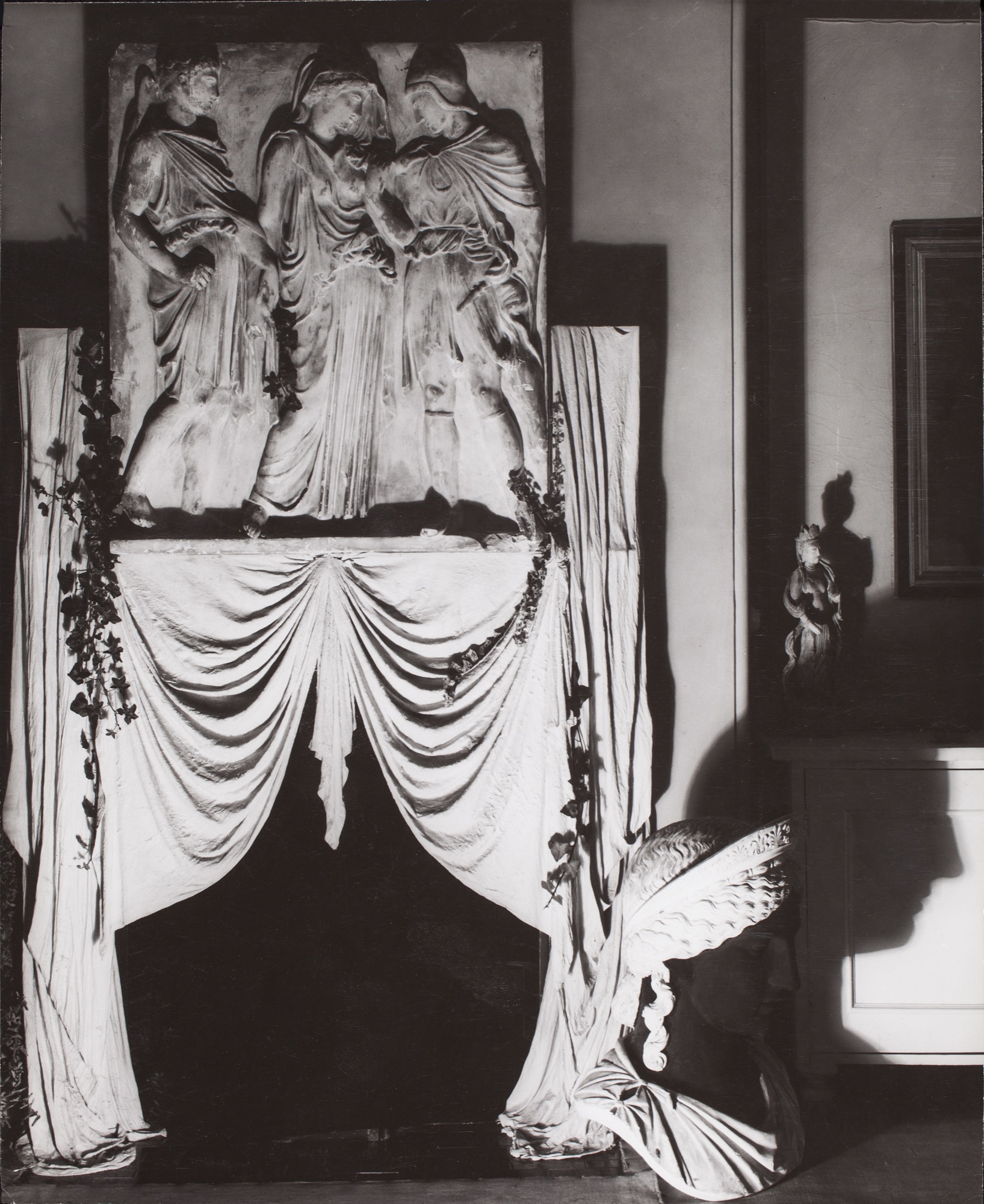
In the winter of 1945, Sainthill and Tatlock Miller moved into the mansion. Sainthill decorated their room (several times over) in a style Friend wittily called “Vogue Regency,” after Friend moved into the mansion in 1946 and decorated his own space with exotic artefacts from Nigeria, where he had lived.17 Sainthill decorated his nineteenth-century fireplace with an overmantel plaster bas-relief of Eurydice and her two suitors, inspired by Parthenon, with lower mantel drapes he made from mosquito net dripped in white plaster (fig. 5). An Italian Renaissance technique for preparing drapery studies using muslin, this modern application was a quasi-Surrealist juxtaposition of elements that played with reality and illusion. An oversized, black-faced plaster bust of Hera, the Queen of the Heaven in antiquity, rested near the fireplace.
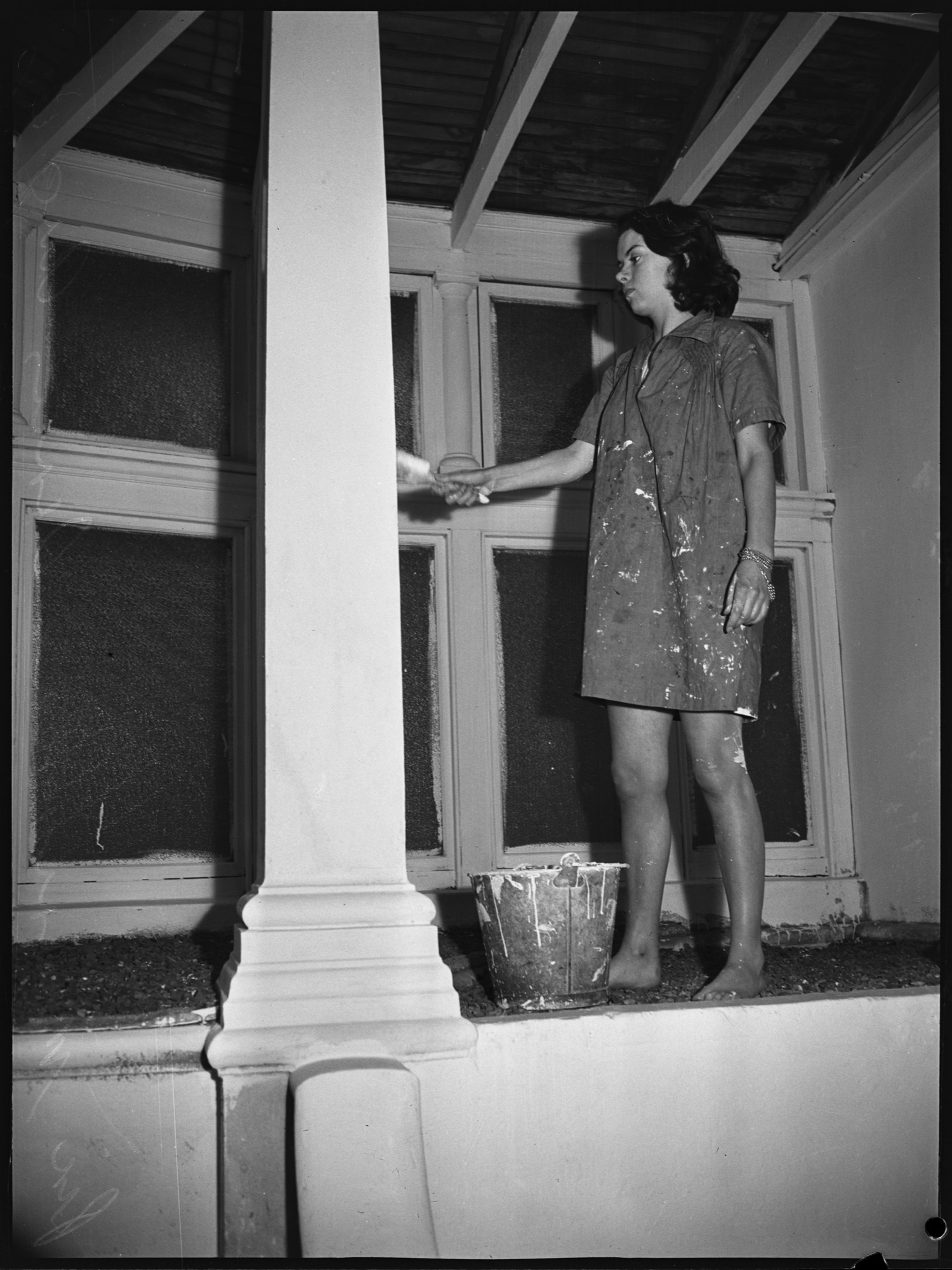
After the Dutch ballerina Beatrice Vitringa returned to Holland, Jocelyn Rickards repainted Merioola’s spacious ballroom—formerly Vitringa’s dance studio—for Alec Murray’s use as his photographic studio (fig. 6).18 With college-boy looks Alec Murray, from an upper middle-class South Australian family, had a fling with an earlier tenant artist, Juanita (Mitty) Lee-Brown, before she headed off to Paris to paint, followed by a longer fling with Rickards. Anne Weinholt was another early—and brief—resident; she won the NSW travelling art scholarship in 1944, with Brown the runner up. Weinholt left Sydney for New York city in 1945, before many of the more long-term residents had arrived at Merioola.19
Queer goings on
With its ballroom freshly painted and Tatlock Miller’s impressive social and media connections as the art critic for Sydney newspapers, the scene was set for Merioola’s residents to stage parties, exhibitions, and events. Publicised and photographed in the press, Merioola was mythologised as a playground for bohemian sophisticates, a “human zoo” as Rickards termed it, queer to the core, and an artist’s community of living, work and fun. Marketed and sensationalised in the press, the colony represented a symbolic enclave of artistic and creative individualism and was an antidote to postwar rationings, rebuilding and re-construction programs, and society’s homogenising industrialisation and mainstream repressive, white-collar conservatism. And not least it was an antidote to mainstream society’s increasing homophobia, seen as a corrective to the perceived moral laxity of wartime relationships amongst classes, sexes, and cultures.
Using photographs taken by Alec Murray, Sydney Ure Smith’s Australia: national journal promoted Sainthill’s art and studio apartment in the context of Sainthill’s cohabitation with Tatlock Miller during a period when same-sex cohabitation was euphemistically absorbed into the term bachelor establishment.20 The Sun newspaper and Pix magazine, which employed Tatlock Miller as an art critic, also featured articles on Merioola artists.21 Miller organised Pix photographer Ivan Wilfred Ive to photograph some of the residents at Merioola in 1946, with the objective of promoting its queer world of resident artists to a wider readership (figs. 7, 8).
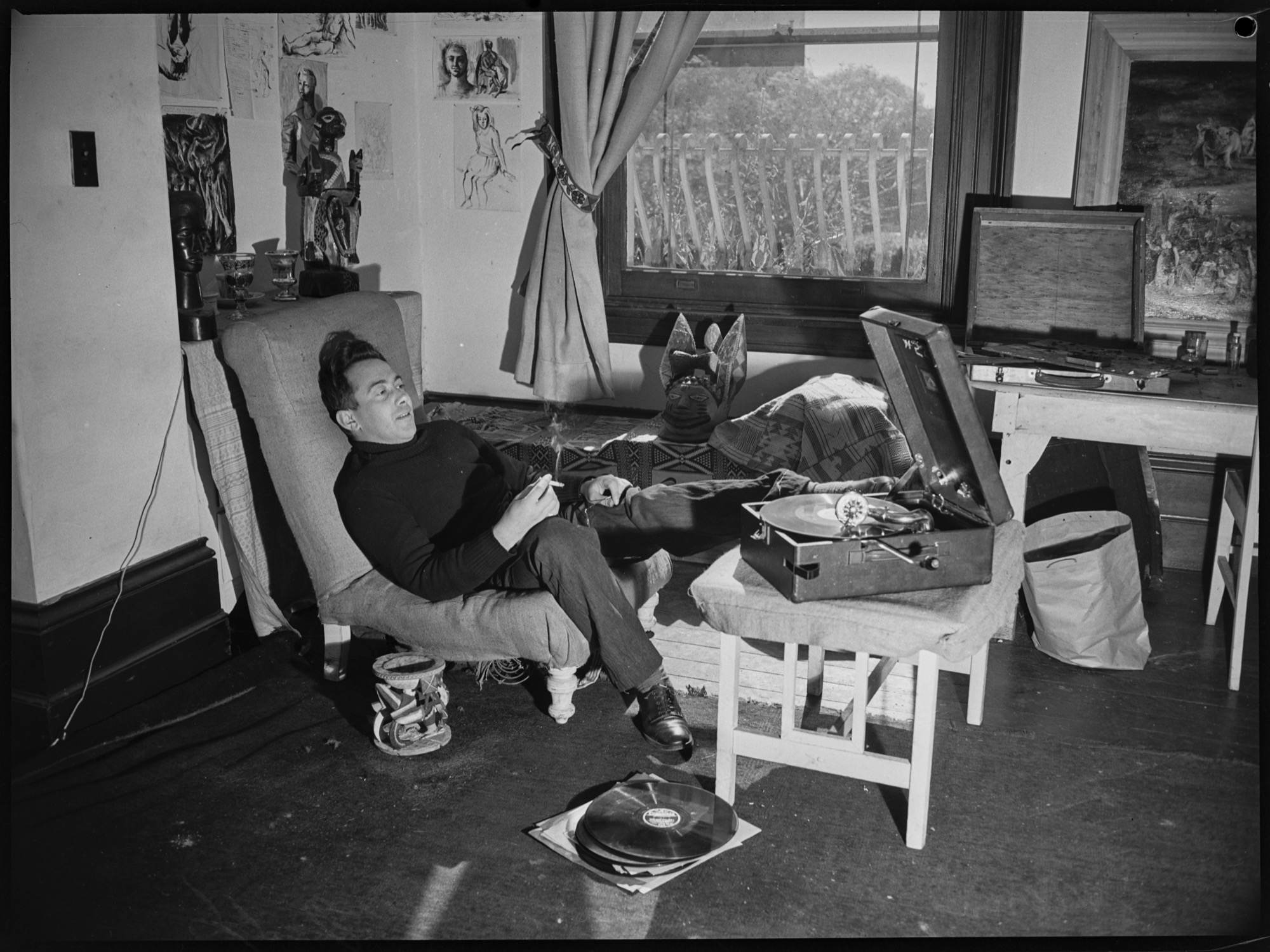
Sainthill and Tatlock Miller’s cohabitation at Merioola challenged the norm of prosaic, respectable middle-class circles, and tabloid journalism exploited the place as a perceived queer, bohemian exoticism. “At that strange communal centre of art and artists—Merioola, at Edgecliff,” wrote George H. Johnston for The Sun newspaper, “there’ll be a riproaring party on Saturday night, as a farewell to painter Justin O’Brien. They’ve had some spectacular nights out that way before this—fawn-dances on the lawns after midnight, revellers plunging through cucumber frames, and, of course, stacks of sophisticated conversation.”22 European visiting musicians were entertained at Merioola and the old mansion was a satellite of the Sydney art scene: painters William Dobell, Sali Herman, Jean Bellette, Francis Lymburner, Paul Haefliger, Adrian Feint, and Margaret Olley were visitors as were interior decorators and stylists Margaret Jaye and Marion Hall Best and gallery directors Treania Smith and Lucy Swan from Sydney’s Macquarie Galleries, where solo exhibitions of Merioola artists were held.
Paradoxically, much mythologising by the press appeased the voyeuristic and vicarious needs of a mainstream culture that showed little practical appreciation of—or demand for—the arts, but a culture to which the artists gave much in any case. And Merioola was a cultural watershed, a hothouse, as much as a holding bay for artists who were ambitious to not only travel after the war but to live and work abroad and make a successful living as artists in what was regarded as the populated old world, in particular London, which was still regarded as the cultural centre of the British empire well into the late 1950s.
Fostering an internationalist and cosmopolitan spirit, one of Merioola’s celebrated entertainments was the staging of a dance concert performed by the young Indian Kathakali dancer Ananda Shivaram, who was touring Australian cities and towns between 1947 and 1949.23 The Sydney ballet teacher Louise Lightfoot, a student of Kathakali dancing in India, had brought Shivaram to Australia and the event and decorations at Merioola were organised and arranged by Sainthill, Tatlock Miller, Rickards and Murray. Over 200 guests attended the performance, which raised funds for the Kathakali School in India and impressed audiences with the richness of traditional Hindu Indian dance culture and mythology.24 Made up and bedecked with flowers and drapes, Shivaram represented Hindu gods, peacocks, animals, hermits and yogis in movements performed against a backdrop of colourful fabrics, transcending gender and offering gestures into queer and perceived exotic cultural spaces not before experienced by most of the audience.25 During the tense decolonisation of India, Shivaram’s spectacle and energy also furthered the Merioola residents’ interest in the arts of Eastern and Islander cultures that formed a part of the exotic accoutrements in some of the artists’ rooms.
The Merioola artists exhibitions, Melbourne and Sydney
Loudon Sainthill mooted the idea to hold a group exhibition of Merioola resident artists, and the first exhibition of this newly named Merioola Group opened in Melbourne at the Myer Mural Hall in early September 1947. Tatlock Miller’s short and pithy introduction in the Merioola Group catalogue for the Melbourne exhibition captures the diversity and ambition of these resident artists:
Merioola is a house, a very old house… its wide windows look down upon Sydney Harbour from the heights of Edgecliff. Its chatelaine is now Chica Edgeworth Lowe.
To-day it is a centre and a force in the present-day art of this country. Artists who at some time have lived, painted and sculpted in Tibet and Mongolia, in London, Paris and Prague, have now all gathered here to live and work beneath its one roof.
Each brings to his, or her, work an altogether individual approach and vision. They share no common cause or way of art. One may paint the Lhama of Tibet, another the kiss of Judas, design a costume for a vivandiere, a ballerina. Where one will seek the satiety of completed forms, for another the search may be beyond appearance to the spirit beneath. One may say with Constable before him, “Painting, for me, is but another word for feeling.” … Merioola itself may not be for very much longer but the creative spirit which its walls have housed in the later years of its life will always remain.26
It was a queer, heterogeneous lot of artists, including the sculptor Arthur Fleischmann, painters Justin O’Brien, Donald Friend, Edgar Ritchard, Roland Strasser, Peter Kaiser, Jocelyn Rickards and Loudon Sainthill and photographer Alec Murray. It was also a fund raiser for these artists because as Tatlock Miller wrote, in the separate brief biographical entries, O’Brien, Sainthill, Rickards, Murray and himself would leave the following year for overseas.27 In the event, Justin O’Brien, as noted above, left first.
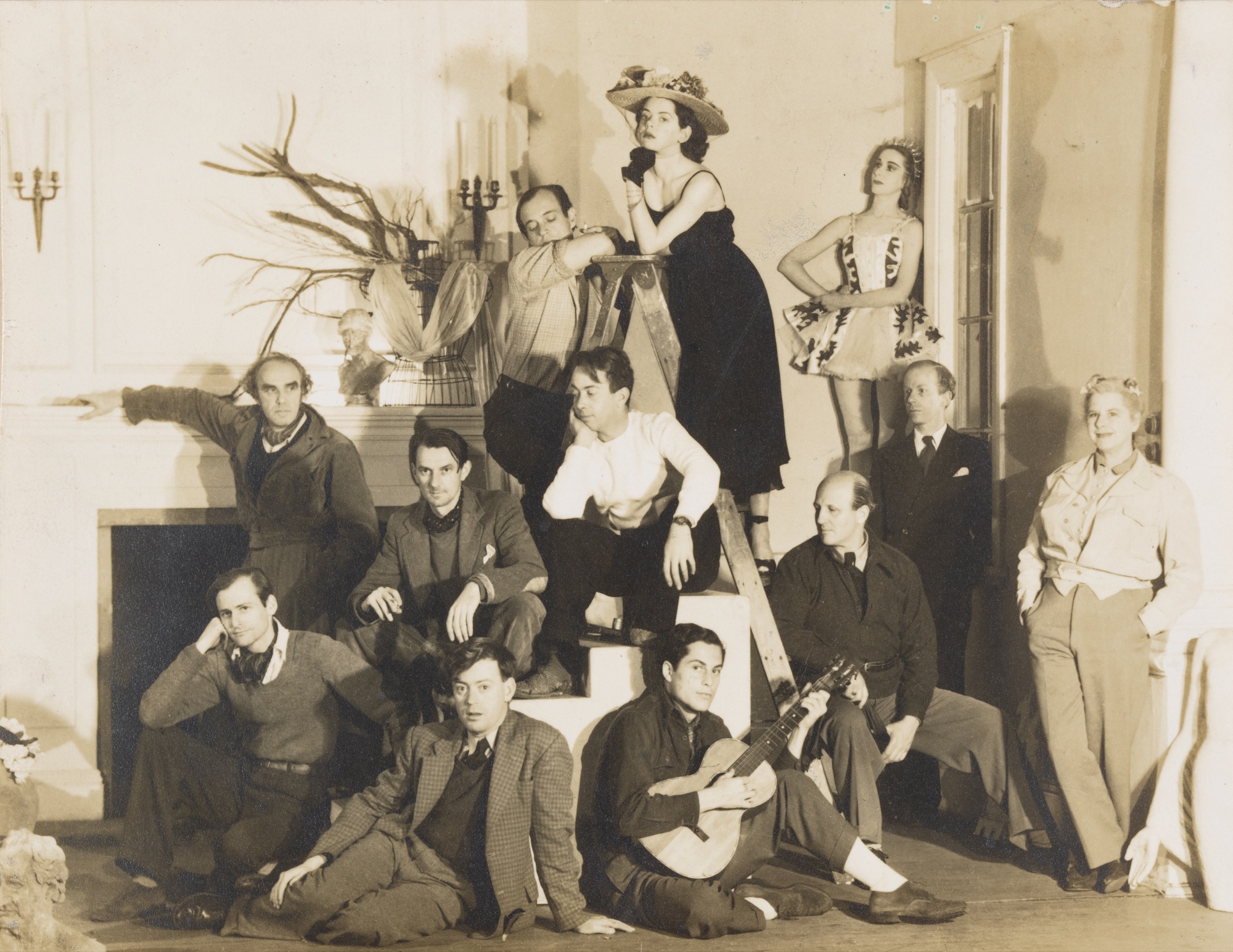
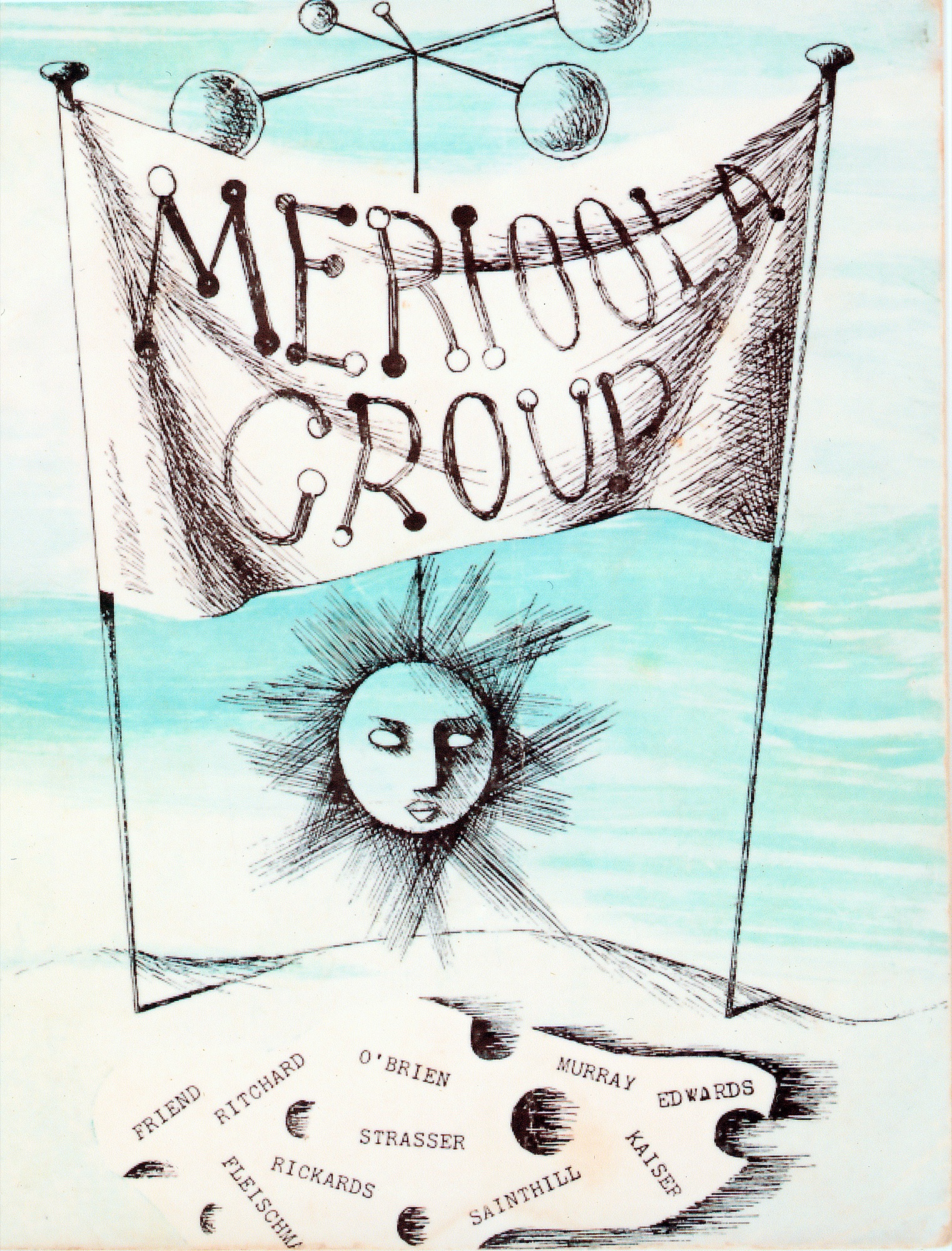
Famously photographed by Alec Murray as a queer collective amidst the decorative trappings of quasi-surrealistic fantasy arranged by Sainthill (fig. 9), the short-lived Merioola Group was born. Their image was published in Sydney Ure Smith’s Australia: national journal just after the closing of the Melbourne exhibition and a month before the group’s next exhibition opened in Sydney, in late November, at David Jones Gallery, which was then directed by Marion Hall Best.28 This photograph was also included in the Sydney catalogue, the cover designed by Sainthill (fig. 10). Showcasing works by the same artists, the Sydney exhibition also included the paintings of Mary Edwards, a Merioola newcomer who had painted and exhibited in Europe, South-East Asia, the Pacific, and America, but who soon lost traction amongst artists for her attacks and legal challenge over Dobell’s Archibald winning portrait of Joshua Smith, both queer men in 1944.29 Pre-sales were well publicised, and the press exploited the society aspect of the Merioola showing. Best hosted a party at her fashionable home in Woollahra after the Sydney opening.30
Over the next two years, Merioola became a site of farewell parties: a revolving door of exits, through which none returned to live there again. Like Justin O’Brien, Edgar Ritchard left Merioola in early 1948 for England. Fleischmann, resident since the early 1940s, returned to Europe in February 1948 and by April had married and settled in London. By the end of the year Murray left for London, soon followed by Rickards, and in March 1949 Russell Drysdale and his wife Bonn held a farewell party for Donald Friend and Peter Kaiser, both of whom were travelling to Italy to paint.31
Cultural exchanges
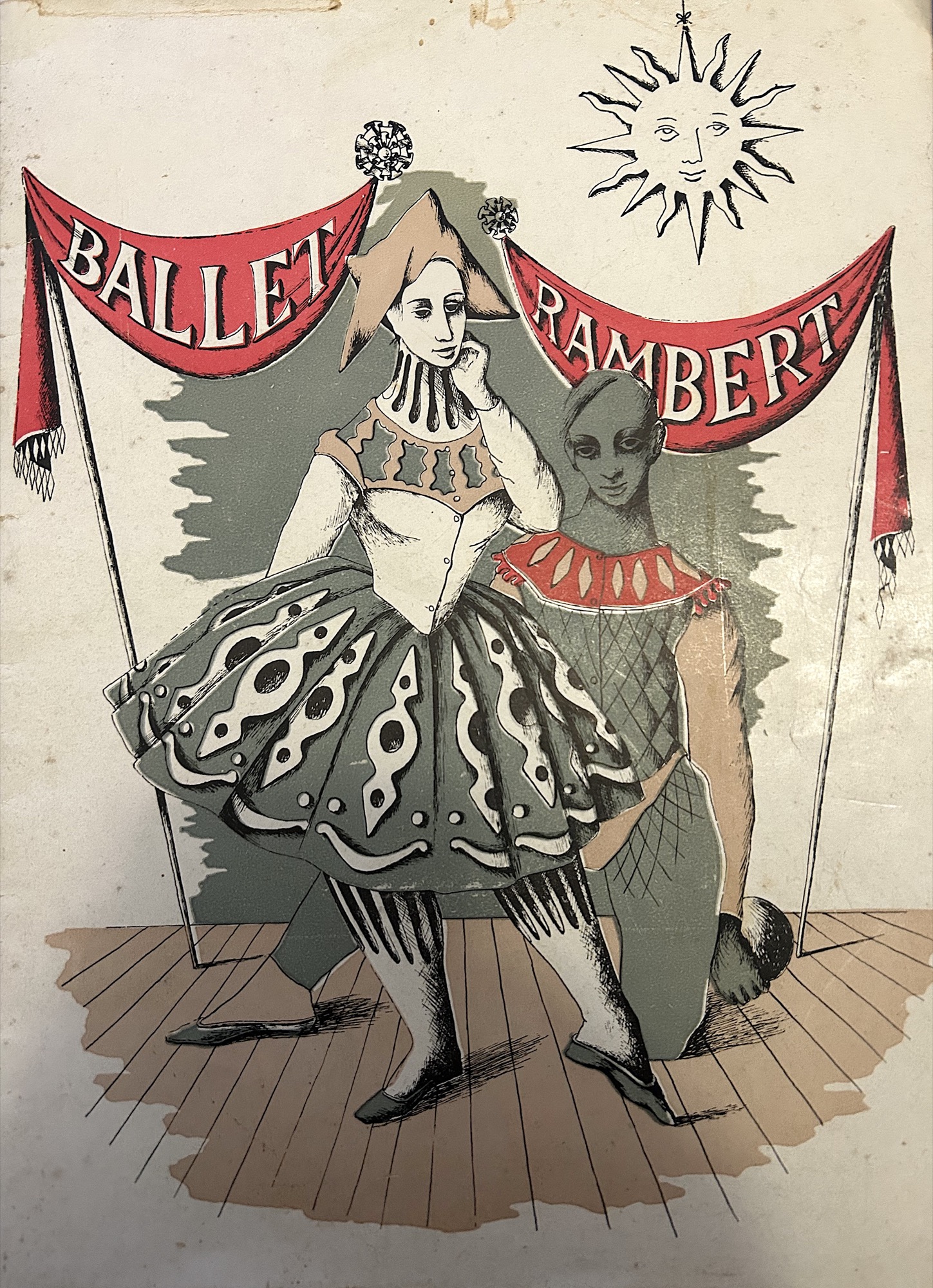
But it was not only lack of money that prevented Sainthill and Tatlock Miller from getting to London in 1948 as planned. The greatest incentive to stay and work sprung from the much anticipated British Council tours across Australia and New Zealand of the Ballet Rambert (fig. 11) and the Old Vic Company (starring the famed stage and screen actors Vivien Leigh and her husband Laurence Olivier). With his earlier experiences with the Ballets Russes, the art for theatre exhibitions he organised and his working knowledge of the Sydney and Melbourne contemporary art scenes, Tatlock Miller would shape and promote the artistic marketing of the tours and their celebrities.
Pursued by the press around Australia, the tours—held between 1947 and 1949—were essentially British cultural propaganda in the Dominion. Each tour aimed to raise the standard of the arts in Australia, enthuse and develop audiences and stimulate the national theatre movement while promoting the British Empire’s dominant cultural role model. Through the profitable entertainment of the perceived “young nation,” these tours would reward Australia for its allegiance to Britain during the war and for Australian support for the long and ongoing Food for Britain appeals. The British Council’s ambitions in Australia and the South West Pacific went back to wartime, when representatives identified that “thinking Australians” were concerned that a postwar American influence in Australia would undermine the finer English elements of Australian life and the British Council sought to strengthen the “invisible bonds with the Old Country.”
Through his previous exhibitions, writing and connections, Tatlock Miller was well known to the British Council and its newly appointed representatives in Australia—in particular Charles Wilmot in 1947 and Tyrone Guthrie in 1949. The creative input of Tatlock Miller, Murray and Sainthill greatly assisted the promotion, aesthetic reception and success of the tours. Tatlock Miller was commissioned by the British Council to edit and produce a lavish souvenir of the Australian tour of the Old Vic Company, which Sainthill designed including the artwork for its striking fantasy cover.32 Giving the souvenir program an Australian slant, Merioola photographer Alec Murray was sent “with a plane-load of arc-lamps and equipment” to photograph the full repertoire of plays in Perth and then Adelaide.33 Sainthill created Old Vic posters, as well as playbills and illustrated the programmes. The same artists created the handsome souvenir of the Ballet Rambert’s Australasian tour, held between 1947 and 1949 (fig. 12), likewise with a cover designed by Sainthill, and Ballet Rambert choreographers and dancers were often the subject of photographs by Murray when they visited Merioola.34
Aftermath: Australian art history and reckonings
The Merioola diaspora had long begun when Tatlock Miller and Sainthill departed Merioola in the middle of 1949, meeting up with their colleagues in London and after some time establishing successful careers in the arts in England. Tatlock Miller’s role as art critic for The Sun newspaper was transferred to artist and poet James Gleeson, who from May 1947 to December 1948 had lived at the Abbey Art Centre, a residential art colony outside London, using it as a base to visit France, Italy, and the Netherlands. Known to the Merioola artists by his powerful surrealistic paintings and art lectures, Gleeson was never a part of the Merioola set. What influence, then, did the Merioola colony have on Australian art? The work of Justin O’Brien, Donald Friend and to an extent Mitty Lee-Brown and Loudon Sainthill is well known, but many other resident artists have fallen off the radar in art history. Their work was never a school, a style or an art movement, although spiritualised fantasy and a modernising classicism united some: Sainthill and O’Brien, for example, and to a lesser sense Rickards’ nascent exploration. The Merioola colony and its diaspora was an inspiration, a creative lead, and a stimulus; consequently, this short-lived artists’ colony holds a significant place in historic and cultural memory and in the growing development of international queer studies and histories.35
The Merioola group in art history represents the art of the possible: a self-conscious concentration of talent both supplying and creating demand in what was then seen and experienced as the complex Janus-faced cultural bridge connecting Australia with England, in particular. And its life offers the makings of another Australian art history. Inhabiting the end of an era in the then soon-to-be-demolished old mansion, the artists—with their mix of talents—brought a tangible sense of what was possible for the future and what could be achieved through work, ambition, and not a little social carousing, networking, and self-promotion after World War II by many queer artists.
In 1949 when Bernard Smith was researching in London, towards what became his European vision and the South Pacific, 1768–1850 (first published in 1960), he visited Rex Nan Kivell at the Redfern Gallery in search of Australiana, which Nan Kivell collected and was then in negotiations with the National Library and the Commonwealth Government to acquire for Australia. As Smith recounted, Nan Kivell gave him “clear evidence that Rex was homosexual. He kept rubbing his shoulders up against mine.”36 Nan Kivell proposed that Smith might be a possible partner at the gallery, but Smith felt uncomfortable, later recommending to Tatlock Miller, whom he knew well from Sydney, that he approach Nan Kivell about the position. “I suggested he contact Nan Kivell at the Redfern,” Smith recalled of his chance meeting with Tatlock Miller in London, “saying ‘you probably have the qualifications he is looking for.’ Harry did, and remained at the Redfern for the rest of his life.”37
Smith’s covert pigeonholing of Tatlock Miller’s sexuality was inadvertently isolationist and was refuted when Tatlock Miller reflected on his own sexual orientation and identity decades later. When the word gay became a political and subcultural signifier of male same-sex desire in the 1960s and 1970s, he preferred the word queer, to gay. “I am queer not gay,” he humorously asserted to friends in the 1970s.38 His life experiences and his years living at the Merioola colony with Sainthill and other queer artists had undoubtedly impacted on his person during these often difficult but creative years and from which his queer networks in both the Australia and British art scenes profited.
-
For an early study of the Merioola Group, see Christine France, Merioola and after (National Trust of Australia, NSW, 1986). ↩
-
H. Tatlock Miller, An exhibition of art for theatre and ballet, under the auspices of the British Council, London; collected and arranged by H. Tatlock Miller (Harbour Press for the British Council, 1940). The cover was designed by Loudon Sainthill and the exhibition held “under the auspices of the British Council” at the David Jones Art Gallery in Sydney and the Myer Emporium gallery in Melbourne. ↩
-
Rex Butler & A. D. S. Donaldson, “The myth of heterosexuality: queer Australian artists, art historians and gallerists in London 1930–1961’, Journal of Australian studies 48, no. 3 (2024): 279–278. https://doi.org/10.1080/14443058.2024.2369500 ↩
-
Friend’s later self-confessed pedophile activities in Bali lie beyond the timeframe of this essay but were investigated in the documentary film A Loving Friend (2009), 77 mins, directed by Kerry Negara for Negara Film and TV Productions. ↩
-
Angela Hesson, “Queer fantastic: imagination, metamorphosis, magic,” in Queer: stories from the NGV collection, ed. Ted Gott, Angela Hesson, Myles Russell-Cook, Meg Slater and Pip Wallis (National Gallery of Victoria, 2021), 317. ↩
-
For Noël Coward’s comment, see John Rickard, “Elliott, Leah Madeleine (Madge) (1896–1955),” Australian dictionary of biography (National Centre of Biography, Australian National University, published first in hardcopy 1996). https://adb.anu.edu.au/biography/elliott-leah-madeleine-madge-10112/text17851 ↩
-
Jocelyn Rickards, interviewed by Jenny Turpin for Geoffrey Dutton, London, October 1984, transcript courtesy Jenny Turpin. See also Jocelyn Rickards, The painted banquet: my life and loves (Weidenfeld & Nicholson, 1987), which briefly overviews her time at Merioola. ↩
-
Garry Wotherspoon, Gay Sydney: a history (NewSouth Books, Sydney, 2016), 99; see also Peter McNeil, “Friday essay: hidden in plain sight—Australian queer men and women before gay liberation,” in The Conversation, 5 March 2021. https://doi.org/10.64628/AA.xgaxwra34 ↩
-
Ian Britain, The making of Donald Friend: life and art (Yarra & Hunter Arts Press, 2023), 125–126. ↩
-
“‘Merioola,’ Edgecliff, Sydney—The Home of Mr. and Mrs. Arthur Wigram Allen,” The Home: an Australian quarterly 2, no. 4 (December 1921): 22. http://nla.gov.au/nla.obj-377366045](http://nla.gov.au/nla.obj-377366045 ↩
-
“That reminds me,” Smith’s Weekly, Sydney, 7 March 1942, 11, http://nla.gov.au/nla.news-article234591220 ↩
-
GML Heritage, Woollahra interwar buildings: thematic history (prepared for Woollahra Municipal Council, 31 July 2024), 33, https://www.woollahra.nsw.gov.au/files/assets/public/v/1/building-and-development/documents/final_woollahra-inter-war-buildings-thematic-history.pdf ↩
-
“Old Sydney home is now colorful [sic] little colony,” The Sun, Sydney, 23 June 1946, 11. http://nla.gov.au/nla.news-article229462463 ↩
-
Chica Lowe, Elizabeth Bay, Sydney, to Donald Friend, Cairns, 15 June 1941, Friend family papers, ML MSS 6305/1, series 2, Mitchell Library Sydney. ↩
-
Tatlock Miller, “Recent Paintings of Justin O’Brien,” Art and design, no. 1 (1949): 7. ↩
-
Robert Hughes, The art of Australia (Penguin, 1970), 170. Hughes adopted the term “charm” from Sydney artist and critic Paul Haefliger’s Sydney Morning Herald review of Jocelyn Rickards’ exhibition of paintings held at the Macquarie Galleries in 1948. See Paul Haefliger, “Artist relies on charm,” Sydney Morning Herald, 20 October 1948, 4. http://nla.gov.au/nla.news-article18098956 ↩
-
Donald Friend, The diaries of Donald Friend vol. 2, ed. Paul Hetherington (National Library of Australia, 2003), entries for March 1946 and May 1946, 359, 377. ↩
-
H. Tatlock Miller, “Merioola: ‘Latin Quarter’ for unique community of Sydney arts,” Pix 18, no. 20 (16 November 1946): 23–25. http://nla.gov.au/nla.obj-480396032 ↩
-
“Social news and events,” Sydney Morning Herald, 22 November 1944, 6. http://nla.gov.au/nla.news-article17928713 ↩
-
Australia: national journal 7, no. 2 (January 1946): 47–48. ↩
-
“Georgie’s column,” The Sun, Sydney, 21 November 1946, 13, http://nla.gov.au/nla.news-article229555901; H. Tatlock Miller, “Merioola: ‘Latin Quarter’ for unique community of Sydney artists,” Pix 18, no. 20 (16 November 1946): 23–25. http://nla.gov.au/nla.obj-480396032 ↩
-
George H. Johnston, “Sydney diary,” The Sun, Sydney, 9 December 1947, 7. http://nla.gov.au/nla.news-article230554846 ↩
-
Amit Sarwal and David Walker, “Staging a cultural collaboration: Louise Lightfoot and Ananda Shivaram’s first Indian dance tour of Australia, 1947–1949,” Dance chronicle 38, no. 3 (2015): 305–355. https://doi.org/10.1080/01472526.2015.1088286 ↩
-
“Dance recital by Shivaram,” Sydney Morning Herald, 14 July 1947, 8. http://nla.gov.au/nla.news-article18034832 ↩
-
“A Hindu brings his art to us,” Pix 19, no. 22 (31 May 1947): 15. http://nla.gov.au/nla.obj-480471568 ↩
-
Tatlock Miller, “Foreword,” in Catalogue for the inaugural exhibition of the Merioola Group of Sydney (Myer Mural Hall, September 1947), unpaginated. For a digitised copy of the catalogue, see https://handle.slv.vic.gov.au/10381/140959. ↩
-
Tatlock Miller tried to get his professional colleague the director of the NGV Daryl Lindsay to visit the artists’ studios at Merioola in Sydney for some time, but to no avail. Nevertheless, Lindsay purchased Sainthill’s The actress (1947) and Ritchard’s Seated Vivandiere (n.d.) for the NGV collection from the Myer Mural Hall exhibition; see https://www.ngv.vic.gov.au/explore/collection/work/27667 and https://www.ngv.vic.gov.au/explore/collection/work/27639 respectively for details and images of both works. ↩
-
“The Merioola Group,” Australia: national journal 9, no. 7 (October 1947): 31. ↩
-
“Court claim over Dobell’s painting,” The Daily Mirror, Sydney, 23 October 1944, 2. http://nla.gov.au/nla.news-article272448340 ↩
-
“Sydney’s talking about—,” Sydney Morning Herald, 27 November 1947, 12. http://nla.gov.au/nla.news-article18051167 ↩
-
“Artists’ farewell: parties of the week,” The Sunday Herald, Sydney, 27 March 1949, 14, http://nla.gov.au/nla.news-article18465625; “Roundabout,” Truth, Sydney, 27 March 1949, 38. http://nla.gov.au/nla.news-article168880722 ↩
-
For a digitised copy, see: H. Tatlock Miller, ed., The Old Vic Theatre Company: a tour of Australia and New Zealand, designed and decorated by Loudon Sainthill (British Council, 1948).https://nla.gov.au/nla.obj-3373778097 ↩
-
“Sydney diary,” The Sun, Sydney, 17 March 1948, 9. http://nla.gov.au/nla.news-article228992529 ↩
-
Some of the Ballet Rambert dancers photographed at Merioola are included in Alec Murray’s album: personalities of Australia (Ure Smith, 1948), 80–81. ↩
-
Murray became a famed fashion and portrait photographer capturing, for example, an androgynous Veruschka in his work; Sainthill became a famous theatre designer and artist working from London; Rickards became a costume designer in the 1960s for many films including From Russia with love and Blow up; and Tatlock Miller joined Rex Nan Kivell as a director of the Redfern Gallery, often promoting Australian art alongside North American, British and European modern art. ↩
-
Bernard Smith, A pavane for another time (Macmillan, 2002), 241. ↩
-
Smith, A pavane for another time, 241–242. ↩
-
Andrew Pfieffer, personal communication with the author, Sydney, February 2010. ↩
Dr Andrew Montana is an independent researcher, writer and lecturer, whose interests focus on Australian art, design, decorative arts, and architecture in an international context. A former senior lecturer in Art History at the Australian National University, he is the author of books including Fantasy modern: Loudon Sainthill’s theatre of art and life (NewSouth, 2013), Primitive and pop: Keith Haring’s Australia 1984 (Arcadia, 2017), and a co-author of Daniel Cottier: designer, decorator, dealer (Paul Mellon Centre for Studies in British Art, 2021). He is an approved cultural valuer of the Commonwealth’s Cultural Gifts Program.
Bibliography
- “A Hindu brings his art to us.” Pix 19, no. 22 (31 May 1947): 14–15. http://nla.gov.au/nla.obj-480471568
- “Artists’ farewell: parties of the week.” The Sunday Herald, Sydney, 27 March 1949. http://nla.gov.au/nla.news-article18465625
- Britain, Ian. The making of Donald Friend: life and art. Yarra & Hunter Arts Press, 2023.
- Butler, Rex, and A. D. S. Donaldson. “The myth of heterosexuality: queer Australian artists, art historians and gallerists in London, 1930–1961.” Journal of Australian studies 48, no. 3 (2024): 279–278, https://doi.org/10.1080/14443058.2024.2369500
- “Court claim over Dobell’s painting.” The Daily Mirror, Sydney, 23 October 1944. /.
- “Dance recital by Shivaram.” Sydney Morning Herald, 14 July 1947. [http://nla.gov.au/nla.news-article18034832]{.underline}](http://nla.gov.au/nla.news-article18034832)
- France, Christine. Merioola and after. National Trust of Australia (NSW), 1986.
- Friend, Donald. The diaries of Donald Friend, vol. 2, edited by Paul Hetherington. National Library of Australia, 2003.
- Friend, Donald. Friend family papers, 1927–c.1985. Mitchell Library Sydney. ML MSS 6305/1.
- “Georgie’s column.” The Sun, Sydney, 21 November 1946. http://nla.gov.au/nla.news-article229555901
- GML Heritage. Woollahra interwar buildings: thematic history. Prepared for Woollahra Municipal Council, 31 July 2024. https://www.woollahra.nsw.gov.au/files/assets/public/v/1/building-and-development/documents/final_woollahra-inter-war-buildings-thematic-history.pdf
- Hesson, Angela. “Queer fantastic: imagination, metamorphosis, magic.” In Queer: stories from the NGV collection, edited by Ted Gott, Angela Hesson, Myles Russell-Cook, Meg Slater and Pip Wallis. National Gallery of Victoria, 2021.
- Gott, Ted, Angela Hesson, Myles Russell-Cook, Meg Slater and Pip Wallis, eds. Queer: stories from the NGV collection. National Gallery of Victoria, 2021.
- Haefliger, Paul. “Artist relies on charm.” Sydney Morning Herald, 20 October 1948. http://nla.gov.au/nla.news-article18098956
- Hughes, Robert. The art of Australia. Penguin, 1970.
- Johnston, George H. “Sydney diary.” The Sun, Sydney, 9 December 1947. [http://nla.gov.au/nla.news-article230554846]{.underline}
- McNeil, Peter. “Friday essay: hidden in plain sight—Australian queer men and women before gay liberation.” In The Conversation, 5 March 2021. https://doi.org/10.64628/AA.xgaxwra34
- “‘Merioola,’ Edgecliff, Sydney—The Home of Mr. and Mrs. Arthur Wigram Allen.” The Home: an Australian quarterly 2, no. 4 (December 1921): 22. http://nla.gov.au/nla.obj-377366045
- Miller, H. Tatlock. An exhibition of art for theatre and ballet, under the auspices of the British Council, London; collected and arranged by H. Tatlock Miller. Harbour Press for the British Council, 1940.
- Miller, H. Tatlock. “Merioola: ‘Latin Quarter’ for unique community of Sydney arts.” Pix 18, no. 20 (16 November 1946): 23–25. http://nla.gov.au/nla.obj-480396032
- Miller, H. Tatlock. “Foreword.” In Catalogue for the inaugural exhibition of the Merioola Group of Sydney. Myer Mural Hall, 9–23 September 1947. https://handle.slv.vic.gov.au/10381/140959
- Miller, H. Tatlock. “Foreword.” In Catalogue for the inaugural exhibition of the Merioola Group of Sydney. David Jones Art Gallery, Sydney, November–December 1947.
- Miller, H. Tatlock, ed. The Old Vic Theatre Company: a tour of Australia and New Zealand, designed and decorated by Loudon Sainthill. British Council, 1948. https://nla.gov.au/nla.obj-3373778097
- Miller, H. Tatlock. “Recent Paintings of Justin O’Brien.” Art and design, no. 1 (1949): 7.
- Montana, Andrew. Fantasy modern: Loudon Sainthill’s theatre of art and life. NewSouth Books, 2013.
- “Old Sydney home is now colorful [sic] little colony.” The Sun, Sydney, 23 June 1946. http://nla.gov.au/nla.news-article229462463
- Rickard, John. “Elliott, Leah Madeleine (Madge) (1896–1955).” Australian dictionary of biography. National Centre of Biography, Australian National University, published first in hardcopy 1996. https://adb.anu.edu.au/biography/elliott-leah-madeleine-madge-10112/text17851
- Rickards, Jocelyn. Interviewed by Jenny Turpin for Geoffrey Dutton, London, October 1984. Transcript courtesy Jenny Turpin.
- Rickards, Jocelyn. The painted banquet: my life and loves. Weidenfeld & Nicholson, 1987.
- “Roundabout.” Truth, Sydney, 27 March 1949. http://nla.gov.au/nla.news-article168880722
- Sarwal, Amit, and David Walker. “Staging a cultural collaboration: Louise Lightfoot and Ananda Shivaram’s first Indian dance tour of Australia, 1947–1949.” Dance chronicle 38, no. 3 (2015): 305–355. https://doi.org/10.1080/01472526.2015.1088286
- Smith, Bernard. A pavane for another time. Macmillan, 2002.
- “Social news and events.” Sydney Morning Herald, 22 November 1944. http://nla.gov.au/nla.news-article17928713
- “Sydney diary.” The Sun, Sydney, 17 March 1948. http://nla.gov.au/nla.news-article228992529
- “Sydney’s talking about.” Sydney Morning Herald, 10 July 1947. http://nla.gov.au/nla.news-article18034201
- “Sydney’s talking about—.” Sydney Morning Herald, 27 November 1947. http://nla.gov.au/nla.news-article18051167
- “That reminds me.” Smith’s Weekly, Sydney, 7 March 1942. http://nla.gov.au/nla.news-article234591220
- “The Merioola Group,” Australia: national journal 9, no. 7 (October 1947): 31.
- Wotherspoon, Gary. Gay Sydney: a history. NewSouth Books, 2016.