From the Ground Up The Dunmoochin Artists’ Cooperative
The unconventional nature of the artists’ cooperative Dunmoochin, whose members were “as wild—and certainly as woolly—as any in Paris, London or Rome,” and who lived in mud brick homes in the bushland at Cottles Bridge, some thirty kilometres northeast of Melbourne, was of considerable curiosity to the popular press.1 Described as an “ideal,” a “haven,” and a “working utopia,” representations and accounts of life at Dunmoochin were regularly featured in newspaper and magazine articles from the 1950s to the 1990s.2 Yet the nature of Dunmoochin’s contribution to Australian art and architecture has not been fully recognised. Scholarship on Dunmoochin is fragmented, isolated in biographies about Clifton Pugh, monographs on John Olsen and Fred Williams, memoirs, and texts concerning ceramics, mud brick building, and the history of Australian architecture.3 Furthermore, recent scholarship on artist colonies in Australia has excluded Dunmoochin altogether.4 This essay contextualises Dunmoochin in the history of artist communities in Australia and overseas, while identifying those aspects that made it unique within this history.
Dunmoochin was one of several semi-rural artistic communities in Victoria, including Open Country at Murrumbeena (1913), Montsalvat in Eltham (1934), and Heide in Bulleen (1935), between which there was some flow of artists. Although Clifton Pugh of Dunmoochin “did not like the Reeds” and believed their relationship with artists was “sycophantic,” he made occasional visits to Heide through his friendships with Albert Tucker, John Perceval, and Arthur Boyd—all of whom visited Dunmoochin.5 Perceval, who resided at Open Country and worked at AMB Pottery alongside Boyd, purchased land at Dunmoochin, which he later sold to Neil Douglas, who also worked at AMB and at Heide as a gardener.6 Tucker considered himself somewhat of an outlier and moved freely between communities, photographing the artistic spaces and gatherings at Dunmoochin, Heide, Montsalvat, and Open Country.7 However, Pugh’s “deep friendship” with Matcham Skipper of Montsalvat, and his contact with Justus Jorgenson, inspired similar ideas about free love and the importance of a simple, creative life unfettered by materialism.8 Consequently, as an artistic community, Dunmoochin was most closely associated with Montsalvat—geographically and spiritually through a sense of purpose. Art historians have noted the aesthetic and ideological differences between Montsalvat and Dunmoochin: where Montsalvat was autocratic and European, with its neo-Gothic medieval-style architecture and landscaped gardens, Dunmoochin was egalitarian and democratic, Australian and progressive in its desire to preserve the bush.9
Moving into the trees is an ecological gesture.10 Dunmoochin residents looked not to Europe for inspiration but into the interior of the bush, living independently of each other on one-acre allotments and building their homes according to individual tastes and requirements. Handmade homes are not solely accommodations; how their design and material construction reflected the aesthetic and ideological interests of the community has yet to receive sufficient attention. This essay draws on elements of Lawrence Buell’s criteria for an environmental imagination and Allen Carlson’s environmental model, namely, the recognition of the interconnectedness between humans and the natural world, and the perception of nature as close-up and obtrusive.11 I argue that being immersed in the landscape led to a new orientation towards Australian nature in architecture and art—a downward perspective that emphasised an “indivisibility” with the earth and interest in the undergrowth—through which Dunmoochin residents attempted to embed themselves in place. Immersion implies both surrounding and submerging. For many artists associated with Dunmoochin, it often involved a multidimensional approach to landscape composition that presented the environment as an integrated whole. This essay focuses on the artistic engagement with the earth—as a material for construction and ceramics intimately connected to nature and locality—and as a subject of landscape art through the presentation of a worm’s-eye view.
Dunmoochin developed in stages and, in many ways, the collective impulse was more social than artistic—a rejection of the city and suburbia, a lack of funds, and the desire to be free from social conventions and financial obligations. Montsalvat inspired the concept of Dunmoochin.12 Motivated by his desire to escape the “murderous conformity and uniformity” of Melbourne, the modernist artist Clifton Pugh combined funds with the ceramicist Alma Shanahan and painter Myra Skipper in 1951 and purchased an initial fifteen acres of land that comprised part of a chicken farm owned by the Belot Brothers.13 At five pounds sterling an acre, the land was extremely cheap, and Pugh would return to negotiate the sale of additional acres as new members joined the community.14 In July 1954, Pugh established the Dunmoochin Artists’ Cooperative Constitution, which stipulated that the land must be owned communally, with houses built out of sight of one another and no fences or domestic pets.15 The original signatories were Frank Werther, John Howley, Carl Lock, and Pugh. While some artists remained constant, others came and went, and the cooperative expanded over time to cover two hundred acres of bushland.16 In 1964, the dream of collectivism ended with the subdivision of communal land into private allotments to protect financial and familial interests; however, the ideal of a simple creative life in nature continued with the establishment of the Dunmoochin Foundation and residency programme in 1989.
Dunmoochin was part of a broader shift in cultural and ecological thinking about living sustainably and harmoniously in the natural environment. Promoted by the architect Alistair Knox in the years following World War II, the modern earth-building movement thrived as an integral part of the alternative lifestyle popular in the wider Eltham region. The availability of cheap land had attracted a unique community of artists, academics, musicians, and other individualists concerned about the cost of urban living.17 Mud brick homes were low-cost and easy to build, and the use of recycled windows, doors, and other architectural features overcame the postwar shortage of quality building materials.18 The popularity of mud brick construction in Eltham and its surrounding suburbs was unparalleled in the years between 1947 and 1950; it was the main topic of conversation, and Knox recalled “the whole district took on a mud brick psychology.”19 Central to its popularity was a new reverence for the Australian environment and native flora, which distinguished this modern earth-building movement from previous practice and became symbolic of the Eltham bohemian lifestyle.20
Knox valued mud brick because it was the “most universal and enduring” building material.21 It was freely available to everyone, regardless of wealth, and it stimulated a relationship with nature in its production.22 But the use of mud bricks alone did not constitute what Knox termed “environmental building,” which he defined as “primarily sculptured building that utter[ed] a poetic concept for life”—a key aspect of which was “the principle of indivisibility of house and land.”23 Knox employed Pugh, making mud bricks and building houses as needed, subsequently teaching him aspects of the building trade.
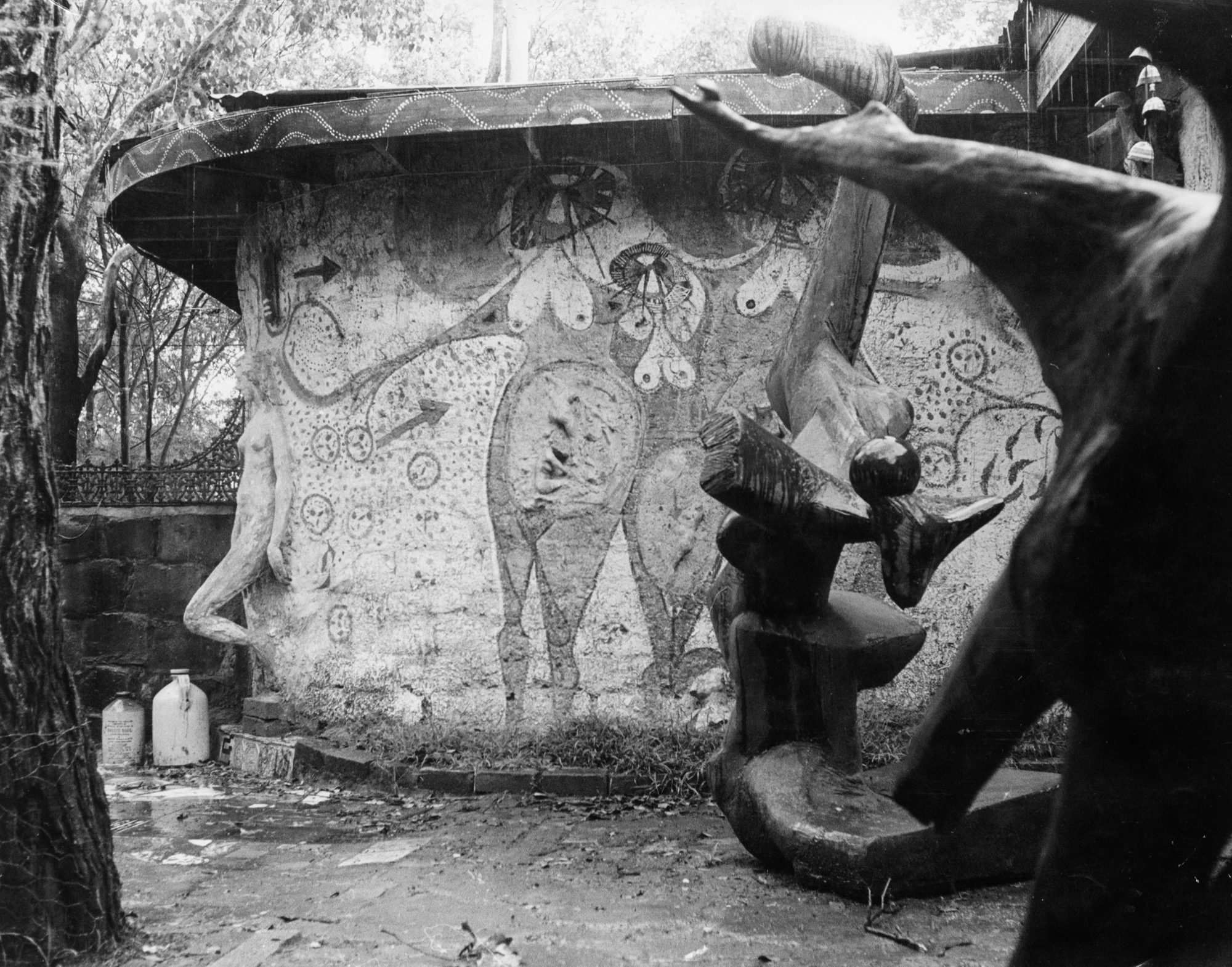
Although Pugh built “visually … as a painter,” and adorned much of the exterior walls of his home with murals, decoration, sculpted forms, and embedded animal skeletons (fig. 1), the material construction of his abode reflected something of Knox’s concept of indivisibility.24 Pugh frequently emphasised its organic composition, stating in several articles that his house “grew out of the ground”; there was no architectural plan or building restrictions, and what began as a one-room wattle-and-daub hut in 1951 would contract and expand as required to reach 85 squares upon Pugh’s death in 1990.25 On occasion, trees and protrusions of quartz impeded the path of construction and became absorbed into the floor plan. The display of death completed this expression of indivisibility with the land. Dehydrated animal carcasses hung on the interior walls to complement the exterior skeletal remains. For Pugh, life and death were not “divisible,” death was “necessary for a change of form.”26 Arguably, Pugh’s home can be construed as a symbolic ecosystem: “rising up and out of the hill on which it stands,” returning nutrients to the soil, and enveloping Pugh in place as part of the landscape.27
The Leon Saper house (1967) stood approximately six hundred metres south of Pugh’s home at Dunmoochin. Designed by the modernist architect Morrice Shaw, the house epitomised Knox’s principle of “indivisibility.” Built using a combination of pisé (rammed earth), mud brick, and reinforced cob, the design of the house was shaped to fit the topography of the site. The original free-form plan was broadly oval, comprising a central space under a vaulted umbrella-like ceiling with radiating rafters encircled by three shell- or wave-like cells that contained the cooking, sleeping, and living areas. The building was embedded into the landscape. The wood shingle roof descended on one side to almost touch the high slope of the irregular site. Boulders were intentionally incorporated into the floor plan to minimise disturbance to the land.28 Knox praised the design, noting how the “spirit of the land” was “repeated inside.”29 Bench seating was built in and moulded out of mud to fit the curves of the walls. The brick floor was laid in a series of winding waves to create a sense of movement throughout the space. For Knox, the interior exuded “an underwater character like coral cavities.”30
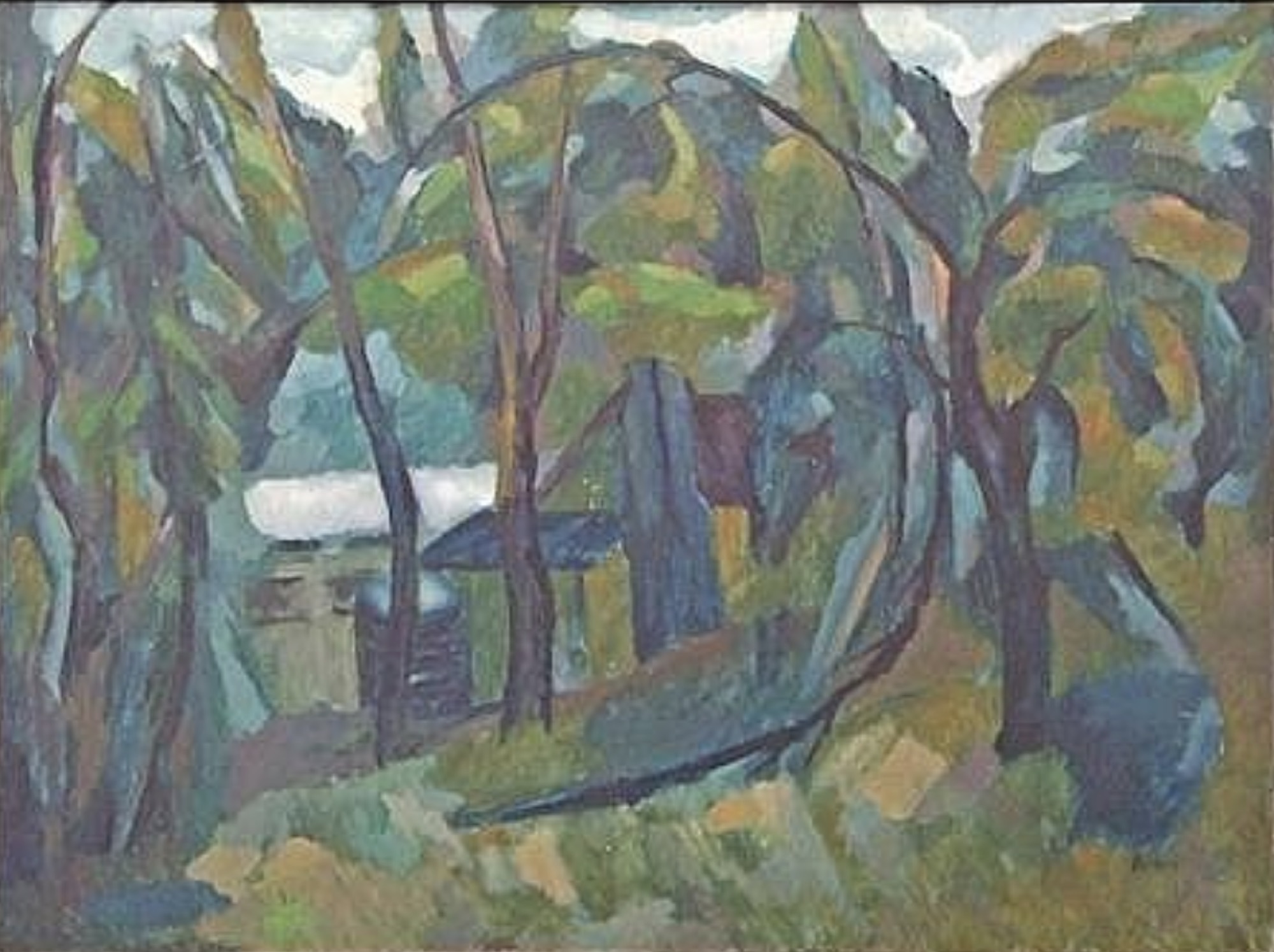
While the designs of other homes at Dunmoochin were more geometric and traditional, they still reflected a sense of the organic being constructed in stages over time. The organic evolution of the home to suit the changing needs of the owner is a notable characteristic of mud brick building in the wider Eltham region.31 The degree to which the painter Frank Werther, who resided at Dunmoochin from 1954 to 1970, perceived his home as being indivisible with the land is conveyed in his painting Bush Homestead, 1965 (fig. 2). The structure and landscape are painted in the same colour and tonal palette. There is little sense of depth, with the house sitting almost on the same horizontal plane as the trees. It is only the central placement and the encircling black line that draws our attention to the home.
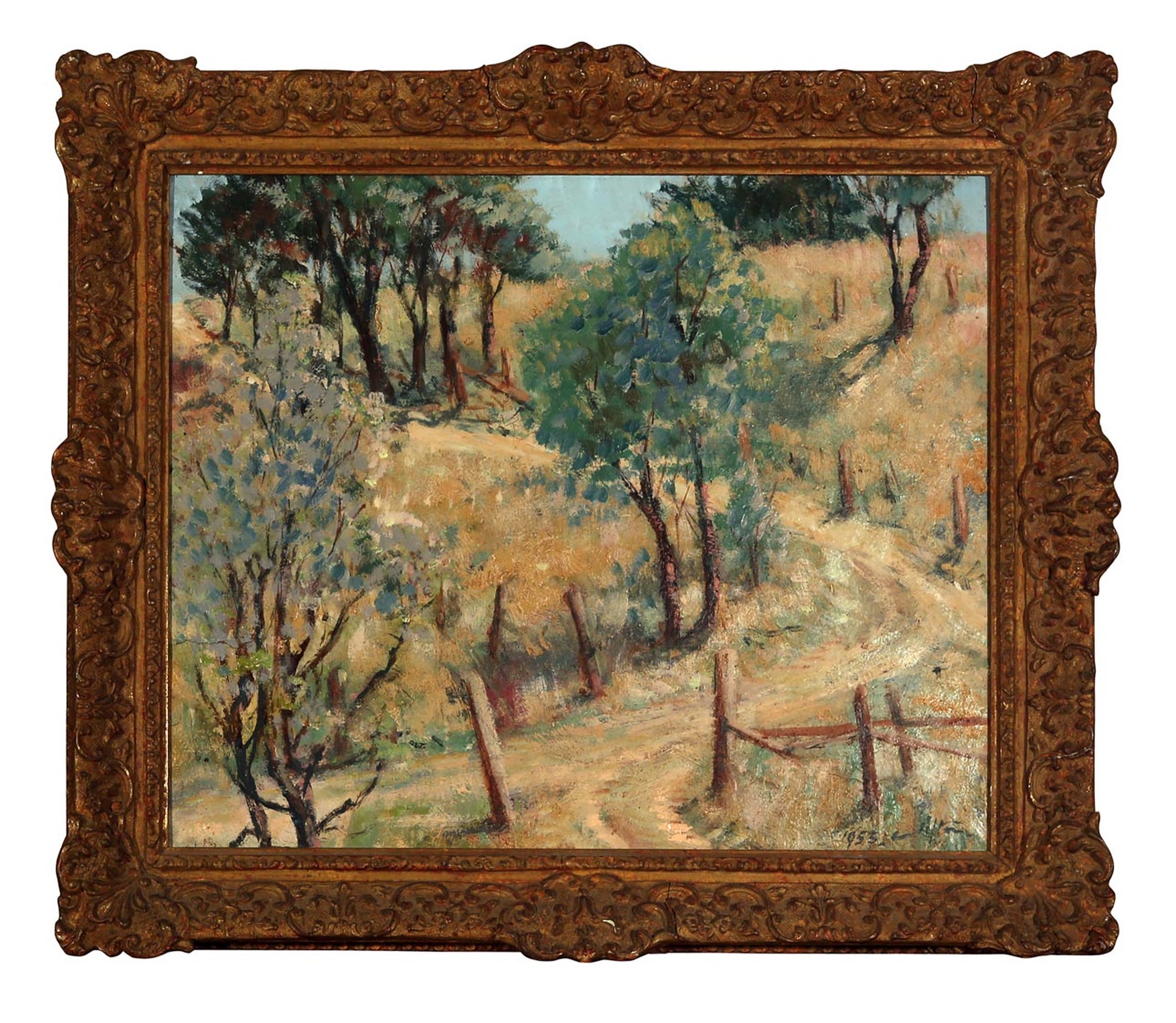
Living inside the landscape enabled Pugh to develop an environmental aesthetic in art.32 That first year at Dunmoochin, in 1951–52, Pugh did not paint at all; he simply wandered and sat amongst the bush, observing the seasonal variations of flora and fauna.33 Nevertheless, his earliest landscapes at Dunmoochin, such as Untitled (Road to Dunmoochin) (1953, fig. 3), comprised mainly prospect views with an emphasis on perspectival space.
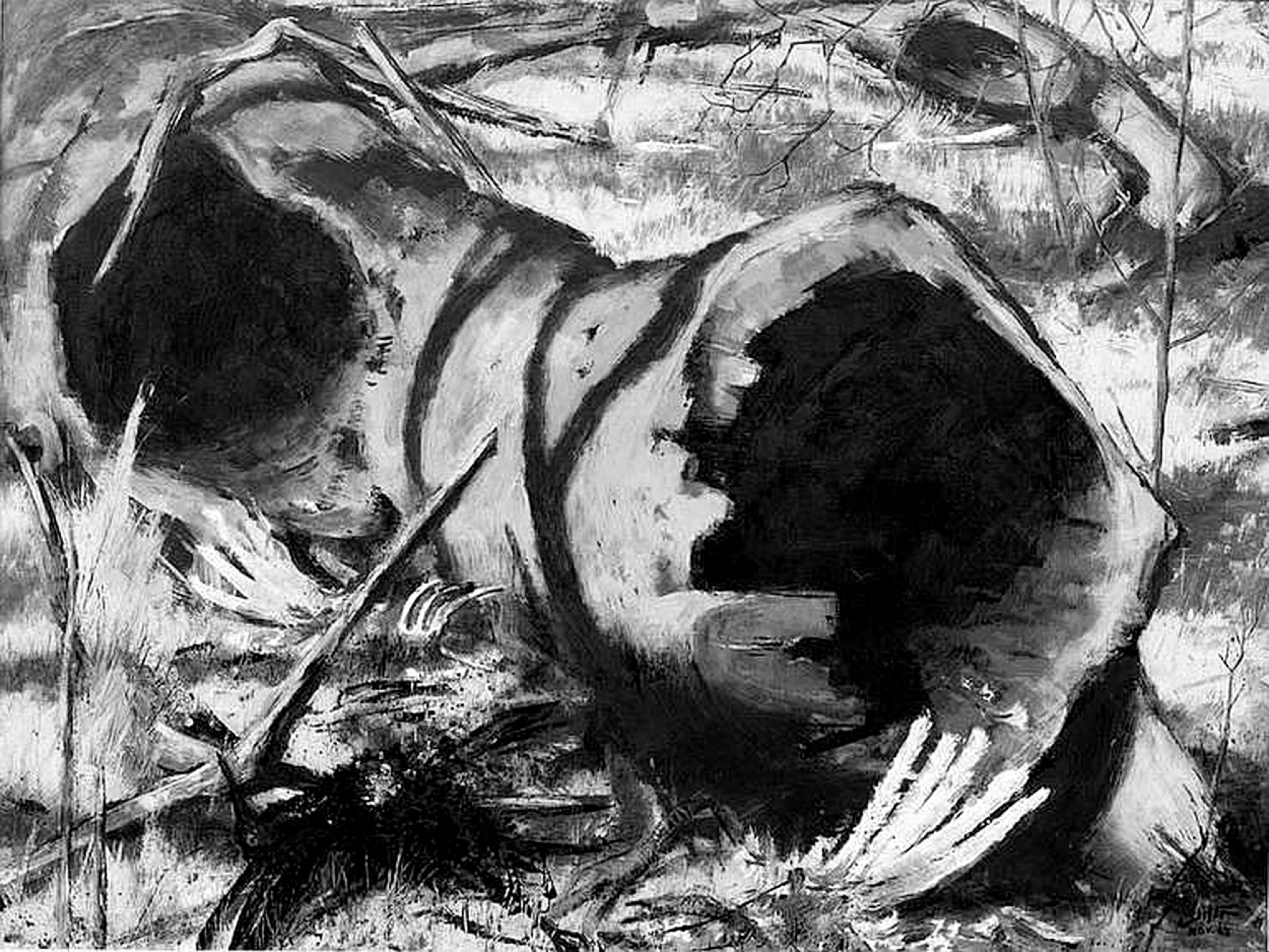
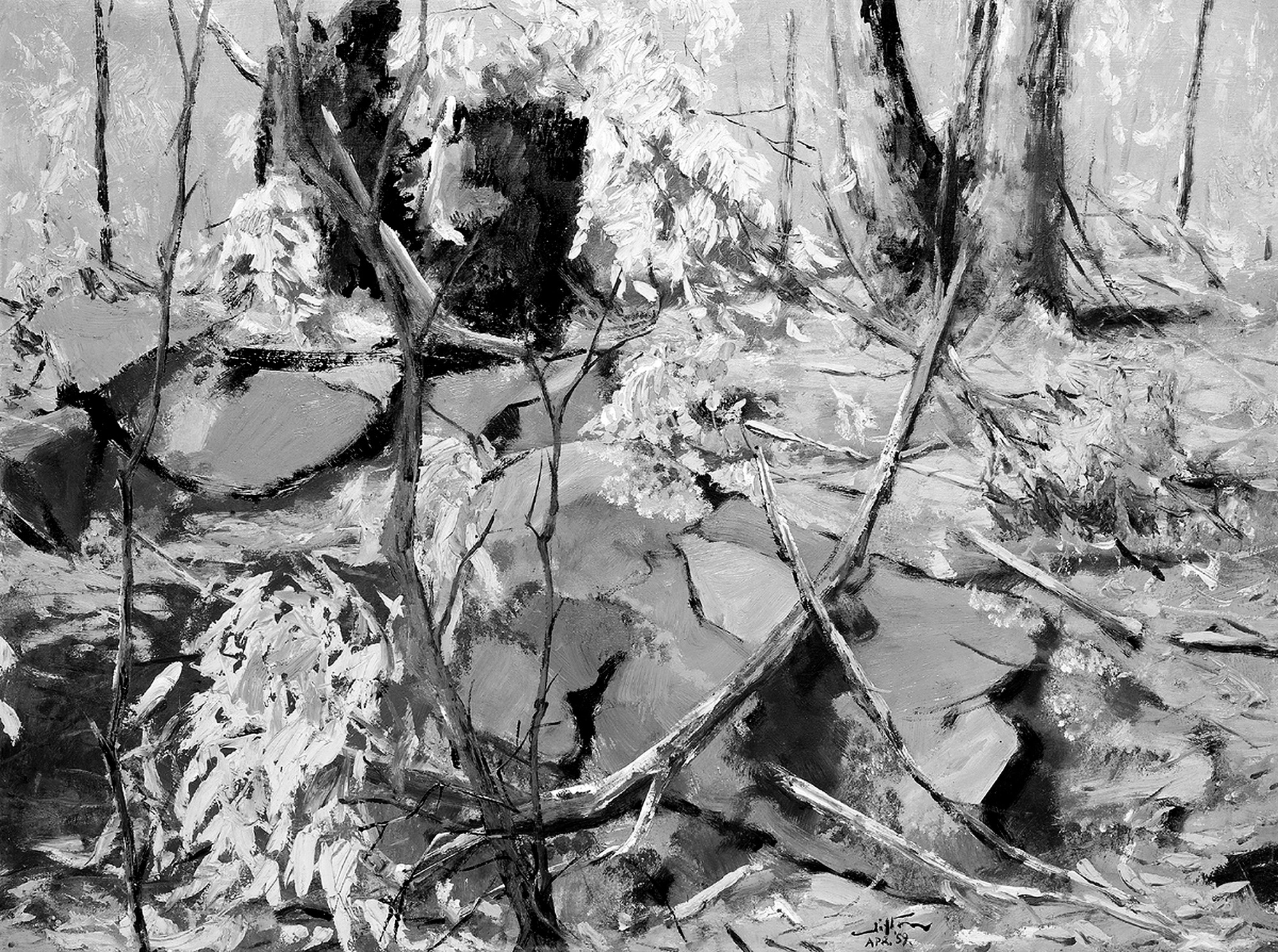
But from 1955 onward his visual orientation towards nature in art shifted dramatically. Pugh began to bring the viewer in close to engage with nature as habitat and ecological process in works such as The Fox Lair (1960, fig. 4) and Rejuvenation after Fire (1959, fig. 5). Notably, in these works, Pugh grounds the viewer low in the landscape, creating a worm’s-eye view. The viewer’s attention is drawn up the picture plane and over elements of the scene rather than through perspectival space. Pugh excludes all references to the horizon or sky, immersing the viewer within the landscape.
In later works, nature becomes more abstract and obtrusive. In Dunmoochin Landscape (1970) (fig. 6), for example, the close stand of trees and the intense patterning of its foliage and undergrowth forms a vertical barrier preventing the viewer from imaginatively entering the scene. There is no prospect view or perspectival space.
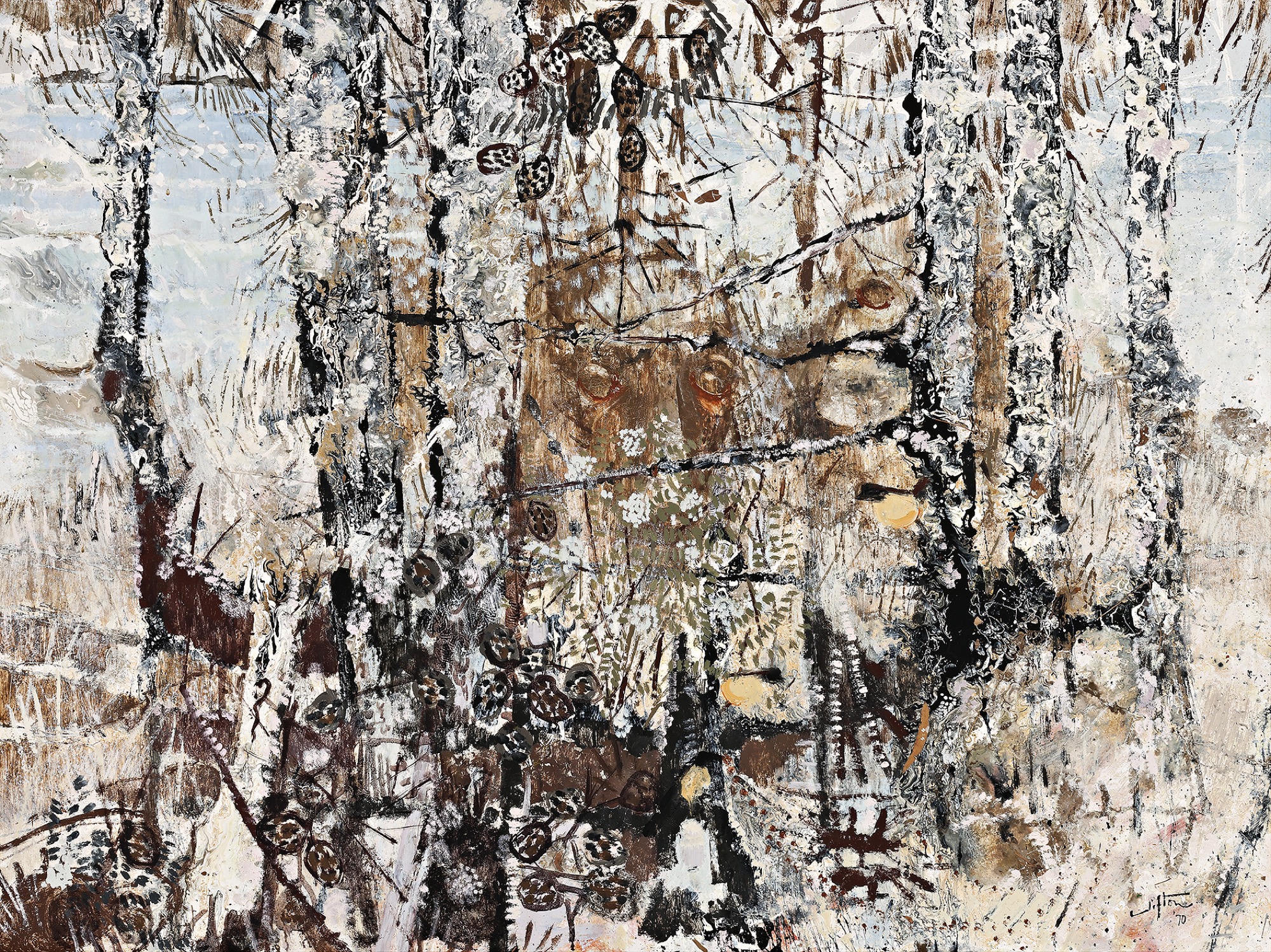
These compositions can be classified as a type of Australian sous-bois, meaning undergrowth or forest interior, a distinct pictorial type that developed from the Barbizon School painters’ experience of the forest of Fontainebleau, France, in the mid-nineteenth century.34 The sous-bois genre is often characterised by spatial ambiguity either in the form of an “abundance of open space” or “an anarchy of undergrowth,” and there is typically “one kind of element, one dominant colour, one kind of brushwork and sensation.”35 Théodore Rousseau, Jean-Baptiste-Camille Corot, and Narcisse-Virgilio Diaz de la Peña were known for their paintings capturing the varied atmospheric light of the forest interior, but the most direct stylistic influence on Pugh was likely Vincent van Gogh.36 Van Gogh painted several sous-bois compositions in Paris, Saint-Rémy-de-Provence, and Auvers-sur-Oise from 1887 through 1890. The composition of Undergrowth (1889) is orientated down towards the ground, attending to the arrangement of a singular type of vegetation and the ivy climbing up the trunks of trees, with only a sliver of the horizon at the top.37 Green dominates the image in a limited tonal range with just a smattering of yellowish-green and blue vertical brushstrokes to indicate the dappled light and shade filtering through the canopy. Van Gogh painted several variations of this corner of the garden at the asylum of Saint-Rémy, moving much closer to the ground in works like Clumps of Grass (1889) and Garden with Butterflies (1890) to observe the directional flow of the foliage.38 By comparison, his paintings of forest interiors display a slightly elevated and distanced perspective where the dense foliage of the canopy reveals only glimpses of the sky.
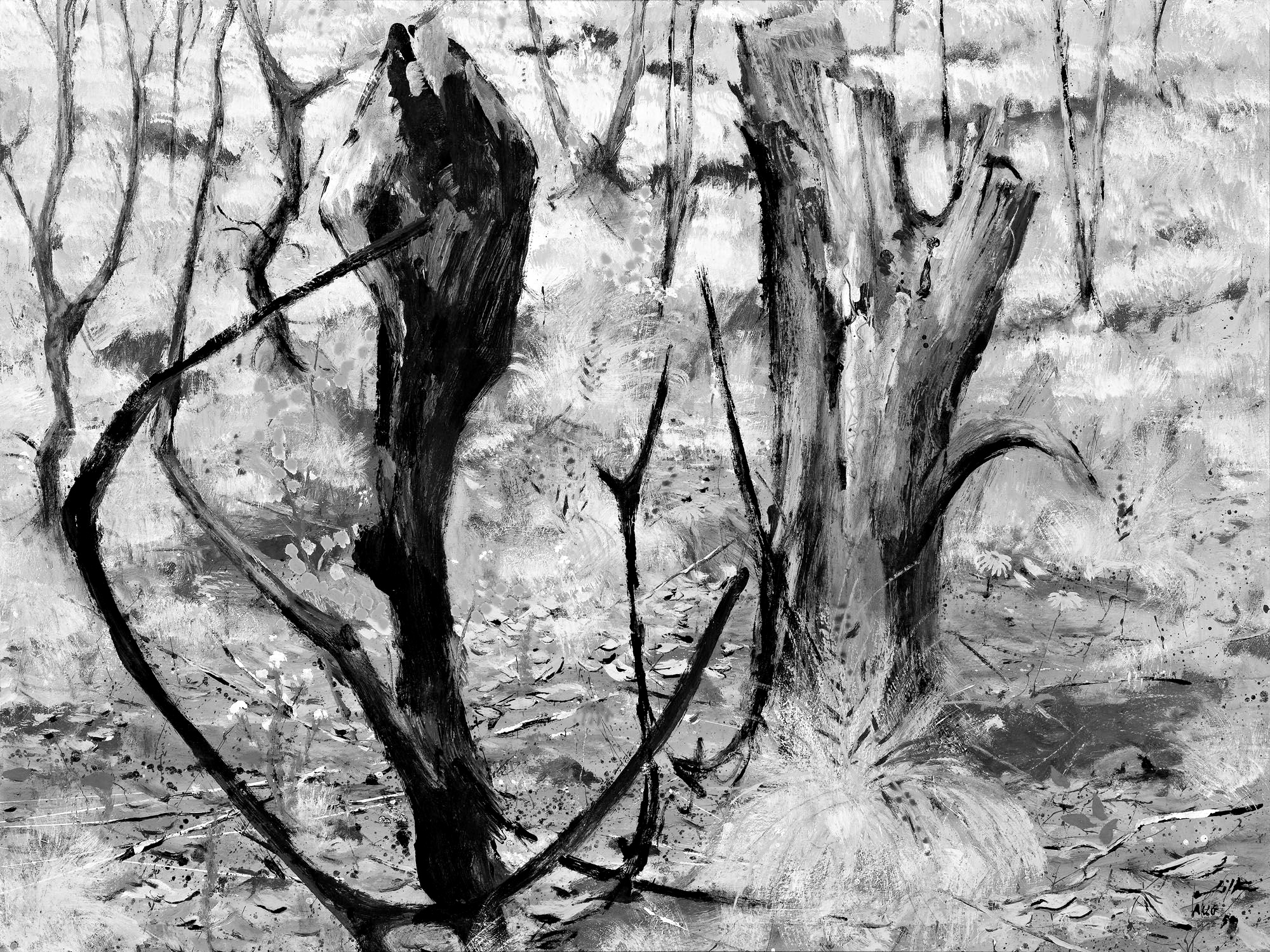
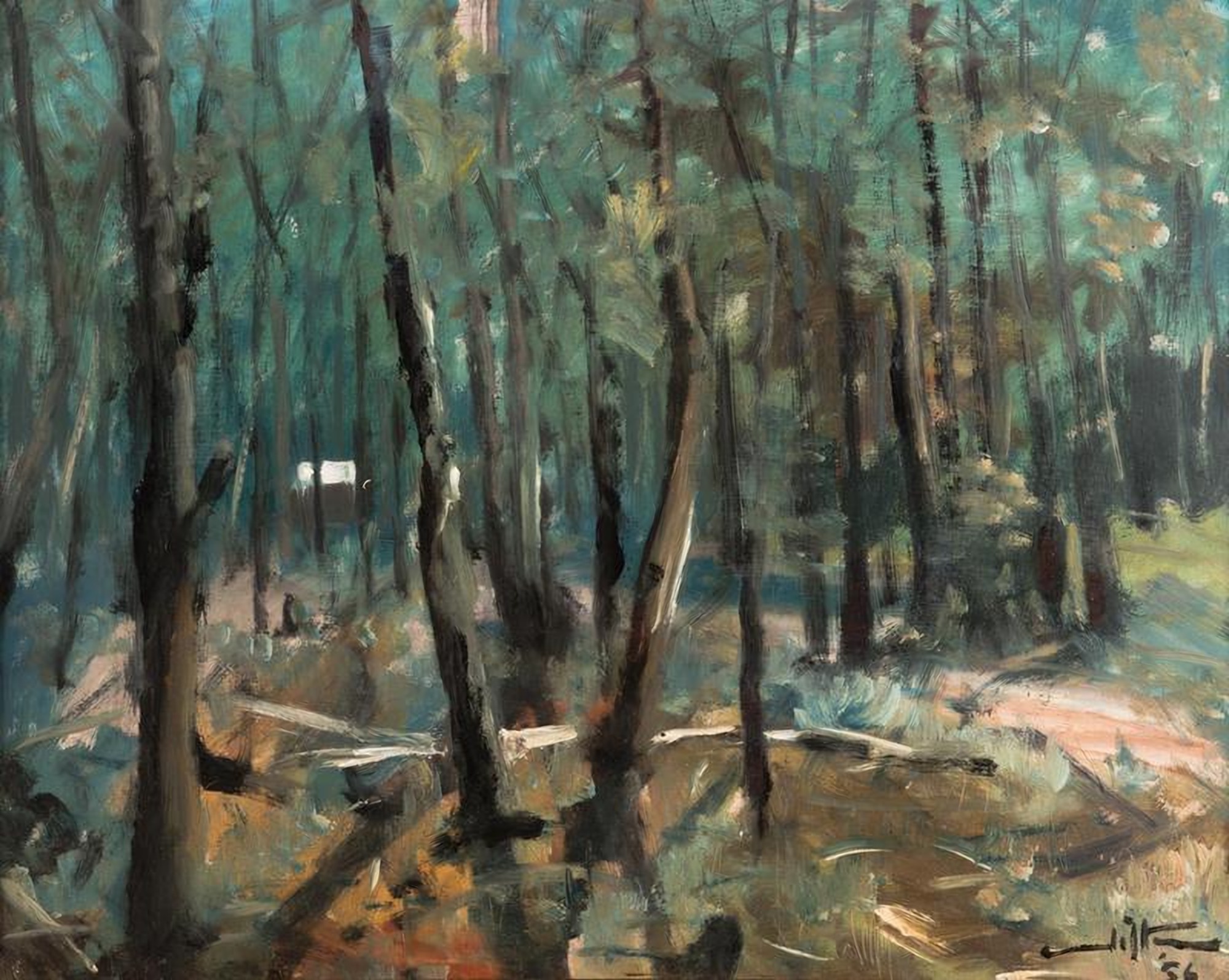
Several artworks by Pugh correspond to those of van Gogh in their composition and subject. Irises (1956) presents the most patent connection.39 The flowers, outlined in black, span the full height of the picture plane, though the dry heat of the bush setting has browned the delicate petals of this non-native variety. While Sea of Grass (1959) (fig. 7) is more varied in its colour palette, providing a subtle contrast between the blackened bark of the tree stumps and the bleached colour of the grey-green grass and rusty soil, its composition demonstrates a similar orientation and preoccupation with the detailed pattern of the bush scrub. Likewise, Dunmoochin, Cottles Bridge (1956) (fig. 8) presents a broader, more distanced perspective of the darkened interior of the densely treed bush landscape. According to Nina Lübbren, the sous-bois composition was an attempt to capture the experience of immersion—an idea Pugh conveys through the subtle suggestion of a dwelling in the distance.
Many artists who visited or resided temporarily at Dunmoochin and painted alongside Pugh in his “open studio” also adopted aspects of the sous-bois in the artworks they produced to convey their sense of immersion in the landscape. John Olsen lived at Dunmoochin for two years, from 1969 to 1971. His arrival followed a period of crisis where he felt “increasingly disillusioned” with the art world and concerned that “the work he had been doing in his thirties was coming to an end.”40 Before this period Olsen had not spent much time working in the landscape, and a marked shift occurred in his paintings of the Dunmoochin region. Deborah Hart noted that his spatial orientation became more vertical with a high horizon line and that his calligraphic annotations of the vegetation ran up the canvas rather than across as in previous works.41 While this new orientation and direction conveyed a sense of being grounded in the landscape, a spatial ambiguity occurred in works like Pied Beauty (1969), where Olsen presented both a cartographic representation of the terrain as seen from above and a microscopic view of the undergrowth of soil, leaf litter, shrubs, and grasses.42 Hart called this effect “Olsen’s ‘all at once world’ in which the near and far, large and small occupy the same space.”43 Only the roughly oval shape of Pugh’s black dam in the lower centre indicates the dominant overview.
Fred Williams exhibits a similar vertical composition and spatial ambiguity in the macro-micro perspective of the land in Waterpond, Cottles Bridge (1976).44 There is no horizon or sky; Williams takes an aerial perspective, focusing solely on the entanglement of shrubs and trees dotted across the terrain and the resulting play of light and shade. Yet the vegetation is abundant rather than his typically minimalist approach. Although Williams stated that he did not particularly “love the bush,” he presents a traditional perspective on the forest interior in Wattles at Dunmoochin (1977).45 The midline horizon and placement of trees suggests perspectival space; Williams peers into the bush, conveying an appreciation of its beauty through a delicate array of purples, blues, and greens, accented with meandering touches of yellow and white.
For Gary Catalano, Olsen’s “passionate nearness” to nature and “sense of bodily identification with the land” epitomised an environmental aesthetic in art.46 Olsen anthropomorphised the topography in Two Eyes of the Dam (1970) to convey his perception of being watched; it rears up the vertical plane like an amoebic figure absorbing the two dams.47 This composition is unique in that Olsen orientated the pictorial space “so that the landscape” was “all around” him.48 A striding figure appears in the upper centre, reflecting Olsen’s exploration of the land and activity of plein-air painting.
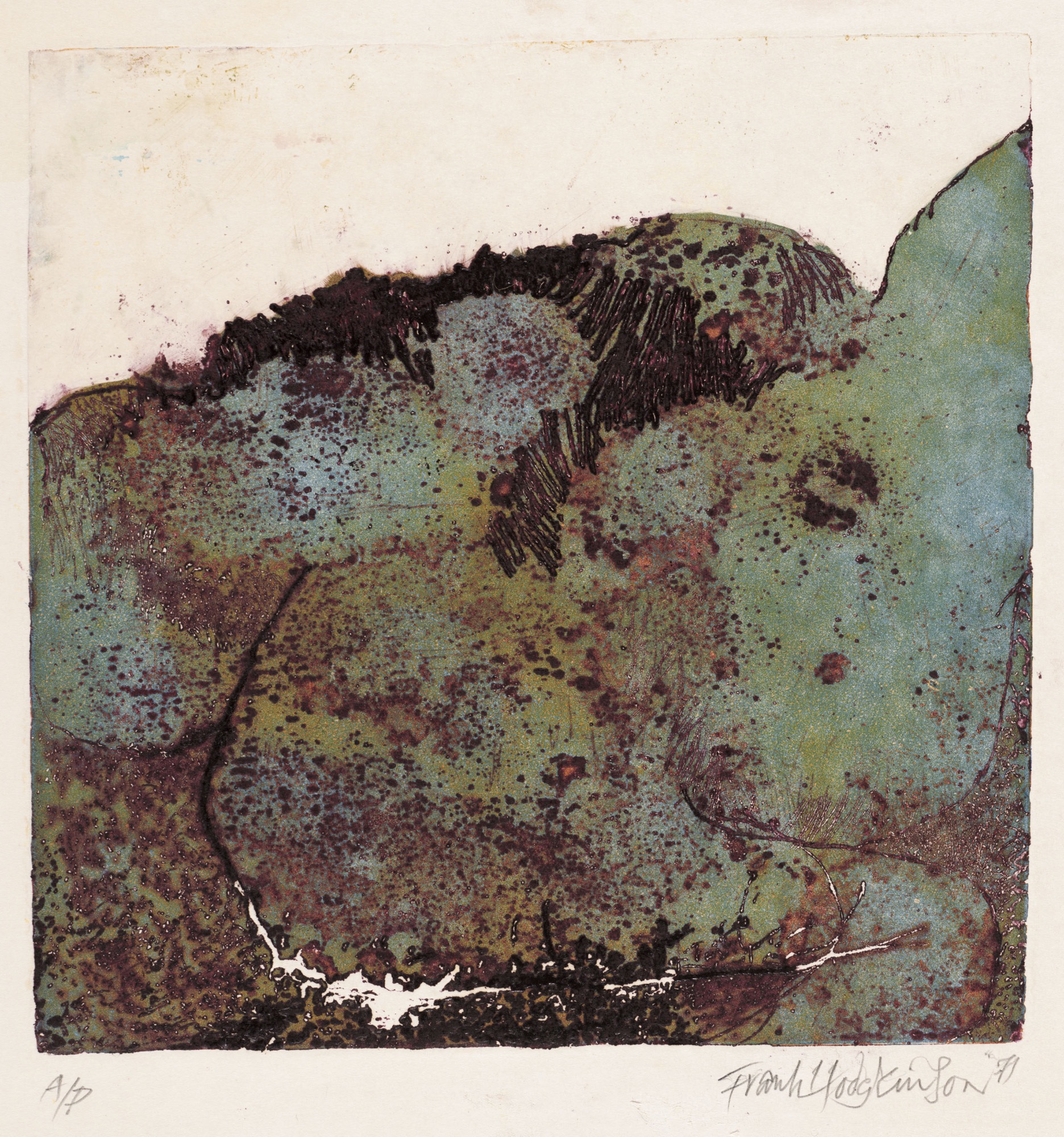
Frank Hodgkinson, who moved to Dunmoochin in early 1971 and painted alongside Pugh and Olsen in the bush, reflects Olsen’s mantra—“I am in the landscape and the landscape is in me”—in the titles of two print series he produced at Dunmoochin: Inside the Landscape and Landscape Inside (1971).49 These works are similarly anthropomorphic where, as Roger Butler observed, the “time-worn lines” of the terrain become a “celebration of female and landscape forms” (fig. 9).50
From 1960 onward, potters formed a large part of the Dunmoochin community; their art was derived from the earth itself and reflected aspects of the landscape in applied decorative motifs with clay sourced locally at Dunmoochin and later in nearby Kangaroo Ground.51 Plans to establish a pottery studio at Dunmoochin to “add to the character of the community” were discussed as early as 1954.52 Pugh was great friends with Arthur Boyd and had visited Merric Boyd’s pottery at Open Country several times. He was intimately familiar with the production of AMB Pottery, established by Boyd, John Perceval, and Peter Herbst in 1944, where Dunmoochin residents John Howley and Neil Douglas worked as decorators.53 Although the formal agreement excluded potters from the cooperative, with land ownership restricted to painters, Pugh agreed to sell an allotment to Peter and Helen Laycock on the condition that they establish a pottery studio.54 In 1960 the Laycocks moved into a wattle-and-daub shack, and Helen built an attached studio and kiln using fire bricks from Open Country.55
The domestic ware they produced promoted a natural earth-toned aesthetic influenced by the writing of the British ceramicist Bernard Leach. The popularity of his publication The Potter’s Book (1940) during the 1950s instigated a stoneware revolution that ended the production of earthenware, which had dominated Australian ceramics up until the 1940s.56 Drawing from Japanese, Korean, and Chinese ceramic traditions, Leach promoted simple, functional forms made from local clays and pigments and decorated with natural glazes to evoke a connection to their environment.57 He favoured minimalistic decoration—a combination of animal and plant motifs painted in bold, fluid brushwork or scratched in sgraffito—and advocated the wood-fired kiln, where the lick of flame could produce unique and unexpected surface effects.58 The Potter’s Book provided an “invaluable technical aid” where there was none previously available, and the use of Australian clays and minerals for bodies, colour, and glaze was uncommon due to its experimental and unpredictable nature.59 Leach’s publication provided formulations for clay bodies to achieve specific textures, recipes for slips and glazes, and information on building and firing kilns; this saw smooth earthenware and vibrant commercial glazes abandoned in favour of roughly textured stoneware decorated with natural glazes derived from wood ashes, iron oxide, and ochre to produce a range of earthy tones from pale green, red, and deep brown to black.
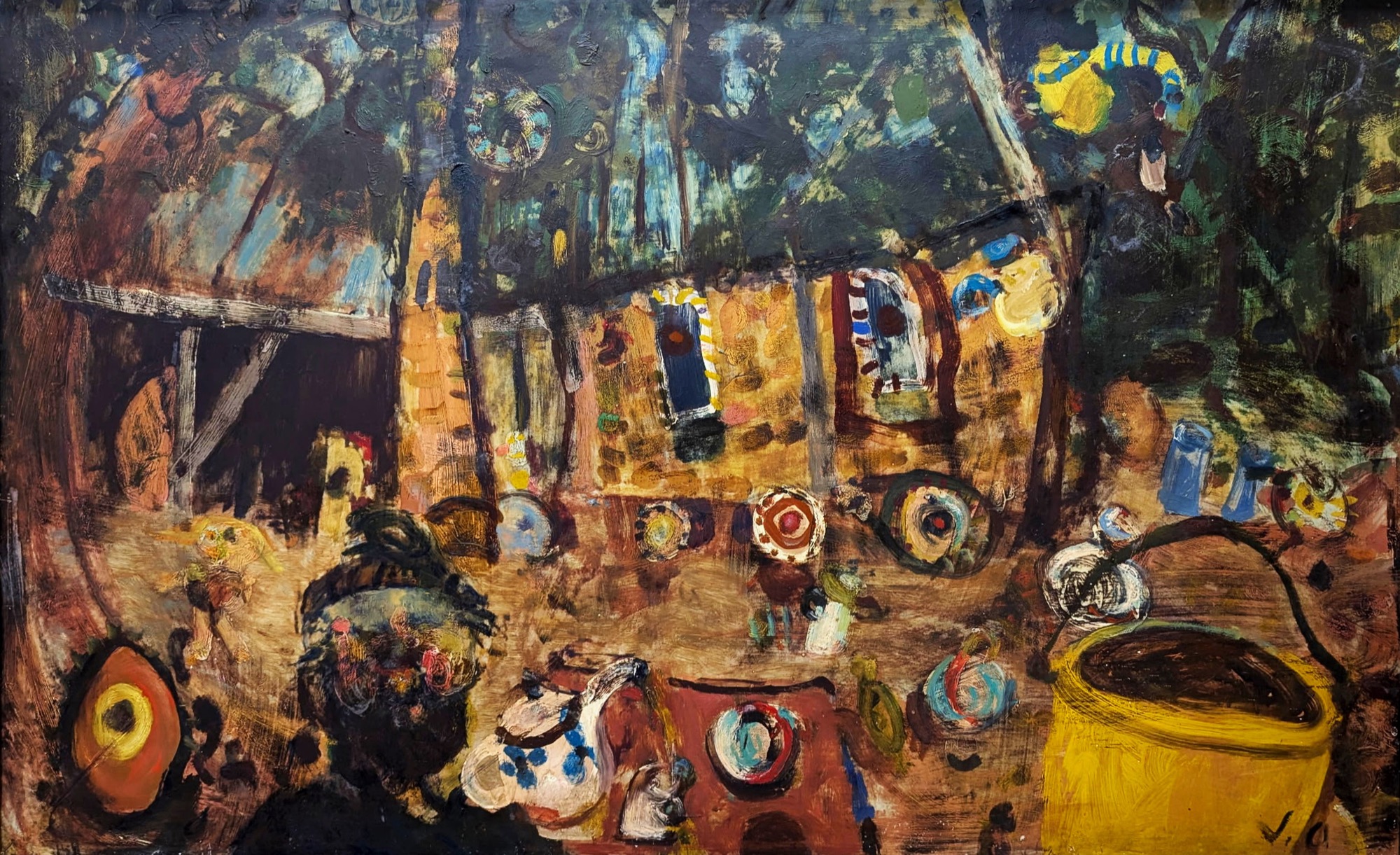
Olsen felt a great “affinity with these earth-bound people” whose “piles of clay and … mysterious glazes … only revealed their beauty after firing.”60 He collaborated with the New Zealand potter Robert Mair, who resided at Dunmoochin from 1964 to 1969, decorating a variety of pottery forms, including the Terry Whelan Suite, a 200-piece dinner service. Olsen’s appreciation of their craft is imparted in his painting of the Peter Laycock Pottery (1969) (fig. 10), which, despite its figurative subject, presents as a sous-bois. There is a spatial ambiguity to the composition, where the perspective is both frontal and aerial, with the circular forms of several ceramic plates dotting the earth, trees, and sky in an all-over pattern. But it is foremost a bush interior that communicates the sense of being earth-bound; the tonal palette is uniform across the lower half of the composition, linking the human, the house, and the earth together. The figure of Laycock takes on elements of the landscape; his facial features are largely absent, and his identity is only distinguishable by his distinctive beard and cap. Sue Ford echoed this notion that Laycock was embedded in place in her pictorial essay Fire and Clay; she wrote, “Peter belongs to his environment, and it is natural that the textures and colours of the bush are reflected in his pots.”61
Dunmoochin stands apart as an artistic community. Its residents took inspiration from the bush, incorporating the texture, colours, and natural features of the landscape into their art and architecture. They lived inside the landscape; their handmade homes embodied a “concept of life”—an outward expression of the community’s thoughts, feelings, and aspirations about living harmoniously in the natural environment. Their art looked down to the earth and into the bush, creating a new perspective on the landscape in Australian art. This essay presents a holistic account of Dunmoochin’s contributions to Australian art and architecture, but there is more work to be done. Dunmoochin cannot be ignored as it forms a vital part of the history of Melbourne’s bohemian culture.
Acknowledgement
I sincerely thank Shane Pugh and the Dunmoochin Foundation for their support of my research and permission to publish images of artworks. I also thank Dr Jane Eckett for her editorial advice and the two anonymous reviewers for their helpful comments on this article.
-
Anon., “Freedom Comes to an Artist,” The Herald, Melbourne, 20 March 1958, 12. ↩
-
John Hetherington, “Clifton Pugh: An Ideal in Five Acres of Bush,” The Age, Melbourne, 9 December 1961, 18; Anon., “Building a Home with No Cash: Just Mud, Junk and Ideas,” Pix, 23 September 1961, 17; Helen Homewood, “In Search of a Haven,” Sunday Observer, 28 December 1969, 12. ↩
-
Traudi Allen, Clifton Pugh, Patterns of a Lifetime: A Biography (Nelson, 1981); Sally Morrison, After Fire: A Biography of Clifton Pugh (Hardie Grant Books, 2009); Deborah Hart, John Olsen (Craftsman House, 1991); David Hurlston and Deborah Edwards, eds., John Olsen: The You Beaut Country (National Gallery of Victoria, 2016); Patrick McCaughey, Fred Williams (Bay Books, 1980); Judith Pugh, Unstill Life: Art, Politics and Living with Clifton Pugh (Allen and Unwin, 2008); Sue Ford, Fire and Clay: The Craft of Helen and Peter Laycock (Heinemann Educational Australia, 1970); Victoria Hammond, ed., Australian Ceramics (Shepparton Art Gallery, 1987); Alistair Knox, Living in the Environment (Mullaya Publications, 1975); Alistair Knox, We Are What We Stand On: A Personal History of the Eltham Community (Adobe Press, 1980); Ted Howard, Mud and Man: A History of Earth Buildings in Australasia (Earthbuild Publications, 1992). ↩
-
Rex Butler and A.D.S. Donaldson, “Australia in the World’s Art Colonies, the World in Australia’s Art Colonies,” Index Journal, no. 5 (2022), https://www.index-journal.org/issues/secession/australia-in-the-world-s-art-colonies ↩
-
Morrison, After Fire, 97, 128. ↩
-
Morrison, 127; Heide Museum of Modern Art, “History of Heide Gardens,” accessed 29 April 2025, https://www.heide.com.au/landscape/article_landscape_garden-history/ ↩
-
Albert Tucker, interviewed by Barbara Blackman, St Kilda, 14 July 1988, Oral History Section, National Library of Australia, TRC 2298; Sue Cramer and Linda Michael, Albert Tucker Photographs: Artists and Their Milieu (Heide Museum of Modern Art, 2012), accessed 29 April 2025, https://wp.heide.com.au/app/uploads/2022/09/882.2012_Artists-and-their-Milieu_v02.pdf ↩
-
Matcham Skipper quoted in Morrison, After Fire, 91–93, 95; Allen, Clifton Pugh, 86, 159. ↩
-
Allen, Clifton Pugh, 43, 86, 159–60, 168; Christopher Heathcote, “Landscape as Nature: The Clifton Pugh Collection,” in Clifton Pugh and Friends at Dunmoochin, ed. Rhonda Noble (La Trobe University, 1993), 5–6; Christopher Heathcote, A Quiet Revolution: The Rise of Australian Art 1946–1968 (Text Publishing, 1995), 86. ↩
-
Ari J. Blatt, “Into the Woods,” Contemporary French and Francophone Studies 25, no. 2 (2021): 172, https://doi.org/10.1080/17409292.2021.1876449 ↩
-
Allen Carlson, “Appreciation and the Natural Environment,” Journal of Aesthetics and Art Criticism 37, no. 3 (Spring 1979): 269–72, https://www.jstor.org/stable/430781; Lawrence Buell, The Environmental Imagination: Thoreau, Nature Writing, and the Formation of American Culture (Belknap Press, 1995), 7–8. ↩
-
Allen, Clifton Pugh, 86. ↩
-
Clifton Pugh quoted in anon., “Men, Women, Art and Kids: Queer Artists’ Colony Goes Bush,” Melbourne Truth, 5 July 1958, 2. ↩
-
Allen, Clifton Pugh, 160, 168. Morrison stated that Pugh acquired fifteen acres for seventy pounds sterling, which equates to less than five pounds sterling per acre. ↩
-
Allen, 169; Enrica Longo, “Artist Gives the People a Living Tapestry,” The Age, Melbourne, 18 November 1989, 1, cited in Morrison, After Fire, 513. ↩
-
Allen, 169. ↩
-
Knox, We Are What We Stand On, 114; Knox, Living in the Environment, 24–27. See also Alan Marshall, “Earth Building in Eltham,” in Pioneers & Painters: One Hundred Years of Eltham and Its Shire (Thomas Nelson, 1971), 96–100. ↩
-
Knox, Living in the Environment, 30. ↩
-
Knox, 27. ↩
-
Knox, 30; Marshall, Pioneers & Painters, 110. ↩
-
Knox, vii. ↩
-
Knox, vii. ↩
-
Knox, Living in the Environment, 22 and 129; Knox, We Are What We Stand On, 35. ↩
-
Anon., “30 Years of Creation: An Interview with Clifton Pugh,” The Owner Builder Magazine, no. 11 (1984): 9. ↩
-
Anon., “Freedom Comes to an Artist,” 2; Anon., “30 Years of Creation,” 9. ↩
-
Pugh quoted in Brian Adams, “Spectrum Clifton Pugh on Commitment” (Australian Broadcasting Corporation National Television, 1966), transcript, 1–2, in Papers of Clifton Pugh, 1943–1991, National Library of Australia, MS 9606, box 17. ↩
-
Clifton Pugh, “Mud House Mural,” Architecture and Arts, no. 26 (October 1955): 55, http://nla.gov.au/nla.obj-3140586251 ↩
-
Allen, Clifton Pugh, 174. ↩
-
Knox, We Are What We Stand On, 124. ↩
-
Knox, 126. ↩
-
Context (GML Heritage), Nillumbik Shire Stage A Places—Key Findings, prepared for Nillumbik Shire Council, 7 June 2021, 104 and 132, accessed 6 August 2026, https://www.nillumbik.vic.gov.au/Develop/Planning-for-Nillumbiks-future/Heritage-planning#section-2 ↩
-
Debbie Robinson, “Imaging a Biocentric Australia: Aboriginalism and Environmentalism in the Art and Life of Clifton Pugh (1924–90)” (PhD diss., University of Melbourne, 2022), 65–89, https://hdl.handle.net/11343/325705 ↩
-
John Hetherington, “Clifton Pugh: An Ideal in Five Acres of Bush,” The Age, Melbourne, 9 December 1961, 18. ↩
-
Nina Lübbren, Rural Artists’ Colonies in Europe, 1870–1910 (Manchester University Press, 2001), 85. ↩
-
Lübbren, Rural Artists’ Colonies, 14. ↩
-
As a student, Pugh was interested in van Gogh and had seen reproductions in books. Clifton Pugh, interviewed by Barbara Blackman, Carlton and Dunmoochin, 11 and 18 May 1983. Oral History Section, National Library of Australia, TRC 1417, https://nla.gov.au/nla.obj-215316314/listen, session 2, 00:29:11, and session 8, 00:16:03. ↩
-
Vincent van Gogh, Undergrowth, Saint-Rémy-de-Provence, July 1889, oil on canvas, 73 × 92.3 cm, Van Gogh Museum, Amsterdam (Vincent van Gogh Foundation), https://www.vangoghmuseum.nl/en/collection/s0051V1962 ↩
-
Vincent van Gogh, Clumps of Grass, Arles, April 1889, oil on canvas, 45.1 × 48.8 cm, Pola Museum of Art, Hakone, https://www.polamuseum.or.jp/en/collection/997-0008/ and Garden with Butterflies, Saint-Rémy-de-Provence, Spring 1890, oil on canvas, 54.8 × 45.7 cm, Van Gogh Museum, Amsterdam, https://www.vangoghmuseum.nl/en/collection/s0110V1962 ↩
-
Clifton Pugh, Irises, 1956, oil on board, 69.5 × 76.5 cm, private collection, sold through Menzies Art Brands, 25 June 2015, lot 190, https://www.menziesartbrands.com/items/15611 ↩
-
Hart, John Olsen, 95. ↩
-
Hart, 98. ↩
-
John Olsen, Pied Beauty, 1969, oil on composition board, 119.8 × 132.0 cm, Art Gallery of South Australia, accession no. 6911P39, https://www.agsa.sa.gov.au/collection-publications/collection/works/pied-beauty/70137/ ↩
-
Deborah Hart, “Poetry in the You Beaut Country of Mind and Place,” in John Olsen: The You Beaut Country, ed. David Hurlston and Deborah Edwards, 54. ↩
-
Fred Williams, Waterpond, Cottles Bridge, 21 September 1976, oil on canvas, 106.5 × 101.5 cm, private collection, sold through Menzies Art Brands, 30 November 2017, lot 43, https://www.menziesartbrands.com/items/17115 ↩
-
Fred Williams quoted in Ian Turner, “Artists’ Camp Erith Island: March 1974,” Overland, no. 60 (Autumn 1975): 50, https://overland.org.au/ol_issue/issue-60/ Fred Williams, Wattles at Dunmoochin, 1977, oil on canvas, 106 × 101 cm, private collection, sold through Sotheby’s, 7 May 2007, lot 96, https://www.sothebys.com/en/auctions/ecatalogue/2007/important-australian-art-including-works-from-the-qantas-collection-au0711/lot.96.html ↩
-
Gary Catalano, An Intimate Australia: The Landscape and Recent Australian Art (Hale & Iremonger, 1985), 96. ↩
-
John Olsen, Two Eyes of the Dam, 1970, charcoal, grey wash, watercolour, 54.0 × 69.0 cm, Art Gallery of New South Wales, 241.1991, gift of Stuart Purves, 1991, https://www.artgallery.nsw.gov.au/collection/works/241.1991/ ↩
-
Hart, John Olsen, 102. ↩
-
Hart, 95. ↩
-
Roger Butler, “Frank Hodgkinson,” in Roger Butler and Jane Gillespie, Landscapes in Sets and Series: Australian Prints 1960s–1990s (National Gallery of Australia, 1999), 7, https://digital.nga.gov.au/archive/landscapes/hodg.htm ↩
-
Ford, Fire and Clay, unpaginated. ↩
-
Knox, We Are What We Stand On, 122. ↩
-
Allen, Clifton Pugh, 169. ↩
-
Alma Shanahan, interviewed by Laura Russo, Cottles Bridge, 10 July 2010. Laura Russo, “Orchids and Artists: The Dunmoochin Community,” Honours diss., La Trobe University, 2010, 16; Morrison, After Fire, 187. While no formal reason was recorded for this exclusion, it is possible that the founding members, having all trained together at the National Gallery School, considered only painting, drawing, and sculpture to be fine art. Pottery was classified as an applied art and taught at technical colleges like the Melbourne Mechanics’ Institute (now RMIT). Traudi Allen independently observed that the founders’ shared training lent the Dunmoochin community a “distinctly artistic flavour.” Allen, Clifton Pugh, 163. See also Grace Cochrane, The Crafts Movement in Australia: A History (NSW University Press, 1992), 90–104. ↩
-
Morrison, After Fire, 188; Kristen Green, “The Survivors,” Pol, July 1974, 36. ↩
-
Damon Moon, “In the Beginning Was the Word: Bernard Leach and Australian Studio Pottery from 1940–1964” (PhD diss., University of South Australia, 2006), xi and 16. ↩
-
Bernard Leach, A Potter’s Book, with introduction by Soyetsu Yanagi and Michael Cardew (Faber, 1945, 2nd edition), 18. ↩
-
Leach, A Potter’s Book, 18–19. ↩
-
Moon, “In the Beginning Was the Word,” vi; John McPhee and Christopher Menz, Australian Decorative Arts, 1900–1985 (National Gallery of Australia, 1988), unpaginated. ↩
-
Olsen quoted in Jenny Zimmer and Ken McGregor, John Olsen: Journeys into the “You Beaut Country” (MacMillan, 2007), 66. ↩
-
Sue Ford, Fire and Clay, 12. ↩
Debbie Robinson is a lecturer in art and design (history and theory) at Monash College, Monash University Pathways, Australia. She completed her PhD on Clifton Pugh at the University of Melbourne in 2023 and has been a board member of the Dunmoochin Foundation since 2013. She has worked with several art collections including The Clifton Pugh Collection held in trust at the La Trobe University Museum of Art and the Matcham Skipper collection of jewellery, moulds, and sculpture at the Montsalvat Arts Centre. Her research interests include Australian modernism, environmental aesthetics, and non-Indigenous artistic engagement with Aboriginal art and culture.
Bibliography
- Allen, Traudi. Clifton Pugh, Patterns of a Lifetime: A Biography. Nelson, 1981.
- Anon. “30 Years of Creation: An Interview with Clifton Pugh.” The Owner Builder Magazine, no. 11 (1984): 9.
- Anon. “Building a Home with No Cash: Just Mud, Junk and Ideas.” Pix, 23 September 1961, 17.
- Anon. “Freedom Comes to an Artist.” The Herald, Melbourne, 20 March 1958, 12.
- Anon. “Men, Women, Art and Kids: Queer Artists’ Colony Goes Bush.” Melbourne Truth, 5 July 1958, 2.
- Adams, Brian. “Spectrum Clifton Pugh on Commitment.” Australian Broadcasting Corporation National Television, 1966, transcript. In Papers of Clifton Pugh, 1943–1991. National Library of Australia, MS 9606, box 17.
- Blatt, Ari J. “Into the Woods.” Contemporary French and Francophone Studies 25, no. 2 (2021): 172–182. https://doi.org/10.1080/17409292.2021.1876449.
- Buell, Lawrence. The Environmental Imagination: Thoreau, Nature Writing, and the Formation of American Culture. Belknap Press, 1995.
- Butler, Roger. “Frank Hodgkinson.” In Roger Butler and Jane Gillespie, Landscapes in Sets and Series: Australian Prints 1960s–1990s. National Gallery of Australia, 1999. https://digital.nga.gov.au/archive/landscapes/hodg.htm.
- Butler, Rex, and A.D.S. Donaldson. “Australia in the World’s Art Colonies, the World in Australia’s Art Colonies.” Index Journal, no. 5 (2022). https://www.index-journal.org/issues/secession/australia-in-the-world-s-art-colonies.
- Carlson, Allen. “Appreciation and the Natural Environment.” Journal of Aesthetics and Art Criticism 37, no. 3 (Spring 1979): 267–75. https://www.jstor.org/stable/430781.
- Catalano, Gary. An Intimate Australia: The Landscape and Recent Australian Art. Hale & Iremonger, 1985.
- Context (GML Heritage). Nillumbik Shire Stage A Places—Key Findings. Prepared for Nillumbik Shire Council, 7 June 2021. Accessed 6 August 2026. https://www.nillumbik.vic.gov.au/Develop/Planning-for-Nillumbiks-future/Heritage-planning#section-2.
- Cramer, Sue, and Linda Michael. Albert Tucker Photographs: Artists and Their Milieu. Heide Museum of Modern Art, 2012. Accessed 29 April 2025. https://wp.heide.com.au/app/uploads/2022/09/882.2012_Artists-and-their-Milieu_v02.pdf.
- Ford, Sue. Fire and Clay: The Craft of Helen and Peter Laycock. Heinemann Educational Australia, 1970.
- Green, Kristen. “The Survivors.” Pol, July 1974, 34–37.
- Hammond, Victoria, ed. Australian Ceramics. Shepparton Art Gallery, 1987.
- Hart, Deborah. John Olsen. Craftsman House, 1991.
- Hart, Deborah. “Poetry in the You Beaut Country of Mind and Place.” In John Olsen: The You Beaut Country, edited by David Hurlston and Deborah Edwards. National Gallery of Victoria, 2016.
- Heathcote, Christopher. A Quiet Revolution: The Rise of Australian Art 1946–1968. Text Publishing, 1995.
- Heathcote, Christopher. “Landscape as Nature: The Clifton Pugh Collection.” In Clifton Pugh and Friends at Dunmoochin, edited by Rhonda Noble. La Trobe University, 1993.
- Heide Museum of Modern Art. “History of Heide Gardens.” Accessed 29 April 2025. https://www.heide.com.au/landscape/article_landscape_garden-history/.
- Hetherington, John. “Clifton Pugh: An Ideal in Five Acres of Bush.” The Age, Melbourne, 9 December 1961.
- Homewood, Helen. “In Search of a Haven.” Sunday Observer, 28 December 1969, 12.
- Howard, Ted. Mud and Man: A History of Earth Buildings in Australasia. Earthbuild Publications, 1992.
- Hurlston, David, and Deborah Edwards, eds. John Olsen: The You Beaut Country. National Gallery of Victoria, 2016.
- Knox, Alistair. Living in the Environment. Mullaya Publications, 1975.
- Knox, Alistair. We Are What We Stand On: A Personal History of the Eltham Community. Adobe Press, 1980.
- Leach, Bernard. A Potter’s Book, with introduction by Soyetsu Yanagi and Michael Cardew. Faber, 1945, 2nd edition.
- Longo, Enrica. “Artist Gives the People a Living Tapestry.” The Age, Melbourne, 18 November 1989.
- Lübbren, Nina. Rural Artists’ Colonies in Europe, 1870–1910. Manchester University Press, 2001.
- Marshall, Alan, ed. Pioneers & Painters: One Hundred Years of Eltham and Its Shire. Thomas Nelson, 1971.
- McCaughey, Patrick. Fred Williams. Bay Books, 1980.
- McPhee, John, and Christopher Menz. Australian Decorative Arts, 1900–1985. National Gallery of Australia, 1988.
- Moon, Damon. “In the Beginning Was the Word: Bernard Leach and Australian Studio Pottery from 1940–1964.” PhD diss., University of South Australia, 2006.
- Morrison, Sally. After Fire: A Biography of Clifton Pugh. Hardie Grant Books, 2009.
- Pugh, Clifton. Interviewed by Barbara Blackman, Carlton and Dunmoochin, 11 & 18 May 1983. Oral History Section, National Library of Australia, TRC 1417. https://nla.gov.au/nla.obj-215316314/listen.
- Pugh, Clifton. “Mud House Mural.” Architecture and Arts, no. 26 (October 1955): 55. http://nla.gov.au/nla.obj-3140586251.
- Pugh, Clifton. Papers of Clifton Pugh, 1943–1991. National Library of Australia, MS 9606.
- Pugh, Judith. Unstill Life: Art, Politics and Living with Clifton Pugh. Allen and Unwin, 2008.
- Robinson, Debbie. “Imaging a Biocentric Australia: Aboriginalism and Environmentalism in the Art and Life of Clifton Pugh (1924–90).” PhD diss., University of Melbourne, 2022. https://hdl.handle.net/11343/325705.
- Russo, Laura. “Orchids and Artists: The Dunmoochin Community.” Honours diss., La Trobe University, 2010. Dunmoochin Foundation archives.
- Tucker, Albert. Interviewed by Barbara Blackman, St Kilda, 14 July 1988. Oral History Section, National Library of Australia, TRC 2298.
- Turner, Ian. “Artists’ Camp Erith Island: March 1974.” Overland, no. 60 (Autumn 1975): 41–55. https://overland.org.au/ol_issue/issue-60/.
- Zimmer, Jenny, and Ken McGregor. John Olsen: Journeys into the ‘You Beaut Country’. MacMillan, 2007.