Australian and American artists in turn-of-the-century French artists' colonies
This paper will focus on artists’ colonies in France from 1880–1914. Artists routinely worked in a colony over the summer, leaving the cosmopolitan ethos of Paris for pre-modern subjects to portray in rural villages. This was a nineteenth-century phenomenon in which artists stepped outside the institutional structures of the Parisian artworld, for a differing artworld environment in which they “lived, worked, dined, sang and played together” as “cohesive social entities with shared rituals and commitments.”1 Yet art histories more broadly, and those addressing Australia’s expatriate artists in France in particular, tend to focus mainly on the metropolitan experience of ateliers attended, exhibition success, and the broader issue of engagement with modernism. Time spent in a colony is glossed over, apart from Elena Taylor’s Australian Impressionists in France in 2013.2
The relatively scant art historiography devoted to artists’ colonies obscures the reality that artists of this era structured their working lives around time in ateliers in Paris, and periods painting en-plein-air in rural villages.3 This was initially an act of rebellion against the confining strictures of the atelier curriculum. But, as Michael Jacobs observed, from the 1850s onwards open air painting had come to be an accepted part of the art student’s life in France, with artists frequently spending “half their year working in the countryside” because it was widely believed that their subjects, the peasant or fisherman, were figures of “great moral worth.”4 Artists working there developed their “own brand of plein-air practice” and, as Nina Lübbren has argued, the popularity of their kind of painting suggests “that rural artists’ colonies lay at the heart of the nineteenth-century plein-air painting boom.”5
Artists’ colonies present case studies for writing art histories in new and interesting ways. They draw attention to the idea that art had a geography constructed around cultural centres, and in particular that modernist art was premised on a centre/periphery model with modern art movements emanating from the centre radiating all over the world.6 Piotr Piotrowski called this “ordering of artistic geography in terms of centres and peripheries” a vertical art history.7 However, in the light of alternative conceptions presented by global art history, he has argued that there are horizontal, polyphonic, and transnational art histories, free of geographical hierarchies, located in the peripheries.8 His model has a focus on “other” non-western places and spaces of production, and a focus on “local narratives.” 9 Terry Smith has suggested that while Piotrowski’s model of horizontality has the virtue of opening up the centre/periphery issue, the concept can be taken further to think laterally in terms of “inside out, outside in, precipitating lateral connections across expanding planes of possibility.”10
The Australian and American artists who are the subject of this paper chose to work in artists’ colonies in the regions (or periphery) of France in which there was a non-linear, pre-modern sense of time and an anti-modern notion of progress. Their paintings were popular with audiences in metropolitan centres premised on modernity and progress. Therefore, a lateral art historical perspective assists in situating artists’ colonies in a more sophisticated web of art history, in which a reflexive dynamic was operating between the centre and the colonies in the regions.
The late nineteenth and early twentieth-century era was an exceptional period of mobility and cultural traffic on the part of artists, but their mobility came with a paradoxical vison: a forward-looking vision towards modernity in their moving to Paris and looking to the past in portraying life in the colonies: the specific subject of this paper. I will also turn the lens on mobility as it came with its own politics of representation. The rise of artists’ colonies was a pan-European phenomenon, but the focus of this paper is on just two colonies: Étaples and Concarneau, where there was a close engagement between Australian and American artists. First, a few preliminary points to set the scene for a cross-national engagement at this time with naturalism and impressionism.
Naturalism was the dominant aesthetic in later nineteenth-century France. Its focus was on representing the physical, visible world and actual experiences, and made “art from daily experience the stuff of everybody’s shared existence.”11 Within this core aesthetic style, “the attentive observation and close description of bodies, environments and social organisms … was in tune with the scientific character of modern existence.”12 Yet it was a flexible and pluralist style, and impressionist practice in all its breadth co-existed within its ambit.13
MaryAnne Stevens has argued that instead of stretching the term impressionism, as in recent global art histories, to embrace the myriad ways artists of differing nationalities painted contemporary life and experience directly from nature, it is more accurate to employ the term “painterly naturalism.”14 This best describes how a group of international artists working in the late nineteenth-century, grounded in French naturalism of the 1870–80s, used light to “enhance the substantiality of form” rather than the impressionist code of light dissolving form.15
The embrace of these nuances of style points to the richness of the Parisian art world then. It was a cosmopolitan site rich in “multi-valent and multi-directional exchange” in which influences were frequently fellow artists from across the globe who had gravitated to the city of light.16 In relation to impressionism, Richard Brettell has argued that “the participation of foreigners in France was essential” to its the success.17 But Emily Burns and Alice Rudy Price look to its reach beyond Paris, arguing that impressionism—and I can add naturalism—was “explicitly tied to mobilities, [and] the movement of artists in and through space, across borders”, and it had no centre, rather “many locations and iterations”: points highly relevant to its iteration in artists’ colonies.18
Now to focus on just one of those expatriate groups in Paris who worked with Australians in artists’ colonies: the Americans.19 By the late 1880s and into the 1890s there were far more American that Australian artists there: 5,000 Americans compared to a few dozen from Australia.20 The Americans had a more sophisticated and self-interested infrastructure in place than the Australians, and by the 1890s they had their own “social cliques and customs, charities, clubs and churches, shops and pensions.”21 They had dedicated clubs such as the all-male American Art Association of Paris, which opened in 1890, where expatriate male artists could dine, read books in the library, attend lectures and utilise the gymnasium. The club created a little America in bohemian Paris and conveyed “an insular experience of the foreign city as a site of focused work and uninterrupted nationalism.”22 By 1893 they had established the American Girls’ Club for women art students. They ran an art supply store, newspapers, the Paris edition of The New York Herald and The American Register, and the Quartier Latin literary magazine.23
Australian-American links in Paris developed in several ways. One was in shared studio accommodation, especially in a modest complex at 51 Boulevard Saint Jacques, on the edge of the Latin Quarter.24 The studios on the third floor consisted of one room for living and working, doubling as a studio with the only running water being a community pump in the courtyard. Australian artists Hugh Ramsay (1877–1906) and James MacDonald (1878–1952) shared one studio in 1901, Ambrose Patterson (1877–1966) shared another with Americans Frederick Frieseke (1874–1939), whom they called Frisky, and Henry Ossawa Tanner (1859–1937).25 Musical gatherings and studio parties around the piano that Hugh Ramsay hired were frequent, Frieseke singing along with the Australians including Agnes Goodsir (1864–1939) and Amy and George Lambert (1873–1930) who lived nearby. These Australian-American friendships developed: James MacDonald became engaged to an American art student, Maud Keller, whom Hugh Ramsay portrayed in A lady in blue (1902).26 Australian male artists frequented the American Art Association of Paris; Rupert Bunny (1864–1947) was a member and some exhibited in their exhibitions as did he and Ambrose Patterson.27 Lilian Chauvel (1867–1953) frequented the American-run Holy Trinity Lodge for American women, where she took their French languages classes.28 Bunny taught there too, while Hilda Rix (1884–1961) and New Zealander Frances Hodgkins (1869–1947) exhibited there.29
In what might seem a surprising move, Australians who headed to Paris for tuition often sought out American artists as teachers in the ateliers they ran. Emanuel Phillips Fox (1865–1915), a few months into his training at Académie Julian in 1887 decided to supplement it with afternoon classes with Alexander Harrison (1853–1930), a well-known American, since he found no teachers at Julian’s with an interest in impressionism.30 Harrison, in contrast, would encourage students to try all approaches, especially in relation to painting en-plein air.31 Fox wrote home how “at first it seemed strange that one should come to Paris to study under an American, but I expect (judging from my first impressions of him) to learn a great deal from his teaching … the tendency of Harrison is towards Impressionistic. His teaching seems to supply a want of the Julian Academy.”32 Harrison had recent Salon successes, and his atelier was described in 1899 as “the most enthusiastic place in Paris.”33
Cristina Asquith Baker (1868–1960), who was in Paris from 1902–06, moved from the notoriously crowded classes at Julian’s in 1905 to Charles Lasar (1856–1936). He was a popular American teacher with female art students; his atelier, “one of the big private schools,” was in Montparnasse although he conducted classes in artists’ colonies across France.34 Lasar was well regarded, one of the few male teachers “to champion women students” and his teaching included art theory.35 Baker and Ada May Plante (1875–1950) lived in the studio complex at 51 Boulevard St Jacques next to Phillips Fox, Baker’s teacher at the Melbourne Art School.36 Phillips Fox was enmeshed in the Anglo-American community, and undoubtedly suggested Lasar. Baker was back in Paris from 1912–13, her studio again at 51 Boulevard St Jacques.37
Iso Rae (1860–1940), who arrived in Paris in 1887, supplemented her tuition at the Académie Colarossi with classes from Henry Mosler (1841–1920) in 1892.38 He was a naturalist, and highly regarded in Parisian and in American circles. He too began a special class for women art students in 1891.39 His interest was in everyday life, and the rituals, customs and simplicity of Breton peasant life.40 He was noted for his attention to detail, his authenticity in rendering and his excellence in drawing, which may have been what interested Iso Rae as she developed all those skills.41 She even painted Mosler’s portrait and he, in return, painted her portrait.42
Hilda Rix likewise sought out an American teacher in Richard Miller (1875–1943) in 1908 because her mother (also an artist) decided “[she] should get some technical study from an American painter who was then causing stir in Paris.”43 He favoured paintings of languid women in sunlit interiors with simplified design, vigorous textured brushwork, and strong colours, which became known as “Millerism.”44 Bessie Davidson (1879–1965) and Margaret McPherson (later Preston, 1875–1963) also took classes in 1905 with Richard Miller at Académie de le Grand Chaumière, where he also taught.45
Against that background of Australian-American links, I turn to artists’ colonies outside Paris as an instance of a lateral art history. Mobility is a key aspect in how late nineteenth-century artists engaged with modernism; it was “right at the heart of what it was to be modern,” with new subject positions such as the tourist coming into being.46 For artists it meant working in an artists’ colony over the summer months when the ateliers closed. The subject, the rural life of a peasant class untouched by modernity, seems on the surface anti-modern, but Nina Lübbren has argued the reverse: that nostalgia is a utopian side of modernism, with modernity looking backwards in time. Also, plein-airism—rooted in naturalism—was a deep vein in French nineteenth-century practice. The paintings of pre-industrial subjects were produced for an urban bourgeois audience in the cultural centres “on the brink of twentieth-century modernism,” but nostalgic for the recent past.47
There were thirty-five nationalities working in artists’ colonies across Britain and Europe in this period, the Americans, Germans and British being the largest in number. Some who inhabited artists’ colonies were temporary residents, others semi-permanent, and others again “colony hoppers.”48 Tim Cresswell called these mobile practices “constellations of mobility.”49 This paper focuses on two colonies, Étaples and Concarneau, as sites for the production of art works, cross-national engagement of Australian and American artists, and locations for decentred painterly naturalism that includes impressionism.
Étaples, in northern France, became popular as an artists’ colony from about 1880; it was a working port with fishing as its main industry and was easily accessible by train from Paris. The American artist Birge Harrison (1854–1929), who resided there with his Australian spouse Eleanor Ritchie (1854–1895) in 1887, described it as “the best of artists’ resorts in France,” noting that the attraction was “the extraordinary opalescent effects of light as well as the opportunity to record areas of picturesque maritime and peasant life.”50 The distinctive light from the sea brought an estimated twenty plus Australian artists there, including Alice Musket (1869–1936) in 1895 and 1896; Phillips Fox in 1887 and 1890; Walter Withers (1854–1914) in 1887; and Tudor St George Tucker (1862–1906) in 1890.51
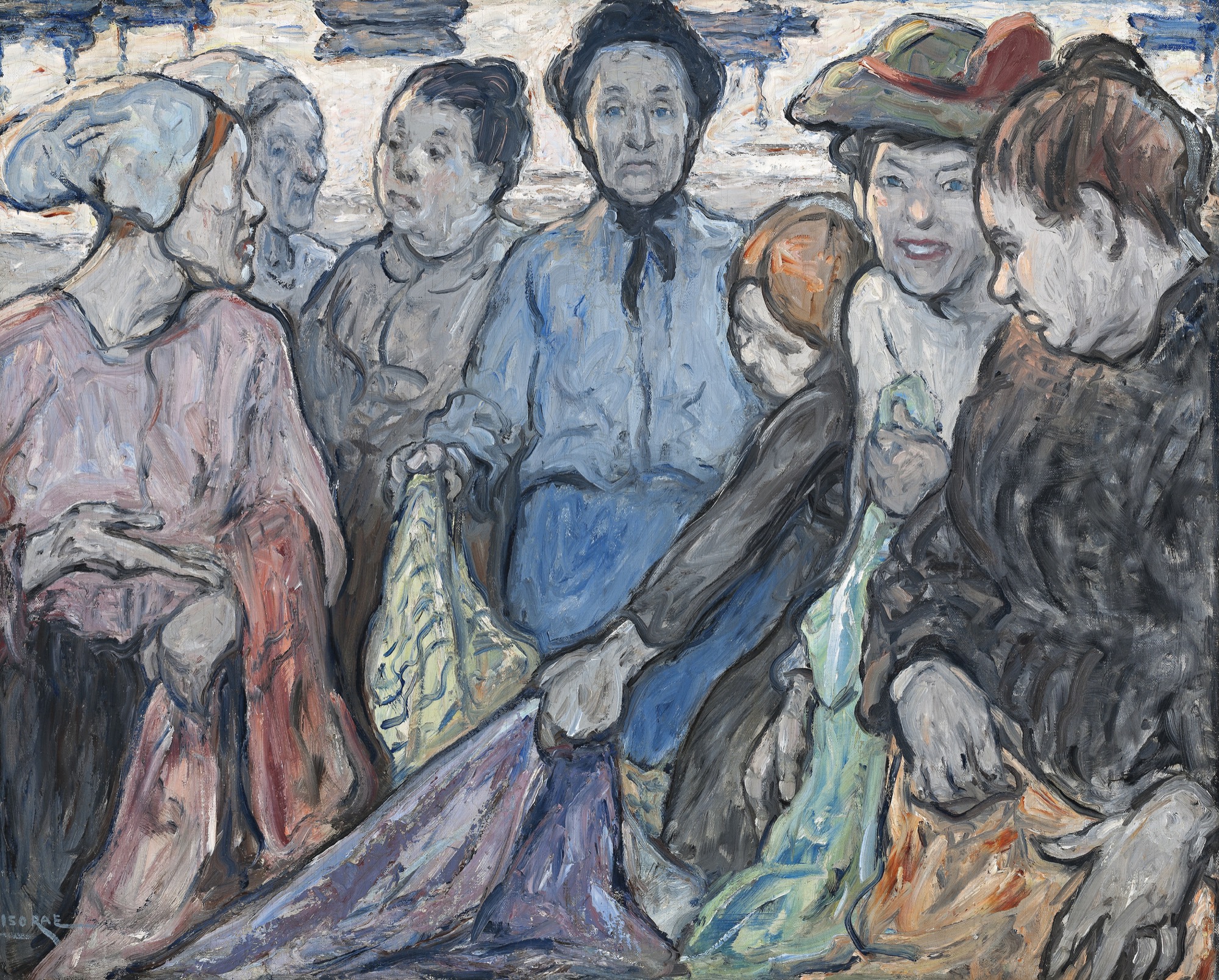
I focus in detail on two women artists who moved to Étaples, the resulting imagery of their rural subjects destined for consumption by metropolitan audiences. Women artists frequently travelled with female companions as a respectable form of mobility, as was the case with Iso Rae. She moved to Étaples permanently in 1893, accompanied by her mother and sister Alison, but from 1888 the threesome had been spending summers there. Alison said the move and choice of lodgings was prompted by the Harrisons’ favourable experience there.52 What really sparked Iso Rae’s interest there was the life and rituals of rural people, a step backwards in time, reflecting Mosler’s influence, as in The wedding procession, Etaples, (no date); religious rituals and ceremonies, as in Procession at Étaples (1913) and Rogation Sunday (1913); and the everyday occurrence of women at the market in Les acheteuses (The buyers) (c. 1913, fig. 1), in which the loose gestural lines take on a symbolist inflection.53
Two decades later, in 1910, Hilda Rix—later Rix Nicholas—and her mother and sister also moved to Étaples from Paris.54 The move was doubtless prompted by advice from old friends, Iso and Alison Rae, about living and working there on budget. Elizabeth Rix, Hilda’s mother, had been to the National Gallery School in Melbourne with Iso Rae.55 Unlike some in Étaples who portrayed the fishing fleet or its workers, Hilda Rix, like Rae, was attracted by the people in their Étaplian dress, whose customs and rituals stood apart from modern life. In portraying them she drew on what she had learned from her American teacher in Paris, Richard Miller. In Grand-mère (c. 1914, fig. 2), she presents a peasant woman in traditional clothing in her garden, an instance of painterly naturalism imbued with loose impressionist brushwork conveying a sea of colour. Her drawings and watercolours, like those of Iso Rae, also capture life on the streets, as in Fruit market, Étaples (c. 1910, fig. 3).
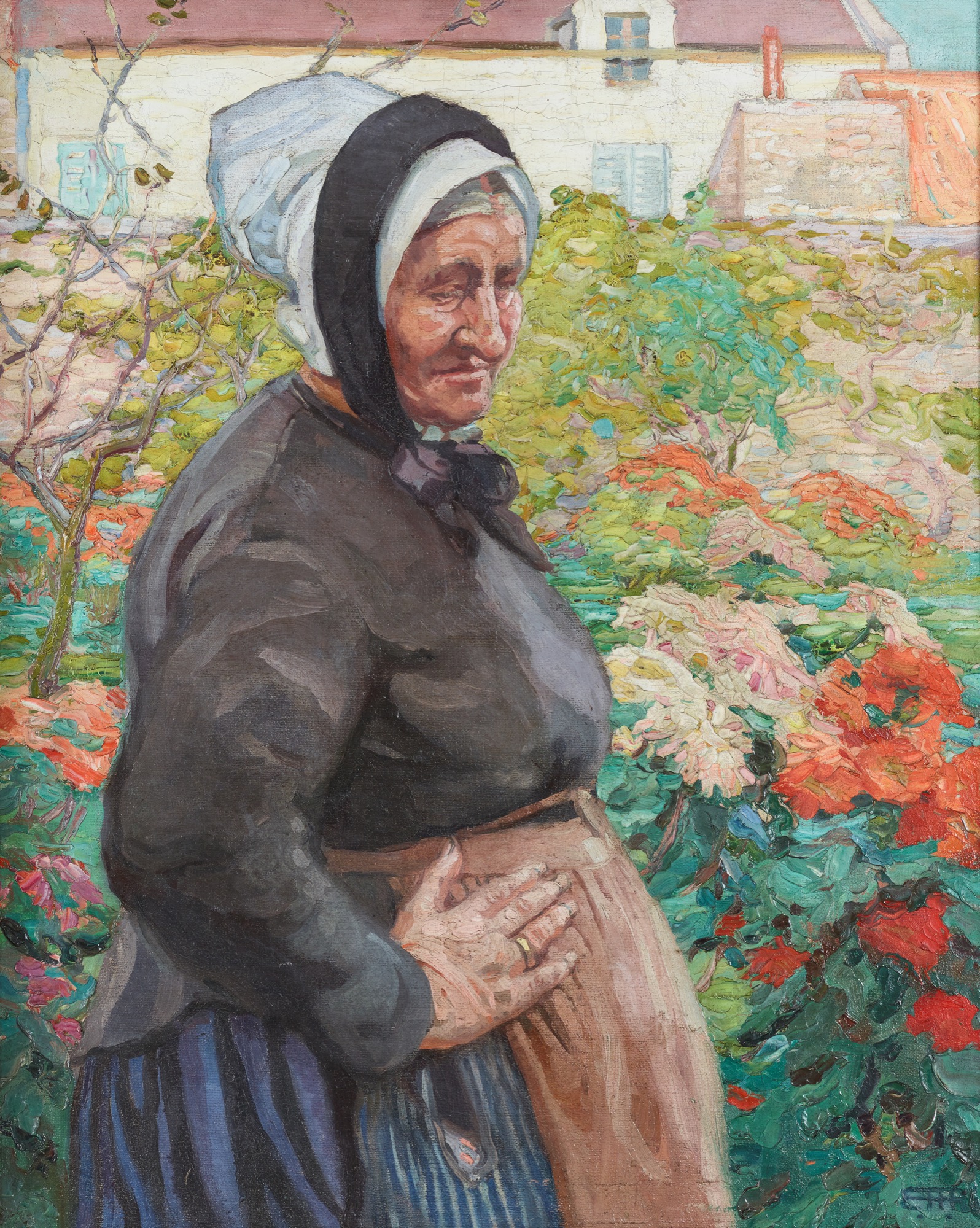
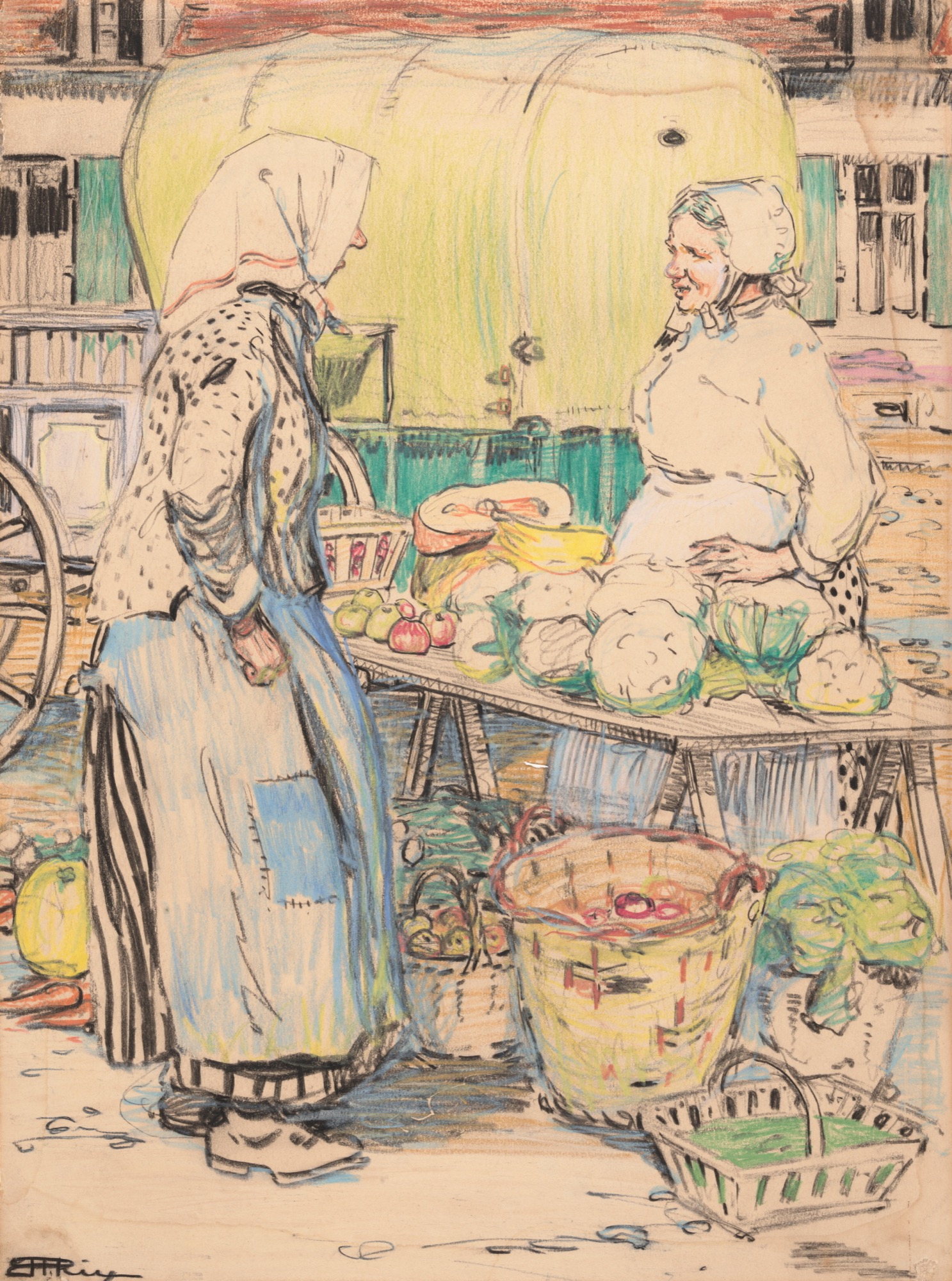
An agrarian romanticism is at play in these images, in which a process of selection and exclusion by the artists creates “a unified picture of the rural scene.”56 Villagers were hired as models to pose as peasants, while peasants became bourgeois subjects. Even Arthur Baker-Clack’s (1877–1955) seemingly modern Paysage d’Étaples (c. 1921) creates a premodern harmony between the built and natural environment.57 But, as Nina Lübbren has argued, the wider concept of nature as countryside was an imagined “subset of an urban Parisian vision” that involved “transforming the countryside from land to be worked on … into a spectacle to be visually consumed by city dwellers.” In this process “nature was cast as a health-giving and refreshing tonic for the tired urbanite.”58
Similarly in the artists’ colony at Concarneau, and nearby, there is that same romanticism. It too was a fishing village, accessible by the late 1880s by railway from Paris. Brittany itself was largely untouched by the industrial revolution. It attracted artists from eleven nations because it felt like travelling back in time to a life governed by religious customs and people wearing peasant dress.59 The town itself had a medieval walled old town, the Ville Close, with its narrow streets and old houses on an island connected to the new town by a bridge. Artists’ studios, in converted lofts in sardine factories, were in the new town.60 Brothers Alexander and Birge Harrison as well as Charles Lasar and other Americans were there in the early 1880s; Cecilia Beaux (1855–1942) likewise by the late 1880s.61 She credited Alexander Harrison as a valuable mentor in encouraging her to bring colour and light to her work, as seen in her Study of two Breton women, Concarneau, France (1888).62
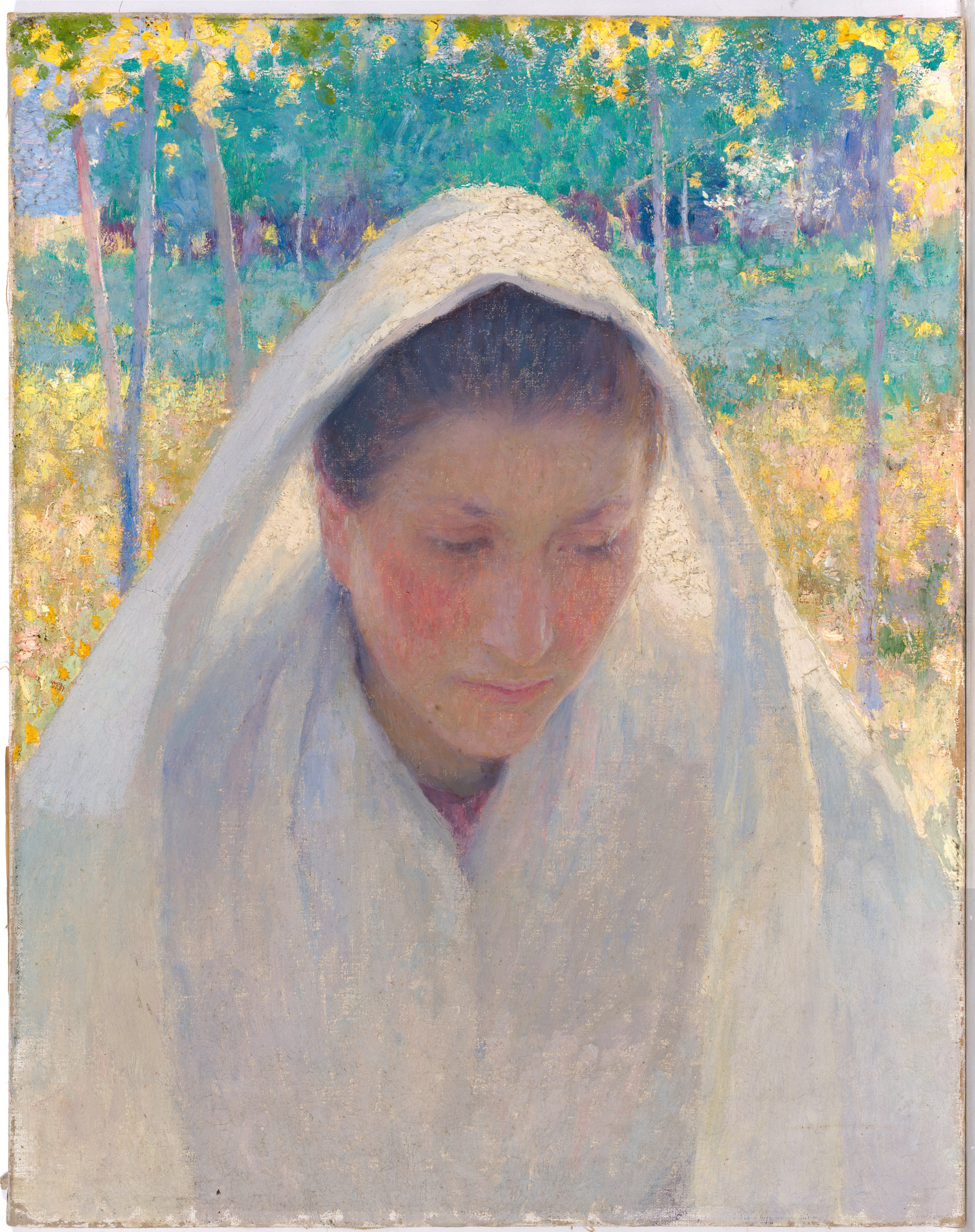
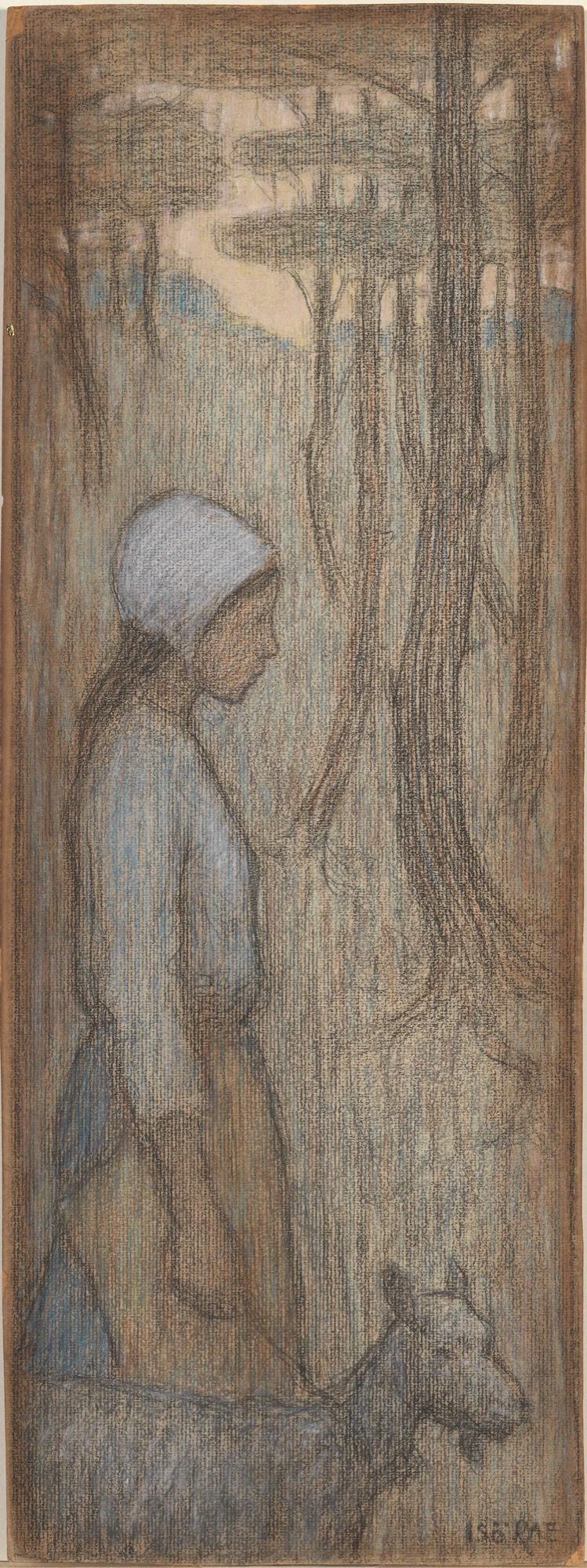
In 1889, Phillips Fox was in Le Pouldu, a small town near Concarneau. Phillips Fox had taken on board Harrison’s teachings about impressionism—especially “values and colour”—and the way he portrayed his subjects, as in the devout woman in his Sunlight effect (c. 1889, fig. 4), show his mastery of the style.63 The vivid colour bands form a background of trees while a bright light falls on the woman’s filmy blue grey cape and veil. More than that, it is an exploration of the inner self.64 A few years later, Iso Rae was nearby in Pont-Aven, another American colony, where she completed the untitled drawing (Breton girl with goat), (c. 1895, fig. 5). Mosler spent several summers working in Brittany, and it is quite likely he took his students, including Rae, with him.65
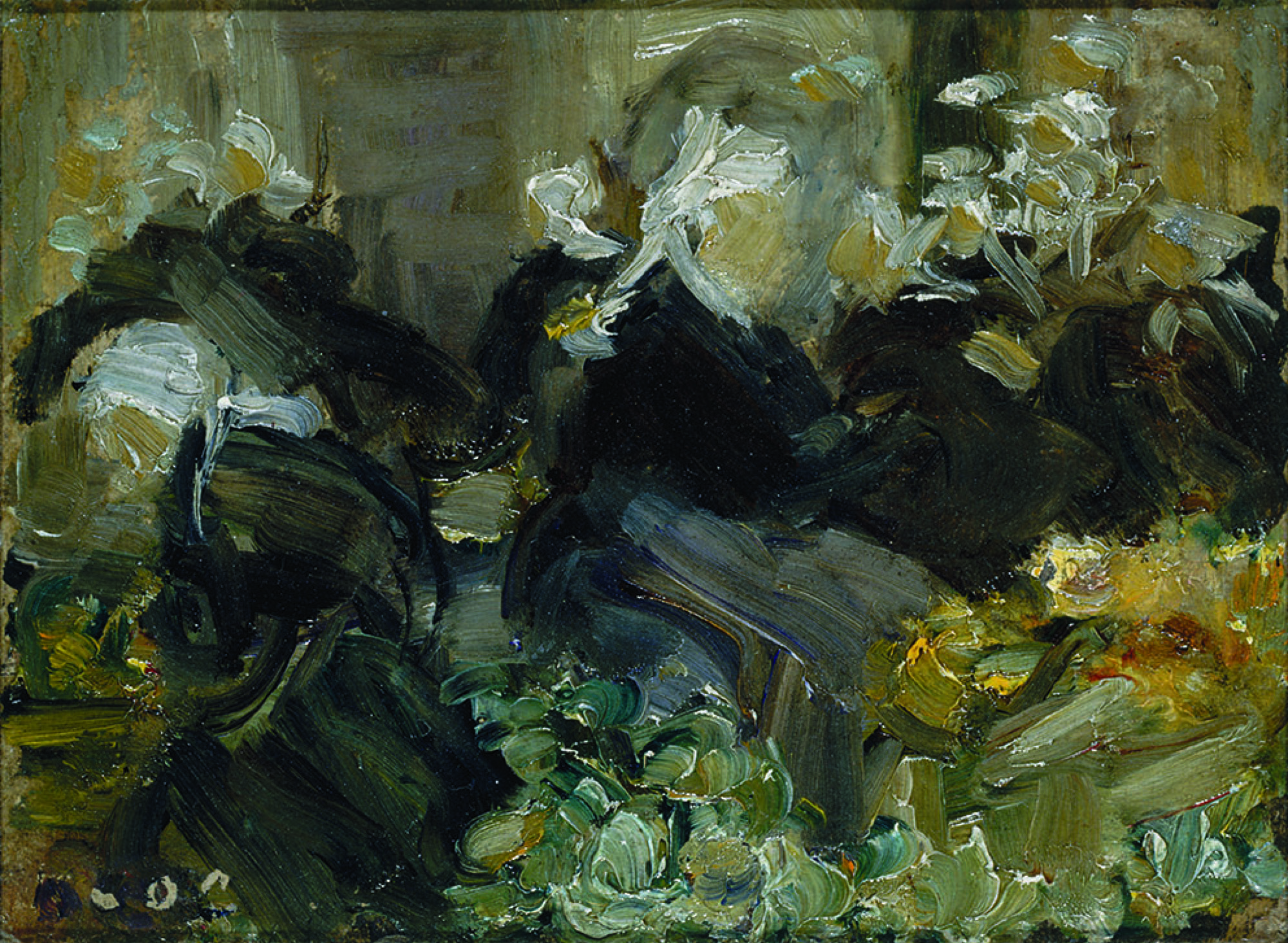
By the summer of 1911 Kathleen O’Connor (1876–1968) was in Concarneau, along with a group of female Colarossi students for a summer school in watercolour painting under New Zealander Frances Hodgkins.66 Concarneau had painting subjects in abundance. O’Connor and Hodgkins visited the American marine painter Charles Fromuth (1866–1937) and with him attended the nearby Quimper Fair, which he said was “a vision of delight for these colonials.”67 O’Connor’s painting Brittany market, Concarneau (c. 1911, fig. 6) shows Breton women at the fair with their distinctive head-dress portrayed in quick sketchy brushstrokes. She also took painting classes with Fromuth and met Alexander Harrison, with whom she remained in correspondence over the years.68
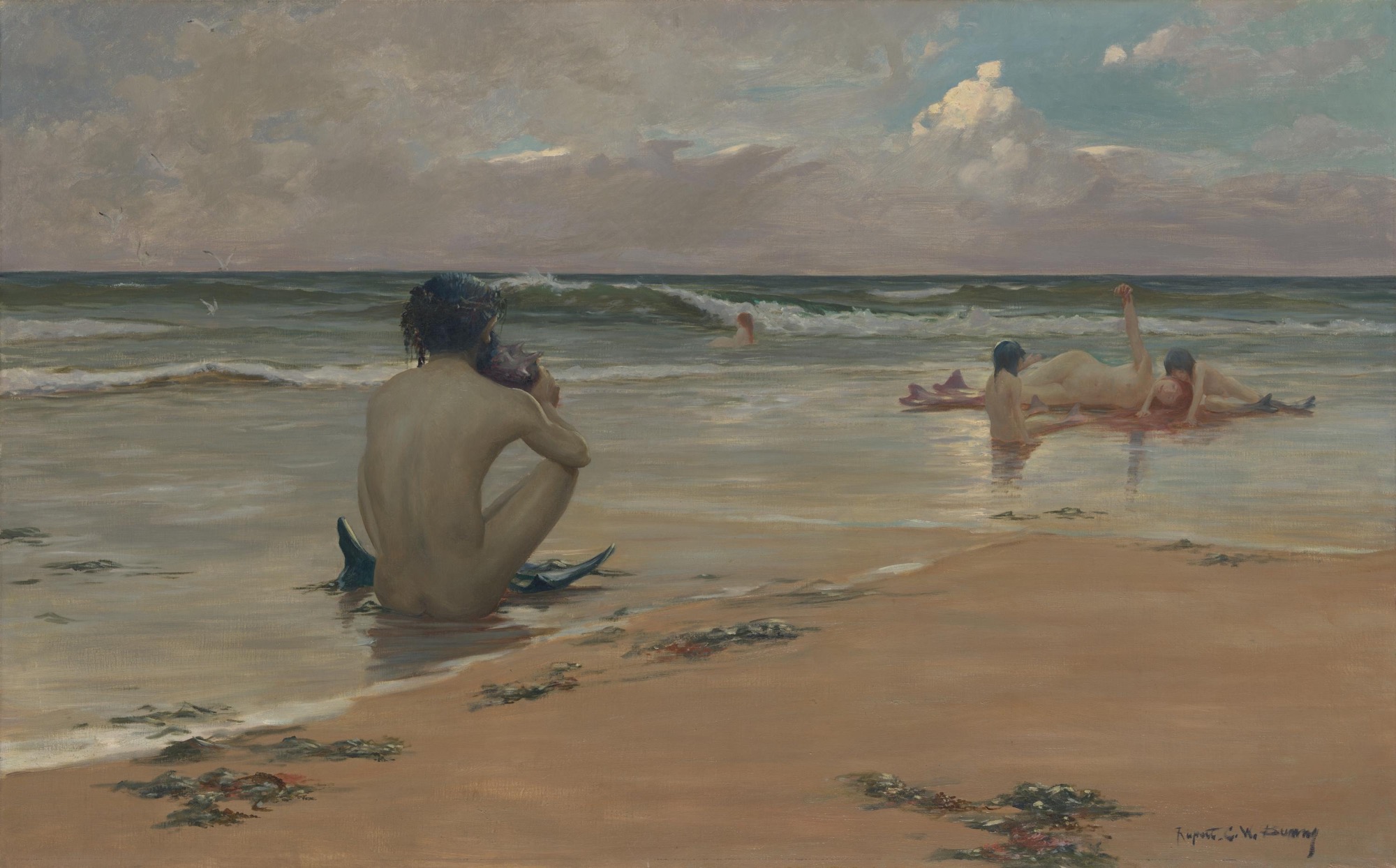
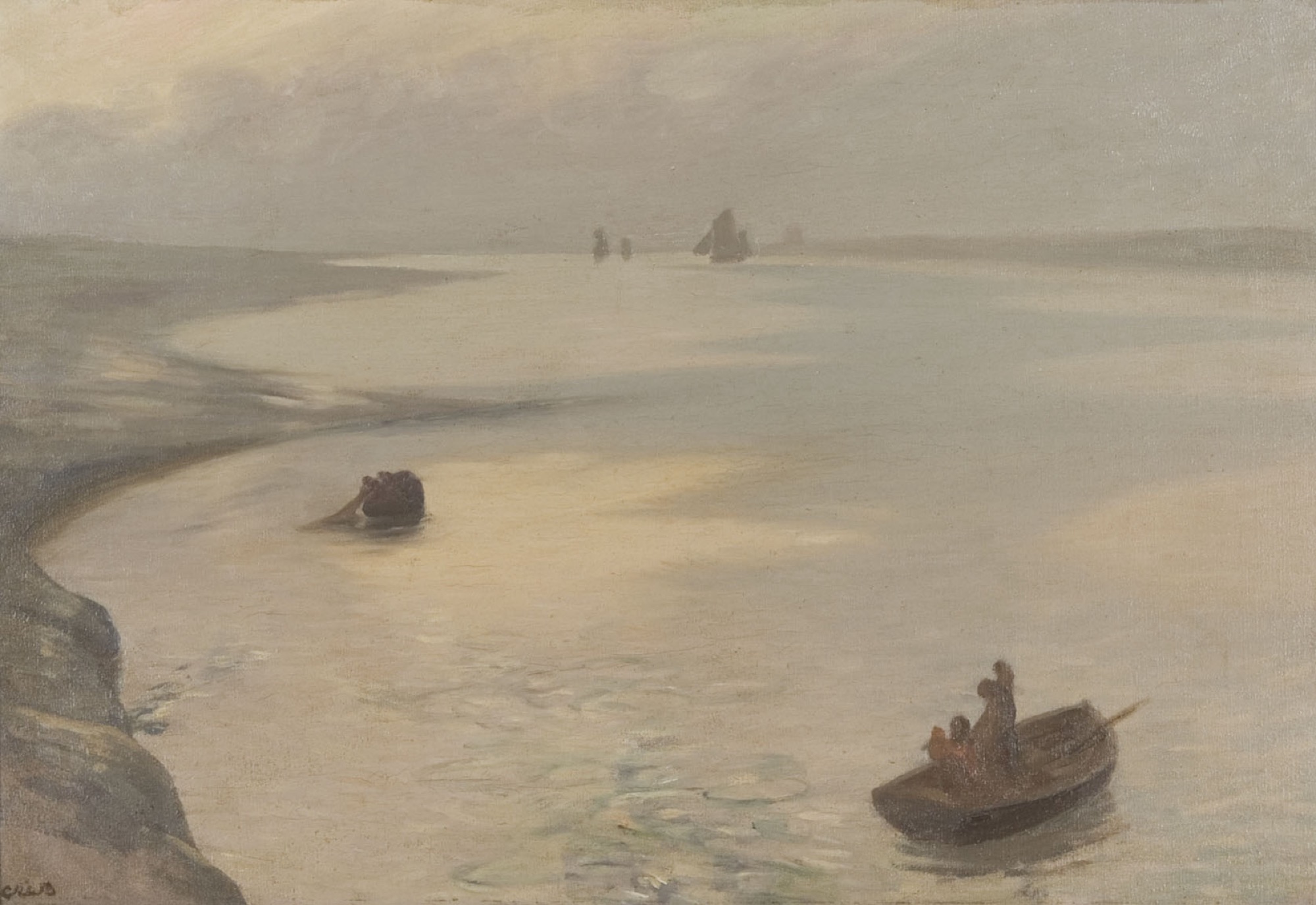
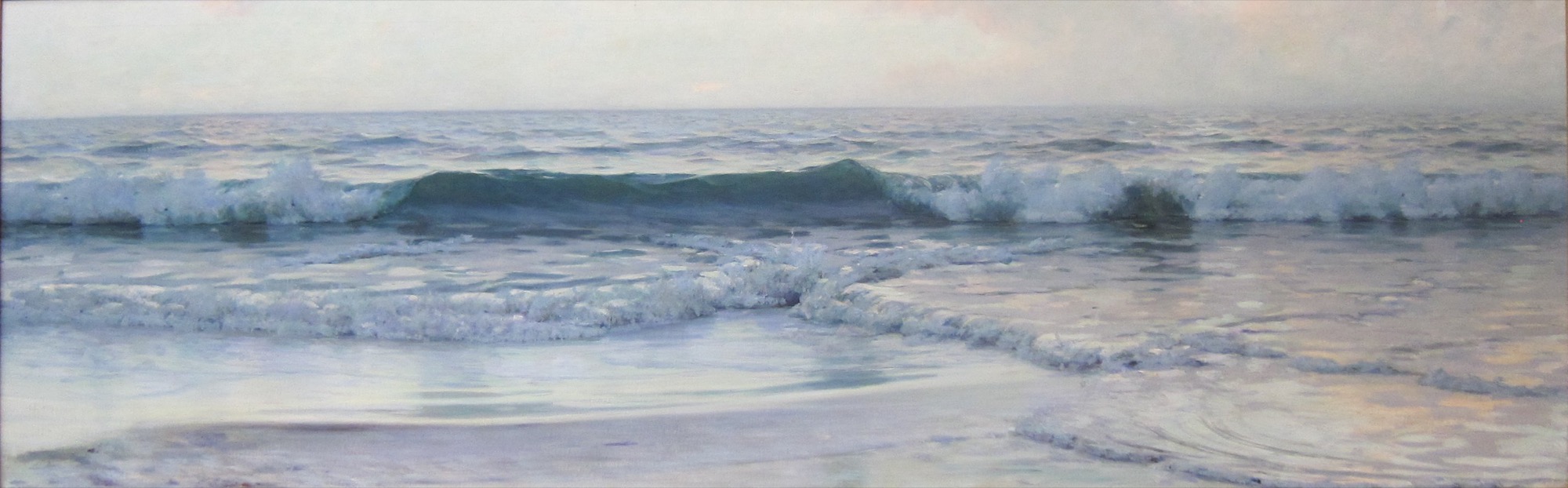
That same agrarian romanticism extended to seascapes. In the late 1880s Bunny completed a series in Brittany, its silver pink light and pre-industrial lustre attracting artists. His paintings such as Sea idyll (c. 1891, fig. 7), evoke a primitive premodern state holding modernity at bay.69 Then some years later, with his American friend Augustus Koopman (1869–1914), Bunny was in Étaples where his rendition of The canche at Étaples (c. 1902, fig. 8), with its low flat expanse of quiet water, draws the eye to the figures in the boat who are similarly in complete communion with nature. Alexander Harrison’s The wave (c. 1885, fig. 9), painted at Concarneau, eschews a human presence and takes immersion in nature to its extreme limits. This is yet another strain of work produced in artists’ colonies: minimal and immersive landscapes that construct a unity with nature for their bourgeois audiences.70
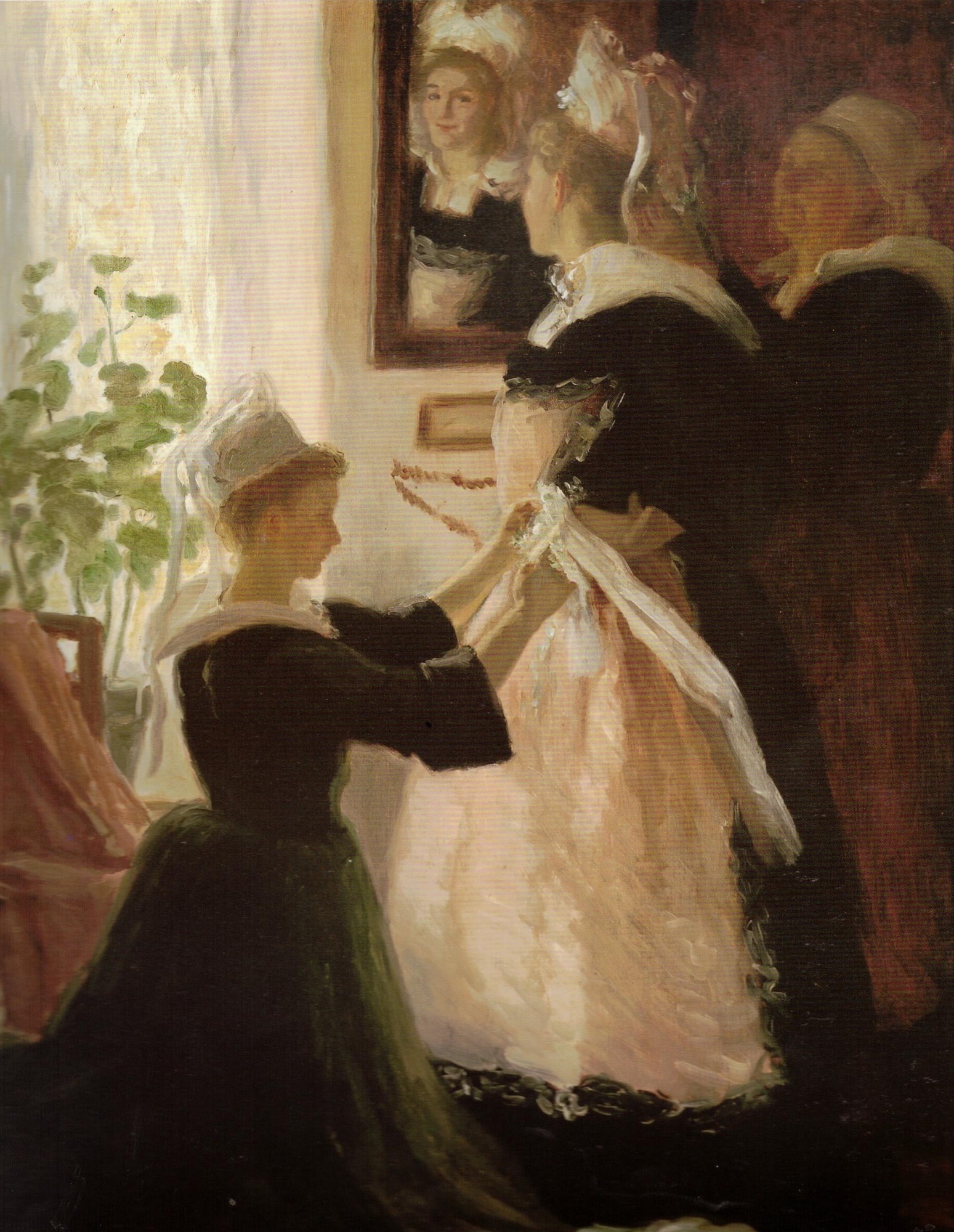
Not all artists worked in the same location year-in and year-out. With mobility at play, Marie Tuck (1866–1947), heeding the advice of her teacher Rupert Bunny, moved around to several artists’ colonies. Spending the summers in Étaples in 1907 and 1908, she headed for Brittany (Concarneau, Quimper, Pont-Aven and Royan) in 1909–10.71 There she completed her drawings for a stunning painting of a Breton woman being dressed traditionally for her wedding in Toilette de la mariée (Toilette of the bride) (1911, fig. 10).72 It received an honourable mention when hung at the Salon des Artistes Français in 1911, doubtless for its clever use of light filtering through the window and illuminating every aspect of the bride’s elaborate costume. Phillips Fox is another artist who moved around. By 1892, he was in the American artists’ colony of Giverny with his American friend Louis Paul Dessar (1867–1952), where he painted Wheat stacks, Giverny (1892). It demonstrates a similarly close engagement with impressionism with its broken brushwork, thickly applied paint, and use of a more gestural style to indicate light and colour.73
A close-knit and cohesive artistic community was key to the success of artists’ colonies.74 In Concarneau, the community centred around the Hôtel des Voyageurs, where there was a culture of informal criticism of work produced in the area. By contrast, criticism was more formalised in Étaples, even though the commune had a hotel of the same name (along with the Hôtel Loos) that performed the same critical function. The Étaples group had their own Société Artistique de Picardie, of which Henry Ossawa Tanner was president for some years.75 They held social events such as pantomimes and masked balls, which Hilda Rix was often involved in organising. Iso Rae portrayed one such event in her Bal à Etaples (no date).76 The annual Beaux-Arts exhibition at nearby Le Touquet-Paris-Plage was a high point each summer with many exhibitors and an exhibition catalogue. By 1913 the exhibition included work by Americans in Paris such as Elizabeth Nourse (1859–1938), who had earlier painted in Étaples, and Frederick Frieseke; by 1914 Richard Miller and Rupert Bunny were exhibitors.77 This Australian-American relationship in late nineteenth and early twentieth-century France, in Paris and in the artists’ colonies, was a deep, cross-national engagement with naturalism, impressionism, and neo-impressionism in which national identities dropped away.
Artists working in artists’ colonies were part of a global movement, in which the representation of space, time, and place was subject to location. The practice itself was driven by mobility and the ensuing politics of an educated class portraying life in rural areas, as well as wider existential issues raised by modernity and complicity by residents in the colonies to act as models for artists making work for a burgeoning art market. Artists would often begin work there on a painting destined for entry in a forthcoming Salon, and for some—such as Iso Rae, Hilda Rix Nicholas, and Marie Tuck—their paintings, watercolours, and drawings produced in artists’ colonies have come to define them as artists.
Analysis of these transnational artists working in the regional centres presents a lateral art history based on locations within France. It also throws into the spotlight the implications of the mobility of the artists who were working some of each year in Paris and at other times in an artists’ colony, where they were producing paintings for exhibitions and sale in galleries in Paris and London. This, in turn, makes the lateral interplay between the centre and the region (the periphery) within France more complex, reflexive, and less binary, creating an art historical web premised on mobility. It also makes for a multi-valent, decentred naturalism and impressionism with no centre, and, in its place, “many locations and iterations.”78
-
Nina Lübbren, Rural Artists’ Colonies in Europe 1870–1910 (Rutgers University Press, 2001), 17. ↩
-
Elena Taylor, Australian Impressionists in France (National Gallery of Victoria, 2013). ↩
-
Key texts exempt from this tendency to neglect rural artists’ colonies include Michael Jacobs, The Good and Simple Life: Artist Colonies in Europe and America (Phaidon, 1985); and Lübbren, Rural Artists’ Colonies in Europe 1870–1910. ↩
-
Jacobs, The Good and Simple life, 10, 12. ↩
-
Lübbren, Rural Artists’ Colonies in Europe 1870–1910, 78. ↩
-
For an interesting counterexample see Rex Butler and A.D.S. Donaldson, “Against Provincialism: Australian-American Connections 1900–2000,” Journal of Australian Studies 36, no. 3 (2012): 291–307, https://doi.org/10.1080/14443058.2012.703221 ↩
-
Piotr Piotrowski, “Towards Horizontal Art History,” in Crossing Cultures: Conflict, Migration and Convergence, ed. Jaynie Anderson (Miegunyah Press, 2009), 83. ↩
-
Piotr Piotrowski, “Towards a Horizontal History of the European Avant-Gardes,” in Europa! Europa?: The Avant-Garde, Modernism and the Fate of a Continent, ed. Sasha Bru et al. (De Gruyter, 2009), 51; and Piotrowski, “Towards Horizontal Art History,” 83. On global art history see James Elkin, Is Art History Global? (Routledge, 2007). ↩
-
The other places of production suggested by Piotrowski are peripheries outside western cultural centres such as those in Eastern Europe. See also Agata Jakubowska and Magdalena Radomska, eds., Horizontal Art History and Beyond: Revising Peripheral Critical Practices (Routledge, 2023). ↩
-
Terry Smith, “Allegories of Orientation,” in Horizontal Art History and Beyond, 178, https://doi.org/10.4324/9781003186519-19 ↩
-
Richard Thomson, Art of the Actual: Naturalism and Style in Early Third Republic France, 1880–1900 (Yale University Press, 2012), xi. ↩
-
Thomson, Art of the Actual, xi. ↩
-
On the pluralism of impressionist practice see Richard Brettell, “Impressionism and Nationalism: The American Case,” in American Impressionism: A New Vision, 1880–1900, ed. Katherine M. Bourguignon (Musée des impressionnismes, National Galleries of Scotland, Museo Thyssen-Bornemisza, and Éditions Hazan in association with the Terra Foundation for American Art, 2014), 15–21. ↩
-
On global impressionism see: World Impressionism: The International Movement, 1860–1920, ed. Norma Broude (Harry N. Abrams, 1990); Alexis Clark and Francis Fowle, Globalising Impressionism: Reception, Translation, and Transnationalism (Yale University Press, 2020), https://aaeportal.com/?id=-19996 and Emily C. Burns and Alice M. Rudy Price, eds., Mapping Impressionist Painting in Transnational Contexts (Routledge, 2021). ↩
-
MaryAnne Stevens, “When is impressionism not impressionism? The case of Australian art at the turn of the nineteenth century,” in She-Oak and Sunlight: Australian Impressionism, edited by Anne Gray and Angela Hesson (National Gallery of Victoria and Thames and Hudson, 2021), 253–258. ↩
-
Susan Waller and Karen L. Carter, “Introduction. Strangers in Paradise: Foreign Artists and Communities in Modern Paris, 1870–1914,” in Foreign Artists and Communities in Modern Paris, 1870–1914: Strangers in Oaradise, ed. Karen L. Carter and Susan Waller (Ashgate, 2015), 12. ↩
-
Richard Brettell, “Impressionism and Nationalism: The American case,” 15–21. ↩
-
Burns and Price, Mapping Impressionist Painting in Transnational Contexts, 11, 3, 5. ↩
-
For an overview, see Kathleen Adler, Erica E. Hirshler and H. Barbara Weinberg, Americans in Paris 1860–1900 (National Gallery, London, 2006). ↩
-
E. A. Taylor, “The American Colony of Artists in Paris,” Studio 52, no. 218 (May 1911): 263, https://doi.org/10.11588/diglit.20972.40 ↩
-
M. B. Ford, “American Society in Paris,” Cosmopolitan 15 (May 1893): 73. Cited in Hirshler, “At Home in Paris,” in Adler, Hirshler and Weinberg, Americans in Paris 1860–1900, 71. ↩
-
Emily C. Burns, “Revising Bohemia: The American Colony in Paris 1890–1914,” in Foreign Artists and Communities in Modern Paris, 1870–1914: Strangers in Paradise, ed. Karen L. Carter and Susan Waller (Ashgate, 2015), 99. ↩
-
Hirshler, “At Home in Paris,” 98–105. By 1917 The Chicago Tribune launched a Paris edition as an Army Edition; see Nissa Ren Cannon, “The American colonies: Paris’s Chicago Tribune and Paris-American identity,” The Journal of Modern Periodical Studies 8, no. 1 (2017): 37, https://muse.jhu.edu/article/698637 ↩
-
Taylor, Australian Impressionists in France, 86. ↩
-
Deborah Hart, Hugh Ramsay (National Gallery of Australia, 2019), 99–107; Anne Gray, George Lambert 1873–1930; Art and Artifice (Craftsman House, 1996), 31; Erica Hirshler, “At home in Paris,” 66–67. ↩
-
Hugh Ramsay, A lady in blue, also known as The lady in blue (Mr and Mrs JS MacDonald), 1902, oil on canvas, 172 x 112 cm, Art Gallery of New South Wales, presented by the family of Hugh Ramsay 1943, https://www.artgallery.nsw.gov.au/collection/works/7317/ See also, Hart, Hugh Ramsay, 125–129. ↩
-
I am indebted to Emily Burns for this information. ↩
-
Kathleen Adler, “‘We’ll Always have Paris’: Paris as Training Ground and Proving Ground,” in Adler, Hirshler and Weinberg, Americans in Paris 1860–1900, 11; Lilian Chauvel, “Art Life in Paris. An Australian Student’s Impressions,” The Brisbane Courier, 10 February 1906, 12, http://nla.gov.au/nla.news-article19449381 ↩
-
Brunhilde Biebuyck and Meredith Levin, “[St. Luke’s Chapel, 1892–1934,” in Reid Hall (Columbia University in the City of New York, 2019), accessed 24 September 2024, https://reidhall.globalcenters.columbia.edu/content/st-lukes-chapel-1892-1934 I am indebted to Emily Burns for this information about Hilda Rix. ↩
-
Académie Julian was popular with foreign students because it was more affordable; it had nine studios, five of which were open to men and four to women: Adler, “‘We’ll Always have Paris’: Paris as Training Ground and Proving Ground,” in Adler, Hirshler and Weinberg, Americans in Paris 1860–1900, 30. ↩
-
Ruth Zubans, E. Phillips Fox: His Life and Art (Miegunyah Press, 1995), 29. ↩
-
Phillips Fox to his sister-in-law Laura Fox, 6 January 1889, cited in Zubans, E. Phillips Fox, 29. ↩
-
Charles Francis Browne, “Alexander Harrison: painter,” Brush and Pencil 4, no. 3 (June 1899): 143, https://doi.org/10.2307/25505422 ↩
-
Alice Muskett, “Le Quartier latin s’amuse,” The Daily Telegraph, Sydney, 28 July 1897, 9, http://nla.gov.au/nla.news-article238399346 ↩
-
On Lasar see Peter Falk, “Minerva Josephine Chapman (1858–1947),” Illinois Historical Art Project, accessed 27 September 2024. https://www.illinoisart.org/essays/minerva-josephine-chapman ↩
-
Cristina Asquith Baker is the central figure in the blue dotted painting smock in Emanuel Phillips Fox’s painting Art Students, 1895 (Art Gallery of New South Wales) completed when the artist was back in Melbourne running the Melbourne Art School with Tudor St George Tucker. Victoria Hammond and Juliet Peers, Completing the Picture: Women Artists and the Heidelberg Era (Artmoves, 1992), 32. ↩
-
Asquith Baker lost some paintings in a fire in the studios at 51 Boulevard St Jacques: “Fire in Paris,” The Mercury, Hobart, 20 December 1912, 5. http://nla.gov.au/nla.news-article10267804 ↩
-
“Art notes,” The New York Times, 14 February 1887, Merl M. Moore Files, Smithsonian American Art Library; Mosler’s studio was at no. 28 Faubourg, St. Honore; Barbara Gilbert, “Henry Mosler rediscovered: a nineteenth century American-Jewish artist,” American Art Review 8, no. 3 (1996): 98–99. ↩
-
Henry Mosler was an artist for Harper’s Weekly during the American Civil War, and a frequent prize winner in French and European exhibitions including a gold medal at the International Exhibition in Nice in 1884, a silver medal at the Universal Exhibition in Paris in 1886, and a gold medal from the Archduke of Austria for the Vienna exhibition in 1890. His historical genre painting The return of the prodigal son (1879) was the first by an American acquired by a French gallery, the Luxembourg. See also “Notes on Art. French Art Notes. From Our Special Correspondent in Paris,” The Illustrated Sydney News, 4 June 1892, 10, http://nla.gov.au/nla.news-article64030771 Henry Mosler 1841–1920, Cincinnati Art Galleries catalogue notes, Henry Mosler file, Smithsonian American Art Library. ↩
-
H. Barbara Weinberg, “Summers in the Country,” in Adler, Hirshler and Weinberg, Americans in Paris 1860–1900, 120. ↩
-
Brigitte Foley, “Henry Mosler: Figure Drawings for Narrative Paintings,” American Art Review 8, no. 3 (1996), 100; Julia Rowland Myers, “The American Expatriate Painters of the French Peasantry, 1863–1893” (PhD diss., University of Maryland, 1989), 180, https://www.proquest.com/dissertations-theses/american-expatriate-painters-french-peasantry/docview/303703763/se-2. ↩
-
“Notes on Art. French Art Notes. From Our Special Correspondent in Paris,” The Illustrated Sydney News, 4 June 1892, 10, http://nla.gov.au/nla.news-article64030771 ↩
-
Hilda Rix Nicholas, “In Search of Beauty,” 1908, 30, cited in Richard Travers, Hilda: The Life of Hilda Rix Nicholas (Thames and Hudson, 2021), 34. Earlier ateliers Rix attended in Paris were Académie Delécluse, Académie Colarossi, and Académie de la Grande Chaumière. ↩
-
Wallace Thompson, “Richard Miller—A Parisian-American artist,” Fine Arts Journal 27, no. 5 (November 1912): 711. ↩
-
Penelope Little, A Studio in Montparnasse: Bessie Davidson, an Australian Artist in Paris (Craftsman House, 2003), 30; Roger Butler, The Prints of Margaret Preston: A Catalogue Raisonné (National Gallery of Australia, 2005), 6. ↩
-
Tim Cresswell, “Towards a politics of mobility,” Environment and Planning D: Society and Space 28, no. 1 (2010): 27. https://doi.org/10.1068/d11407 ↩
-
Lübbren, Rural Artists’ Colonies in Europe 1870–1910, 13–14. ↩
-
Lübbren, Rural Artists’ Colonies in Europe 1870–1910, 4. ↩
-
Cresswell, “Towards a Politics of Mobility,” 17, 29 ↩
-
Birge L. Harrison, “In Search of Paradise: With Camera and Palette,” Outing: An Illustrated Monthly Magazine of Sport, Travel and Recreation 21, no. 4 (January 1893): 310. ↩
-
Iris Field, comp., Letters from Alison and Iso Rae, ed. Brian and Betty Lacy (privately published, c. 2011), 36; Taylor, Australian Impressionists in France, 18; Jean-Claude Lesage, Australian Painters in Etaples, (ETT Imprint, 2022), 50. ↩
-
Alison Rae, “The Traveller. An Old House at Etaples,” The Australasian, Melbourne, 9 May 1891, 43, http://nla.gov.au/nla.news-article140172759 ↩
-
Iso Rae, The wedding procession, Etaples (1913), pastel, 32 x 53.5 cm, sold through Walker’s, Ottawa, 4 December 2013, lot 267, https://www.invaluable.com/auction-lot/isobel-rae-267-c-9771c28700 Iso Rae, Procession at Étaples (1913), oil on canvas, 114 x 162 cm, Musêe du Touquet-Paris-Plage, reproduced in Lesage, Australian painters in Étaples, 30; Iso Rae, Rogation Sunday (1913), oil on canvas, 130 x 195 cm, Musêe du Touquet-Paris-Plage, https://commons.wikimedia.org/wiki/File:Rae_Iso-Rogation_Sunday.jpg ↩
-
Étaples marked a turning point in Hilda Rix’s career because she met African American artist Henry Ossawa Tanner, who lived in nearby Trépied. He became a mentor and friend, and in 1912 she joined his trip to Tangiers, which marked the beginning of her Moroccan work. The paintings were exhibited to much acclaim in Paris in 1913 and 1914, but their being exhibited in Paris was due to yet another Australian American connection. Hilda Rix’s studio in Étaples was one of four. One was occupied by the French painter Jules Alder, who introduced Hilda to another American, Harry van der Weyden, who in turn became a mentor and introduced Hilda to his agent, Galerie J. Chaine and Simonsen, who exhibited her paintings and drawings from Morocco in November 1912. See Jean-Claude Lesage, “Tanner, the Pillar of Trépied,” in Henry Ossawa Tanner: modern spirit, ed. Anna O. Marley (Pennsylvania Academy of Fine Arts and University of California Press, 2012), 91–94; Travers, Hilda: The Life of Hilda Rix Nicholas, 56–70. ↩
-
Travers, Hilda: The Life of Hilda Rix Nicholas, 45. ↩
-
Lübbren, Rural Artists’ Colonies in Europe 1870–1910, 53–59. ↩
-
Arthur Baker Clack, Paysage (c. 1921), oil on canvas, 54 x 67 cm, Etaples-sur-mer, Musée Quentovic, https://webmuseo.com/ws/musenor/app/collection/record/19249 ↩
-
Lübbren, Rural Artists’ Colonies in Europe 1870–1910, 80. Lübbren is extending on an argument Nicholas Green developed in The Spectacle of Nature: Landscape and Bourgeois Culture in Nineteenth-Century France (Manchester University Press, 1990), which applied to early nineteenth-century France. ↩
-
Jacobs, The Good and Simple Life, 44. ↩
-
Jacobs, The Good and Simple Life, 64–65. ↩
-
Other Americans in Concarneau were Edward Emerson Simmons, Arthur Hoebler, and Clifford Grayson. See Myers, “The American Expatriate Painters of the French Peasantry,” 281. ↩
-
Cecilia Beaux, Background with Figures: Autobiography of Cecilia Beaux (Houghton Mifflin, 1930), 148–9. Study for two Breton women, Concarneau, France (1888), oil on canvas, 34.7 x 26.9 cm, is an unfinished oil sketch and is held by Pennsylvania Academy of Fine Arts, https://www.pafa.org/museum/collection/item/study-two-breton-women-concarneau-france The finished work is Twilight confidences (1888), oil on canvas, 71.1 x 27.9cm, Georgia Museum of Art, https://commons.wikimedia.org/wiki/File:Beaux-twilight-confidences-1888.jpg ↩
-
Phillips Fox letter reproduced in The Argus, Melbourne, 11 June 1889, 9, cited in Zubans, E. Phillips Fox, 177. ↩
-
Myers, “The American expatriate painters of the French peasantry,” 285. ↩
-
Gilbert, “Henry Mosler rediscovered,” 98. ↩
-
Frances Hodgkins was the first woman teacher at Colarossi’s. ↩
-
Taylor, Australian impressionists in France, 111; Fromuth cited in Janda Gooding, Chasing Shadows: The Art of Kathleen O’Connor (Craftsman House, 1996), 27–28. ↩
-
Amanda Curtin, Kathleen O’Connor of Paris (Fremantle Press, 2018), 122–23; Patrick Hutchings and Julie Lewis, Kathleen O’Connor: Artist in Exile (Fremantle Arts Centre Press, 1987), 55. ↩
-
Deborah Edwards, “Rupert Bunny,” in Deborah Edwards with Denise Mimmocchi, David Thomas and Anne Gerard, Rupert Bunny: Artist in Paris (Art Gallery of New South Wales, 2009), 36. ↩
-
Lübbren, Rural Artists’ Colonies in Europe 1870–1910, 98–116. ↩
-
Jean-Claude Lesage, Peintres Australiens à Étaples (A.M.M.E. éditions, 2000), 123. ↩
-
Marie Tuck was staying with the family she shows preparing the bride for wedding according to Breton tradition. See: Betty Snowden, “Société des Artistes Français (Old Salon) Paris, 1911” and “Tuck, Marie Anne,” in Heritage: The National Women’s Art Book, ed. Joan Kerr (Craftsman House, 1995) 19, 466; and Betty Snowden, “Marie Tuck: Biography,” Design and Art Australia Online, last updated 2011, accessed 21 September 2024, https://www.daao.org.au/bio/marie-tuck/biography/ ↩
-
Louis Paul Dessar also spent time at Étaples. E. Phillips Fox’s Wheat stacks, Giverny, 1892, oil on canvas, 31.5 x 46.0 cm, sold through Christie’s, Sydney, 27 August 2003, lot 551, and is now held in a private collection, in Perth, WA. https://www.mutualart.com/Artwork/Wheat-Stacks—Giverny/18047508F3742E34. This was painted at Giverny, the location of Monet’s many paintings of the same subject at differing times of the day in his Haystacks series painted in fields around his home in Giverny from 1890. ↩
-
Lübbren, Rural Artists’ Colonies in Europe 1870–1910, 9. ↩
-
Lübbren, Rural Artists’ Colonies in Europe 1870–1910, 9. ↩
-
Iso Rae, Bal à Etaples (no date), gouache, 27 x 35 cm, Musêe du Touquet-Paris-Plage, https://webmuseo.com/ws/musenor/app/collection/record/24627 ↩
-
Lesage, “Tanner, the Pillar of Trépied,” 91–94. Frieseke and Miller spent their summers at Giverny. ↩
-
Burns and Price, Mapping Impressionist Painting in Transnational Contexts, 5. ↩


Catherine Speck is Professor Emerita of Art History and Curatorship at Adelaide University and a Fellow of the Australian Academy of Humanities. She convened postgraduate programs in Art History and Curatorial and Museum Studies with the Art Gallery of South Australia from 2002 to 2020. She is a regular exhibition reviewer for The Conversation. Recent publications include: “Loss and renewal” in Dangerously Modern: Australasian Women Artists in Europe 1890–1940(Art Gallery of South Australia/Art Gallery of New South Wales, 2025); “Sorrow and service: Carrick across the two world wars,” in Ethel Carrick (National Gallery of Australia, 2024); with Joanna Mendelssohn, Catherine De Lorenzo, and Alison Inglis, Australian Art Exhibitions: Opening Our Eyes (Thames & Hudson, 2018); and Heysen to Heysen: Selected Letters of Hans Heysen and Nora Heysen (National Library of Australia, 2011 and Wakefield Press, 2019).
Bibliography
- Adler, Kathleen, Erica E. Hirshler and H. Barbara Weinberg. Americans in Paris 1860–1900. National Gallery (Great Britain), 2006.
- Adler, Kathleen. “‘We’ll Always have Paris’: Paris as Training Ground and Proving Ground.” In Kathleen Adler, Erica E. Hirshler, and H. Barbara Weinberg, Americans in Paris 1860-1900. National Gallery (Great Britain), 2006.
- Beaux, Cecilia. Background with Figures: Autobiography of Cecilia Beaux. Houghton Mifflin, 1930.
- Biebuyck, Brunhilde, and Meredith Levin. “[St. Luke’s Chapel, 1892–1934.” In Reid Hall. Columbia University in New York, 2019. Accessed 24 September 2024. https://reidhall.globalcenters.columbia.edu/content/st-lukes-chapel-1892-1934
- Broude, Norma, ed. World Impressionism: The International Movement 1860–1920. H. N. Abrams, 1990.
- Brettell, Richard. “Impressionism and Nationalism: The American Case.” In American Impressionism: A New Vision 1880—1900, edited by Katherine M. Bourguignon. Musée des impressionnismes, National Galleries of Scotland, Museo Thyssen-Bornemisza and Éditions Hazan in association with the Terra Foundation for American Art, 2014.
- Browne, Charles Francis. “Alexander Harrison: Painter.” Brush and Pencil 4, no. 3 (June 1899): 133–144. https://doi.org/10.2307/25505422
- Burns, Emily C. “Revising Bohemia: The American Colony in Paris 1890–1914.” In Foreign Artists and Communities in Modern Paris, 1870–1914, edited by Karen L. Carter and Susan Waller. Ashgate, 2015.
- Burns, Emily C., and Alice M. Rudy Price. Mapping Impressionist Painting in Transnational Contexts. Routledge, 2021.
- Butler, Rex, and A.D.S. Donaldson. “Against Provincialism: Australian-American Connections 1900–2000.” Journal of Australian Studies 36, no. 3 (2012): 291–307. http://doi.org/10.1080/14443058.2012.703221
- Butler, Roger. The Prints of Margaret Preston: A Catalogue Raisonné. National Gallery of Australia, 2005.
- Cannon, Nissa Ren. “The American Colonies: Paris’s Chicago Tribune and Paris-American Identity.” The Journal of Modern Periodical Studies 8, no. 1 (2017): 34–55. https://muse.jhu.edu/article/698637
- Carter, Karen L., and Susan Waller, eds. Foreign Artists and Communities in Modern Paris, 1870–1914: Strangers in Paradise. Ashgate, 2015.
- Clark, Alexis, and Fowle, Francis. Globalising Impressionism: Reception, Translation, and Transnationalism. Yale University Press, 2020. https://aaeportal.com/?id=-19996
- Cresswell, Tim. “Towards a Politics of Mobility.” Environment and Planning D: Society and Space 28, no. 1 (2010): 17–31. https://doi.org/10.1068/d11407
- Curtin, Amanda. Kathleen O’Connor of Paris. Fremantle Press, 2018.
- Edwards, Deborah, with Denise Mimmocchi. Rupert Bunny: Artist in Paris. Art Gallery of New South Wales, 2009.
- Falk, Peter. “Minerva Josephine Chapman.” Illinois Historical Art Project. Accessed 27 September 2024. https://www.illinoisart.org/essays/minerva-josephine-chapman
- Foley, Brigitte. “Henry Mosler: Figure Drawings for Narrative Paintings.” American Art Review 8, no. 3 (1996): 100–103.
- Gilbert, Barbara. “Henry Mosler Rediscovered: A Nineteenth-Century American-Jewish Artist.” American Art Review 8, no. 3 (1996): 96–99.
- Gooding, Janda. Chasing Shadows: The Art of Kathleen O’Connor. Craftsman House, 1996.
- Gray, Anne. George Lambert 1873–1930: Art and Artifice. Craftsman House, 1996.
- Hammond, Victoria, and Juliet Peers. Completing the Picture: Women Artists and the Heidelberg Era. Artmoves, 1992.
- Harrison, Birge L. “In Search of Paradise: With Camera and Palette.” Outing: An Illustrated Monthly Magazine of Sport, Travel and Recreation 21, no. 4 (January 1893): 310–316.
- Hart, Deborah. Hugh Ramsay. National Gallery of Australia, 2019.
- “Henry Mosler 1841–1920, Cincinnati Art Galleries catalogue notes.” Henry Mosler file, Smithsonian American Art Library, Washington, DC.
- Hirshler, Erica E. “At Home in Paris.” In Kathleen Adler, Erica E. Hirshler and H. Barbara Weinberg, Americans in Paris 1860–1900. National Gallery (Great Britain), 2006.
- Jakubowska, Agata, and Magdalena Radomska, eds. Horizontal Art History and Beyond: Revising Peripheral Critical Practices. Routledge, 2023.
- Hutchings, Patrick, and Julie Lewis. Kathleen O’Connor: Artist in Exile. Fremantle Arts Centre Press, 1987.
- Jacobs, Michael. The Good and Simple life: Artist Colonies in Europe and America. Phaidon, 1985.
- Little, Penelope. A Studio in Montparnasse: Bessie Davidson, an Australian Artist in Paris. Craftsman House, 2003.
- Lübbren, Nina. Rural Artists’ Colonies in Europe 1870–1910. Rutgers University Press, 2001.
- Field, Iris, comp. Letters from Alison and Iso Rae. Edited by Brian and Betty Lacy. Privately published, c. 2011.
- Lesage, Jean-Claude. Peintres Australiens à Étaples. A.M.M.E. éditions, 2000.
- Lesage, Jean-Claude. “Tanner, the Pillar of Trépied.” In Henry Ossawa Tanner: Modern Spirit, edited by Anna O. Marley. Pennsylvania Academy of Fine Arts and University of California Press, 2012.
- Lesage, Jean-Claude. Australian Painters in Etaples. Translated by Pauline Le Borgne. ETT Imprint, 2022.
- Muskett, Alice. “Le Quartier latin s’amuse.” The Daily Telegraph, Sydney, 28 July 1897. http://nla.gov.au/nla.news-article238399346.
- Myers, Julia Rowland. “The American Expatriate Painters of the French Peasantry, 1863–1893.” PhD diss., University of Maryland, 1989. https://www.proquest.com/dissertations-theses/american-expatriate-painters-french-peasantry/docview/303703763/se-2
- Rae, Alison. “The Traveller. An Old House at Etaples.” The Australasian, Melbourne, 9 May 1891. http://nla.gov.au/nla.news-article140172759
- Smith, Terry. “Allegories of Orientation.” In Horizontal Art History and Beyond: Revising Peripheral Critical Practices, edited by Agata Jakubowska and Magdalena Radomska. Routledge, 2023.
- Snowden, Betty. “Société des Artistes Français (Old Salon) Paris, 1911” and “Tuck, Marie Anne.” In Heritage: The National Women’s Art Book. Edited by Joan Kerr. Craftsman House, 1995.
- Snowden, Betty. “Marie Tuck: Biography.” In Design and Art Australia Online, last updated 2011, accessed 21 September 2024, https://www.daao.org.au/bio/marie-tuck/biography/
- Stevens, MaryAnne. “When is Impressionism not Impressionism? The Case of Australian Art at the Turn of the Nineteenth Century.” In She-Oak and Sunlight: Australian Impressionism, edited by Anne Gray and Angela Hesson. National Gallery of Victoria and Thames and Hudson, 2021.
- Taylor, E. A. “The American Colony of Artists in Paris.” Studio 52, no. 218 (May 1911): 263–279. https://digi.ub.uni-heidelberg.de/diglit/studio1911a/0285/image,info,thumbs
- Taylor, Elena. Australian Impressionists in France. National Gallery of Victoria, 2013.
- The Illustrated Sydney News. “Notes on art. French art notes. From our special correspondent in Paris.” 4 June 1892. https://trove.nla.gov.au/newspaper/article/64030771
- The Mercury. “Fire in Paris.” Hobart, 20 December 1912. http://nla.gov.au/nla.news-article10267804
- The New York Times. “Art notes.” 14 February 1887, Merl M. Moore Files, Smithsonian American Art Library, Washington, DC.
- Thomson, Richard. Art of the Actual: Naturalism and Style in Early Third Republic France 1880–1900. Yale University Press, 2012.
- Thompson, Wallace. “Richard Miller—a Parisian-American Artist.” Fine Arts Journal 27, no. 5 (November 1912): 709–714. https://www.jstor.org/stable/42004789
- Travers, Richard. Hilda: The Life of Hilda Rix Nicholas. Thames and Hudson, 2021.
- Waller, Susan, and Karen L. Carter. “Introduction. Strangers in Paradise: Foreign Artists and Communities in Modern Paris, 1870–1914.” In Foreign Artists and Communities in Modern Paris, 1870–1914: Strangers in Paradise, edited by Karen L. Carter and Susan Waller. Ashgate, 2015.
- Lilian Chauvel. “Art Life in Paris. An Australian Student’s Impressions.” The Brisbane Courier, 10 February 1906. http://nla.gov.au/nla.news-article19449381
- Weinberg, H. Barbara. “Summers in the Country.” In Kathleen Adler, Erica E. Hirshler and H. Barbara Weinberg, Americans in Paris 1860–1900. National Gallery (Great Britain), 2006.
- Zubans, Ruth. E. Phillips Fox: His Life and Art. Miegunyah Press, 1995.