Artists' Colonies from the Great Sandy Desert
This paper focuses on Yulparija artists resident at Bidyadanga, an Aboriginal community on the north-west coast of Australia. During the 2000s these artists became part of the Western Desert painting movement and, more widely, the Aboriginal art movement in Australia. Many of these artists were elderly, having moved in from living traditionally as hunter-gatherers in the Great Sandy Desert in their youth. As late as 1974 people came in to live on the coast on La Grange Mission, later called Bidyadanga when it shifted from missionary to Aboriginal management in 1985. They came in from the desert because of a combination of depopulation and drought. The beginnings of industrial scale mining in the Pilbara to the south may well have also begun to lower the water table and empty out soaks that were once reliable sources of living water.1 The great underground river systems began to disappear, leaving the Yulparija and other people still living between jila (waterholes) of the Great Sandy Desert stranded, and necessitating a shift to the coast. There are usually multiple reasons for Aboriginal people moving from their Country to missions and pastoral stations, and drought may have been only one of these. Another story has it that the final move to La Grange happened after the death of an elder who was keeping a group of families in the desert.2 The group’s identity comes into being after their arrival at La Grange, where they became known as Yulparija, the term for “southerner” or “from the south,” referring to the direction from which they had come.3 After coming in from the desert, the Yulparija lived the rest of their lives on Karajarri country, far from the jila of their youths, and went on to exhibit their work across Australia during the 2000s and 2010s.
When they started painting, I want to argue that the Yulparija became an artists’ colony living on Karajarri land. The use of the term colony here is not an unproblematic one, since in Australia the term is overdetermined by its association with invasion and occupation. Colony implies colonisation, and within national discourses these terms are reserved for the settler colonial invader rather than the Indigenous invaded. Critiques of these discourses by First Nations scholars have pointed out the problem with this reduction, however, as discourses of the postcolonial and settler-colonial only reproduce the logic they set out to critique. Taking the settler-colonial as its subject, settler-colonial studies reproduces the settler-colonial’s “logic of elimination” writing over and around the Indigenous.4 The postcolonial, too, is condemned to return to the colonial subjects it sets out to critique as it interprets the ideologies of empire.5 The use of the term artists’ colony here, and its semantic slippage with the colonial and colonisation, is in this sense a semantic decolonisation of the term. It is also useful in reconstructing the history of Bidyadanga, where the local Karajarri people, ancestral owners of the country, regard themselves as having been invaded by refugees from the desert. For Karajarri people the arrival of the Yulparija and other desert people was a kind of colonisation, as they brought with them powerful ceremonial practices and began to include young Karajarri people, including children, into desert law.6
In the aftermath of the ongoing continental invasion of Europeans, groups of Aboriginal people struggled over their claims to different parts of the country. As Walmajarri man Jimmy Bango told anthropologists, “It is the destiny of the Djualin-Walmadjeri [the people who speak the Mangala dialect of Walmajarri], already prescribed in the Dreamtime, to push continually westward.”7 The millenarian influence of Christianity can be seen here, as it can in the Fitzroy Valley to the east of Bidyadanga, where Walmajarri people were moving north from the desert into freshwater country. After decades under the rule of pastoralists and police, the arrival of the Walmajarri with their ceremonial knowledge brought about something of a cultural renaissance.8 The Walmajarri were colonists of an esoteric kind, calling upon the spirits of the deep desert to induct and transform coastal and freshwater societies, as were the Yulparija and other desert groups who came to the coastal settlement at Bidyadanga.
The Karajarri have resumed traditional authority over their Country after long negotiations with other groups at Bidydanga.9 Any ceremonies held at Bidyadanga no longer proceed without Karajarri approval. The Native Title process, drawn out over the rights to Anna Plains Station to the south, was crucial to the reassertion of this authority, through negotiations with the Juwalinny, Mangala, Nyangamarta and Yulparija, who had come to live permanently at Bidyadanga. In Fitzroy Crossing too negotiations have long taken place as to who lives where, and what ceremonies might be appropriate for whom.10 These histories testify to a relationship between artists and country that is just as politicised and discursive as it is metaphysical. Processes of negotiating over ceremonies and Country had always taken place but were transformed and intensified by the urbanisation of Aboriginal people on missions, ration stations and townships. The Bidyadanga art movement can be interpreted as a part of this intensification. As the ancestral, ceremonial authority over Karajarri Country took modern, administrative shape in the 2002 Native Title agreement, an identitarian, Yulparija painting practice followed.
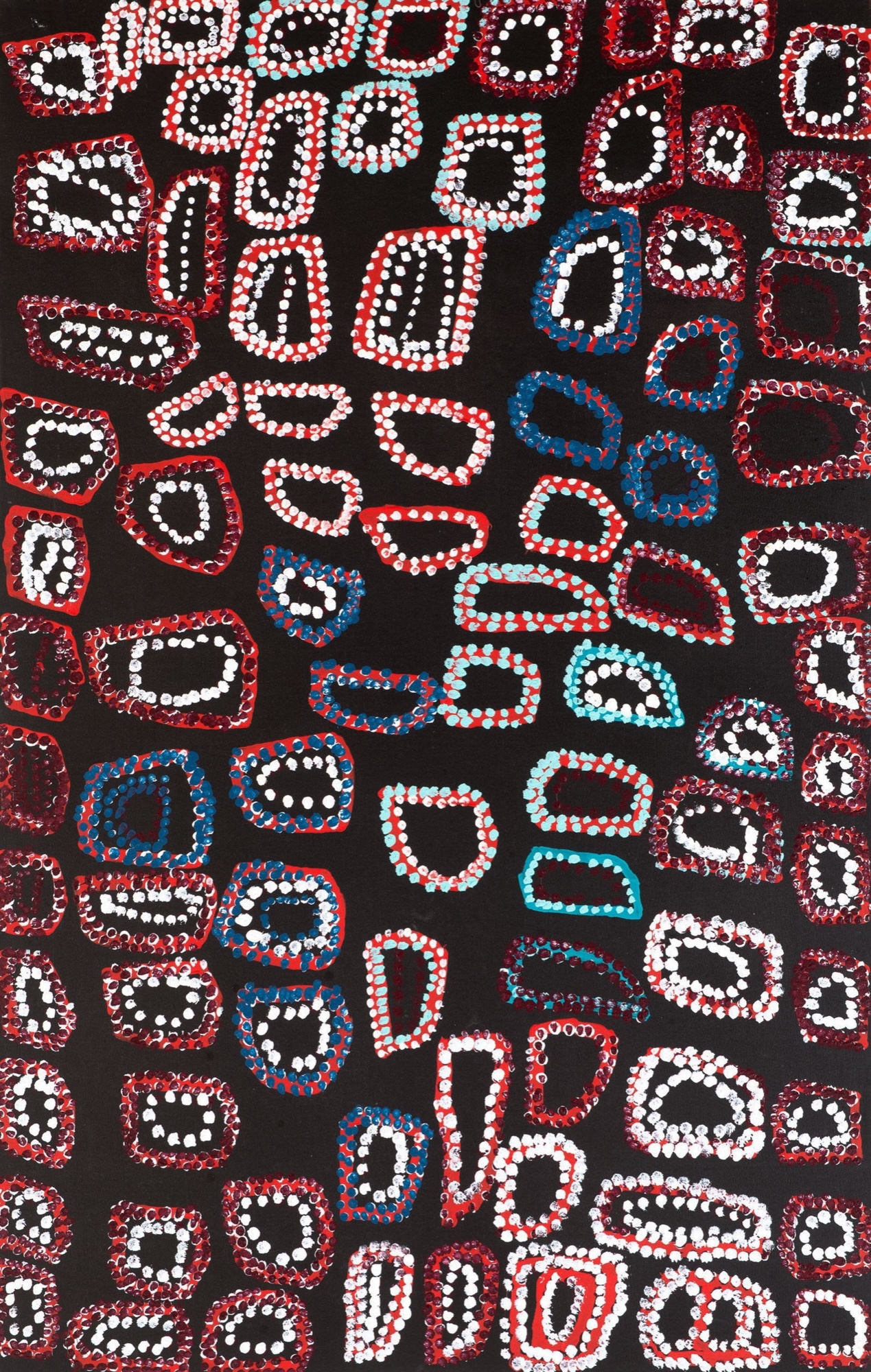
When beginning their painting practice, the Yulparija artists wanted to pay respects to the Karajarri by painting their desert Country in the colours of the coast. This combination of Western Desert iconography and coastal colours can be seen, for example, in the work of Alma Webou Kalaju. In Pinkarlarta (2004), an early painting of Webou’s birthplace in the Great Sandy Desert, aqua blue and ocean green dotting make up roundels of red atop black primer (fig. 1). Webou is one of several Yulparija artists painting the desert country of her childhood while living in Bidydanga. Other elderly artists include Jan Billycan, Donald Moko, Spider Kalbybidi and Weaver Jack, who all combined shades of blue and green with pinks, whites and yellows. The colours symbolise the jila and tali (sandhills), as well as the underground rivers, of the Great Sandy Desert, while also being inspired by the coast where they live.11 They were supported in their new life as artists by the young painter Daniel Walbidi, a child and grandchild of these migrants. Walbidi explains the use of coastal colours in Yulparija painting as a product of exile:
Because we live out in the middle of remote community the land is the biggest influence, the colours. As you can see there’s a mixture of reds and yellows and blues and I guess it’s the land that influences me. Like I explained earlier my father’s family and my mother’s family were desert-oriented people. They migrated to many of the stations and ended up eventually on the mission. Back then it was the La Grange Mission. When the people ended up with administration of the community they called it Bidyadanga community and it’s on the coast, on Karajarri Country, so the land and the sea have also been of influence on me, the colours, you know.12
Walbidi was at the centre of this new painting movement, having been inspired by the broader painting movement from remote Australia, and especially by Emily Kame Kngwarreye. When he began painting, he had never visited the ancestral jila, knowing it only through stories and rituals handed down through Yulparija families.
Tristen Harwood argues that the heightened use of colour by remote Aboriginal artists expresses a metaphysics of relation with Country.13 Rather than deferring to traditional visual practices, colour painters express this feeling of relation, this embeddedness of the artist’s spirit within the land they are painting. This conceptualisation contradicts the idea of colour corresponding to the visual identity of Country, although this use of colour also persists among remote artists. The Balgo painter Jane Gimme recalls, in speaking of her mother Eubena Nampitjin, that:
My mother she taught me a lot of things about painting. Paint the country, which colours I want to paint, you know. Not green, blue, only yellow, red, the sand dunes colour, white the spinifex colour, and yellow the flowers, the seeds that they collect every time. A little bit of black that they used to grind to make damper …14
It is one of the truisms of art history that styles of painting and other forms of expression reflect the changing circumstances of artists. The different uses of colour among remote artists plays out the dynamism of the history of remote communities, the ways in which families, traditions and relations to Country have been transformed by the movement of people across the continent. Harwood traces the very different lives of artists who he argues use colour as a kind of metaphysics, from their upbringings on missions, mining camps and pastoral stations. They have in common the experience of colonisation and its disruptions, arriving at their high key use of colour as a way of overcoming this history and expressing a foundational relationship with Country. Colour defies their personal histories, while its use also expresses the colonial history that they have in common.
Part of the complexity of the discourse around the remote Australian painting movement lies in capturing the simultaneity of colonialism, modern painting and an esoteric relationality of its artists with Country. Canonical histories of European modernism emphasise the universality of modern painting’s themes, and its break with the classical past. Writers on modern art, from Baudelaire to T. J. Clark, argue that modern painters refracted the abstraction and alienation of life in the Euro-American metropolises.15 Ian McLean has made arguments for remote painting to be understood in these same terms, as a modernism that parallels the European avant-gardes, while also arguing that the careers of artists such as Albert Namatjira and John Mawurndjul deconstruct modernism’s identification with colonialism, primitivism and social Darwinism.16
On the other hand, painting from remote Australia is also and often treated with an exceptionalism that looks to the Indigenous as a model of certainty and continuity in an uncertain and discontinuous world. As Henry Skerritt writes:
Unfortunately, the idea that Aboriginal aesthetics can be reduced to a generalized system of “ancestral presencing” has become mainstreamed through commercial gallery catalogs, sales brochures and fluff pieces to such a degree that … it is often used to justify a weak universal aestheticism. This runs counter to the remarkable diversity of Aboriginal art and cultures and ignores the profound challenge that these paintings pose to the ideology of modernist aesthetics.17
Here I want to argue that the specificity of Yulparjia painting, as one part of the “remarkable diversity of Aboriginal art and cultures,” reproduces modernist aesthetics as much as it challenges them. The use of Karajarri colours by Yulparija artists speaks as much to the alienation of these artists from the Country they left behind decades ago as it does to their ongoing relationality and intimacy with this Country.
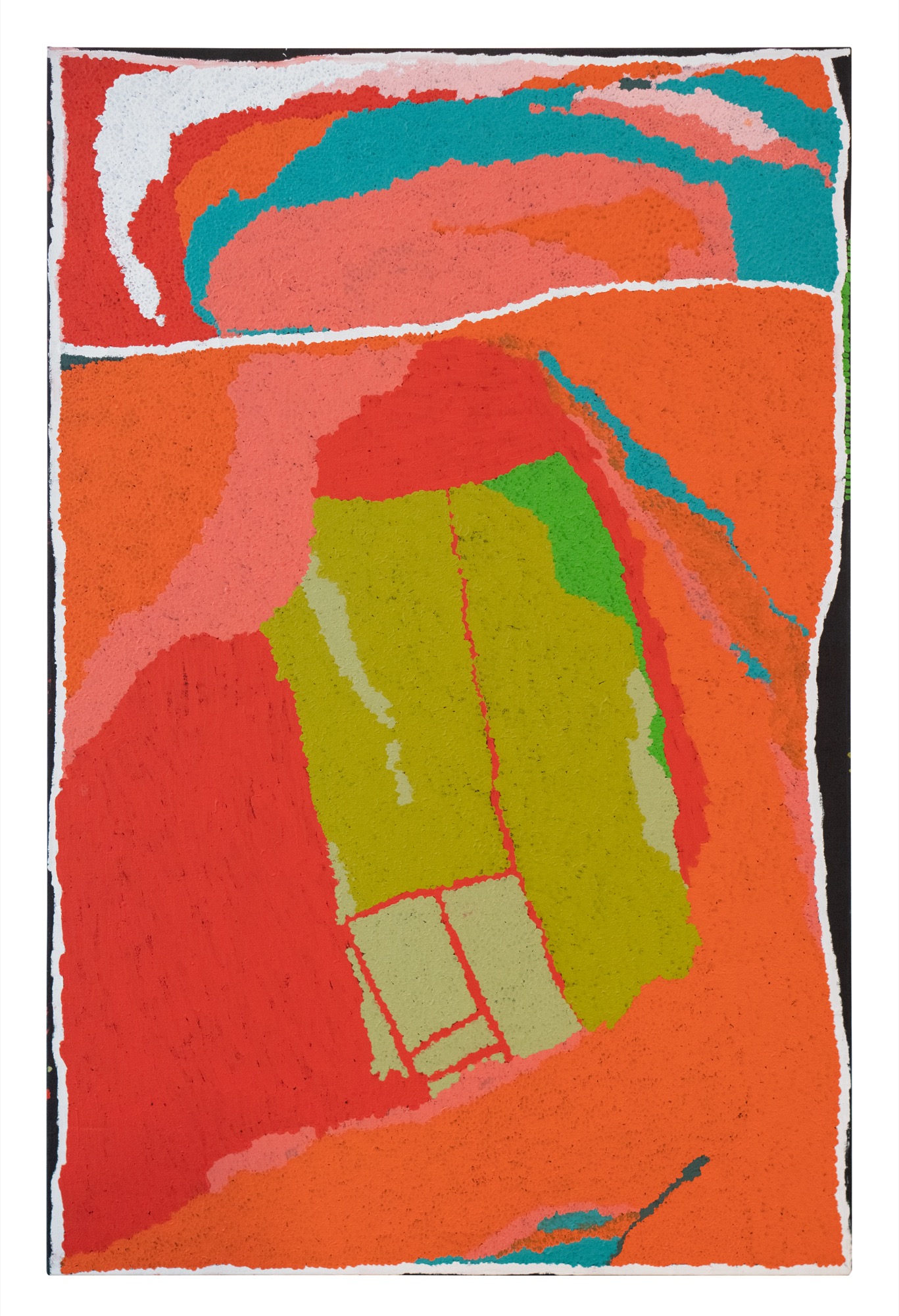
Abstraction has been a conceptual foundation for theorising modernism. The tendency toward abstraction has been one of the shorthand definitions of modern art and is one way that anthropologists have made sense of the painting movement. In longitudinal studies of painting from Balgo and Papunya respectively, John Carty and Fred Myers trace the shift away from iconography and to more painterly abstraction.18 This is also the case for the Yulparija artists. As she painted more, Webou moved from the iconography of Pinkarlarta (2004) to a more painterly, colourful and all-over compositions such as Pinkarlarta (2006, fig. 2). Carty’s book, Balgo: creating Country (2021), argues that this tendency to abstract painting at Warlayirti Artists does more than represent Country; it recreates this Country and the artists’ relation with it. Myers tackles the central contradiction of modernity and Indigeneity by arguing that Papunya painting creates a dialectic between emplacement and displacement; that paintings imply a displacement, because they are interpreted as visual artefacts and part of a Western landscape tradition, but that the objectification of land through art does not imply a distance from it. Myers wants to keep both modernity and relationality in play, writing that:
On the one hand, the paintings have been celebrated for offering an Aboriginal sense of place; on the other hand, these two-dimensional objects are sometimes considered themselves to be expressions of a colonized subjectivity, a colonial project, reflecting the subject/object duality in their prioritizing of vision. For some critics, this has rendered such paintings inauthentic and for others a product of displacement.19
There is, of course, no reason that two cannot be at once: that alienation can co-exist with spiritual habitation, and that modernity can co-exist with Indigeneity. John Kean describes Kaapa Tjampitjinpa and Tim Leura Tjapaltjarri striking this balance in the compositional geometries they invented at Papunya in the early 1970s, as they adapted ancestral designs to the rectilinear format of the boards that they were painting on.20 Kean’s book Dot, Circle and Frame describes “the tension between the interconnected and unbound space of Indigenous ontology and the curtailed and cadastral representations of space common to the European tradition.”21 The painting movement and the modernist legacy of Papunya lies as much in the transformation of this ontology as it does in formal invention. As Kaapa and Leura registered the experience of living in a new Aboriginal township, with its classrooms and communal dining rooms, they adopted styles of painting that reflected its forms.
The dialectics of dwelling and displacement, colonisation and decolonisation, are all simultaneously at work in the remote painting movement. The problem with emphasising one side of these tensions over the other is to reproduce the Othering of the Indigenous all over again, as artists are reduced to either modernity or relationality, and Aboriginal art to a symptom of colonialism or Country. The expressive colours of the Yulparija at Bidyadanga are modern insofar as they express the displacement that this desert people experienced as they moved away from their jila, as well as the depth of feeling and relationality for these same jila. The paintings are complex artefacts of life as part of a diaspora of people living around the Great Sandy Desert.
Poppy Lever, art co-ordinator at Warlayirti Artists in the Balgo community, describes the complexities of living off Country for Western Desert people:
There’s people, Wuntupayi [Jane Gimme], and her cohort of senior artists now, they’ve been painting for Warlayirti for twenty, twenty-five, thirty years and the vast majority of those people have never stepped foot on their own ancestral country. There’s eight language groups in Balgo. Balgo is Jaru country, although Kukatja mob have custodianship over Balgo. So Jaru is one language in Balgo, there’s another seven languages and these are from country in far flung corners of the desert. People have been painting the same specific tree or the same specific waterhole for twenty years, imagine you painting that one thing, you’ve only heard about it through story and song, and perhaps pictures but probably not even that.22
When remote artists say, “I am sad for that country” or “I am missing my country” it may be that they have not visited this country for decades, if at all. The distance of artists from their country is replicated throughout the north-west of Australia. The Wandjina and Ungudd painters of the Mowanjum community north of Broome are exiles from the rocky country of these spirits and live instead on Nyikina country. In Fitzroy Crossing the artists working at Mangkaja Arts are from all over the region and include the Walmajarri from the Great Sandy Desert to the south. Historically, such identities came into being as families migrated from one place to another, and as they distinguished themselves from others. The way that people came to identify as Walmajarri, Yuparija or to another group and not another, came when people walked into missions, pastoral stations and townships. At Bidyadanga the painter Lydia Balbal is known as Mangala rather than Yulparija because she came in from the Great Sandy Desert in 1974 rather than in 1967, when the Yulparija arrived, although she is from the same network of jila. Underlying the identitarian system by which Western Desert people are identified today, they are immersed in a multiplicity of interrelations. The Walmajarri and Yulparija, for example, are closely related, with Yulparija artists the direct relations of the famous Walmajarri artists Rover Thomas, Sonia Kurrara and Jimmy Pike. At Balgo, far to the east of Bidyadanga, the maverick colourist Boxer Milner Tjampitjin is Walbidi’s uncle. The Yulparija are immersed in a relationality not only with the other language and cultural groups at Bidyadanga, but with relatives across the north-west of Australia.
With this history in mind, it is possible to make some provisional generalisations about the way that artist colonies of remote Australia function, and how they differ from other artist colonies. The Yulparija colony is, after all, not the only artist colony. Remote Australia is made up of a diaspora of artists working away from their countries, whether in Fitzroy Crossing or Mowanjum. A first generalisation is that a Western Desert artist colony needs to undertake detailed intercultural negotiations in order to function at all. The Yulparija colony at Bidyadanga could only paint after carefully considering their hosts, the Karajarri. Such negotiations are also part of the history of other remote art movements. To bring the Kuirr Kuirr ceremony, and ultimately the Turkey Creek ochre painting movement, into being, Walmajarri painter Rover Thomas negotiated with the Gija people on whose country he lived.23 Visiting Yuendumu for a sports event, the Kaapa School painters of the early Papunya movement negotiated with their Pitjanjtajara relations after they took issue with the representation of shared ceremonies.24 The art history of the Western Desert is a history of diplomacy, conflict and negotiation in the aftermath of migrations to missions, townships and settlements. A second, provisional generalisation about Western Desert artist colonies is that the particular art made in these modern settlements never unproblematically represents Country. The style of works that come out of remote settlements is situated and situational, relating as much to the society in which it is painted as to the country it represents. While painters take the country they have left behind as their subject, their styles may be influenced by their new circumstances, whether this be life on a colourful coastline (the Yulparija painters), or amidst the rectilinear forms of houses and kitchens (Kaapa and Leura). The history of remote Australian art is a history of displacement and alienation from Country as much as belonging to it. The Yulparija artists in Bidyadanga offer one story of displacement and alienation. As language groups left their parts of the Western Desert, they began negotiating and developing new identities in relation with the places that they had settled. The Aboriginal art movement offered opportunities to visualise these complexities in paint, through which it is possible to begin to unravel the dense histories and lives of remote Australian artists.
-
Emily Rohr, “Bidyadanga,” in Beyond sacred: recent painting from Australia’s remote Aboriginal communities: the collection of Colin and Elizabeth Laverty (Hardie Grant, 2008), 160; Emily Rohr, “Yulparitja artists from Bidyadanga: a proposal for a retrospective,” unpublished manuscript, author’s collection, c. 2015. ↩
-
Daniel Aime Vachon, “The Serpent, the word and the lie of the land: the discipline of living in the Great Sandy Desert of Australia,” (PhD diss., University of Toronto, 2006), 103. http://hdl.handle.net/1807/117352 ↩
-
Murungkurr Terry Murray, “Listening to Country: The inseparable links between family and Dreaming on the ‘Canning Stock Road (Part Two),’” National Museum of Australia, 2009. https://www.nma.gov.au/exhibitions/yiwarra-kuju-canning-stock-route/essays/listening-country/stories-paint ↩
-
See for example J. Kēhaulani Kauanui, “‘A structure, not an event’: settler colonialism and enduring indigeneity,” Lateral: Journal of the Cultural Studies Association 5, no. 1 (Spring 2016): https://csalateral.org/issue/5-1/forum-alt-humanities-settler-colonialism-enduring-indigeneity-kauanui/ ↩
-
Evelyn Araluen Corr, “Inscription and the settler colony: theorising Aboriginal textuality today,” Australian Literary Studies 39, no. 1 (2024), 1-23. https://doi.org/10.20314/als.cf065ede89 ↩
-
Mervyn Mulardy in conversation with the author, 24 May 2018; see also Helmut Petri and Gisela Petri-Odermann, “Stability and change: present-day historic aspects among Australian Aborigines,” in Australian Aboriginal anthropology: modern studies in the social anthropology of the Australian Aborigines, ed. Ronald M. Berndt (University of Western Australia Press for the Australian Institute of Aboriginal Studies, 1970), 261. ↩
-
Petri and Petri-Odermann, “Stability and Change,” 272. ↩
-
Erich Kolig, “Darrugu: secret objects in a changing world,” in Politics of the secret, ed. Christopher Anderson (University of Sydney, 1995), 27-42. ↩
-
Petri and Petri-Odermann, “Stability change: present-day historic aspects among Australian Aborigines,” in Australian Aboriginal anthropology: modern studies in the social anthropology of the Australian Aborigines, ed. Ronald M. Berndt (University of Western Australia Press for the Australian Institute of Aboriginal Studies, 1970), 271-272. ↩
-
Steve Hawke, A town is born: the story of Fitzroy Crossing (Magabala, 2013), 196. ↩
-
Emily Rohr, PITI: An exhibition by Lydia Balbal, exhibition catalogue (Outstation, 2010). ↩
-
Daniel Walbidi, “Daniel Walbidi in conversation with Lucy Foster and Emily Rohr,” D’Lan Contemporary interview, 25 May 2024, 44:31. https://www.youtube.com/watch?v=yZwci9mmrYs ↩
-
Tristen Harwood, “From landscape to landrelation,” in 65,000 years: a short history of Australian art, ed. Marcia Langton and Judith Ryan (Thames & Hudson, 2024), 304-314. ↩
-
John Carty, Jane Gimme and Poppy Lever, “Warlayirti wangka: talking art and country,” D’Lan Contemporary interview, 28 June 2023, 42:16. https://www.youtube.com/watch?v=4wkeLuze7OY ↩
-
Charles Baudelaire, “The painter of modern life” (1863), reprinted in The painter of modern life and other essays, trans. and ed. Jonathan Mayne (Phaidon, 1995), 1-40; T. J. Clark, The painting of modern life: Paris in the art of Manet and his followers (Princeton University Press, 1999). ↩
-
See for example Ian McLean, “Crossing Country: tribal modernism and Kuninjku bark painting,” Third Text 20, no. 5 (2006): 599–616; and Ian McLean, “Modernism and the art of Albert Namatjira,” in Mapping modernisms: art, indigeneity, colonialism, ed. Elizabeth Harney and Ruth B. Phillips (Duke University Press, 2018), 187-207. ↩
-
Henry Skerritt, “Irrititja kuwarri tjungu / past and present together,” in Irrititja kuwarri tjungu / past and present together: fifty years of Papunya Tula artists, ed. Fred Myers and Henry Skerritt (Kluge-Ruhe Aboriginal Art Collection of the University of Virginia, 2022), 9. ↩
-
John Carty, Balgo: creating Country (UWA Publishing, 2021); Fred Myers, “Emplacement and displacement: perceiving the landscape through Aboriginal acrylic painting,” Ethnos 78, no. 4 (2013): 435-463. https://doi.org/10.1080/00141844.2012.726635 ↩
-
Myers, “Emplacement and displacement,” 439. ↩
-
John Kean, Dot, circle and frame: the making of Papunya Tula art (Upswell, 2023), 221-238. ↩
-
Kean, Dot, circle and frame, 84-5. ↩
-
John Carty, Jane Gimme and Poppy Lever, “Warlayirti wangka.” ↩
-
Will Christensen, “Paddy Jimanji and the Guirr Guirr,” in Images of power: Aboriginal art of the Kimberley, ed. Judith Ryan (National Gallery of Victoria, 1993), 33. ↩
-
R. G. (Dick) Kimber, “Politics of the secret in contemporary Western Desert art,” in Politics of the secret, ed. Christopher Anderson (University of Sydney, 1995), 128-129. ↩
Darren Jorgensen is an Associate Professor in the School of Design at the University of Western Australia. His most recent book is The Illustrated Literature of the Strelley Mob(UWAP, 2027), co-authored with Inge Kral. He has also recently co-curated the exhibitions Strike Camps: The Photography of John Wilson at the Berndt Museum and The Strelley Mob at the John Curtin Gallery, that are both touring regional galleries in Western Australia in 2027; and Everlasting Inscription: Wang Qingsong at the Cullity Gallery in Perth for the 2025 Art Association of Australia and New Zealand conference.
Bibliography
- Araluen Corr, Evelyn. “Inscription and the settler colony: theorising Aboriginal textuality today.” Australian Literary Studies 39, no. 1 (2024): 1–24.https://doi.org/10.20314/als.cf065ede89
- Baudelaire, Charles. The painter of modern life and other essays., edited and translated Jonathan Mayne. Phaidon, 1995.
- Carty, John. Balgo: creating Country. UWA Publishing, 2021.
- Carty, John, Jane Gimme and Poppy Lever. “Warlayirti wangka: talking art and country.” D’Lan Contemporary, Melbourne. 28 June 2023. https://www.youtube.com/watch?v=4wkeLuze7OY
- Christensen, Will. “Paddy Jimanji and the Guirr Guirr.” In Images of power: Aboriginal art of the Kimberley, edited by Judith Ryan. National Gallery of Victoria, 1993.
- Clark, T. J. The painting of modern life: Paris in the art of Manet and his lollowers. Princeton University Press, 1999.
- Hawke, Steve. A town is born: the story of Fitzroy Crossing. Magabala, 2013.
- Harwood, Tristan. “From landscape to landrelation.” In 65,000 years: a short history of Australian art, edited by Marcia Langton and Judith Ryan. Thames & Hudson, 2024.
- Kauanui, J. Kēhaulani. “‘A structure, not an event’: settler colonialism and enduring indigeneity.” Lateral: Journal of the Cultural Studies Association 5, no. 1 (Spring 2016): https://csalateral.org/issue/5-1/forum-alt-humanities-settler-colonialism-enduring-indigeneity-kauanui/
- Kean, John. Dot, circle and frame: the making of Papunya Tula art. Upswell, 2023.
- Kimber, R. G. (Dick). “Politics of the secret in contemporary Western Desert art.” In Politics of the secret, edited by Christopher Anderson. University of Sydney, 1995.
- Kolig, Erich. “Darrugu: secret objects in a changing world.” In Politics of the secret, edited by Christopher Anderson. University of Sydney, 1995.
- McLean, Ian. “Crossing Country: tribal modernism and Kuninjku bark painting.” Third Text 20, no. 5 (2006): 599–616. https://doi.org/10.1080/09528820601010445
- McLean, Ian. “Modernism and the art of Albert Namatjira.” In Mapping modernisms: art, indigeneity, colonialism, edited by Elizabeth Harney and Ruth B. Phillips. Duke University Press, 2018.
- Murray, Murungkurr Terry, “Listening to Country: The inseparable links between family and Dreaming on the ‘Canning Stock Road (Part Two),’” National Museum of Australia, 2009. https://www.nma.gov.au/exhibitions/yiwarra-kuju-canning-stock-route/essays/listening-country/stories-paint
- Myers, Fred R. “Unsettled business: acrylic painting, tradition and indigenous being.” Visual Anthropology 17, nos 3–4 (2004): 247–271.
- Fred Myers. “Emplacement and displacement: perceiving the landscape through Aboriginal acrylic painting.” Ethnos 78, no. 4 (2013): 435–463.https://doi.org/10.1080/00141844.2012.726635
- Petri, Helmut and Gisela Petri-Odermann. “Stability and change: present-day historic aspects among Australian Aborigines.” In Australian Aboriginal anthropology: modern studies in the social anthropology of the Australian Aborigines, edited by Ronald M. Berndt. University of Western Australia Press for the Australian Institute of Aboriginal Studies, 1970.
- Rohr, Emily. “Bidyadanga.” In Beyond sacred: recent painting from Australia’s remote Aboriginal communities: the collection of Colin and Elizabeth Laverty. Hardie Grant Books, 2008.
- Rohr, Emily. PITI: An exhibition by Lydia Balbal. Outstation, 2010.
- Rohr, Emily. “Yulparitja artists from Bidyadanga: a proposal for a retrospective.” Unpublished manuscript, author’s collection, c. 2015.
- Skerritt, Henry. “Irrititja kuwarri tjungu / past and present together.” In Irrititja kuwarri tjungu / past and present together: fifty years of Papunya Tula artists, edited Fred Myers and Henry Skerritt. Kluge-Ruhe Aboriginal Art Collection of the University of Virginia, 2022.
- Vachon, Daniel Aime. “The Serpent, the word and the lie of the land: the discipline of living in the Great Sandy Desert of Australia.” PhD diss., University of Toronto, 2006. http://hdl.handle.net/1807/117352
- Walbidi, Daniel. “Daniel Walbidi in conversation with Lucy Foster and Emily Rohr.” D’Lan Contemporary. 25 May 2024. https://www.youtube.com/watch?v=yZwci9mmrYs