Colonies of Colonials Inside the Centres? New York 1960s and 1970s
Did the constellation of Australian artists living at or near the Chelsea Hotel, New York, during the late 1960s and early 1970s—notably Brett Whiteley, Tony Woods and Robert Jacks, as well as several others in the city at the time, including Clement Meadmore, Ian Burn, Robert Hunter, Denise Green and Virginia Cuppaidge—constitute a kind of artists’ colony? Did the conceptual art grouping Art & Language, among whose New York members some Australians were prominent, likewise operate as a kind of artists’ colony?
Thinking of New York in relation to artists’ colonies is to immediately court contradiction, especially during this period, when the city seemed—not least to itself, but also to many in artworlds elsewhere—to rule as the international art centre. Contradictory also, in that centres rarely contain artists’ colonies in the sense in which these are usually understood. The famous ones, such as those at Pont-Aven, Abramtsevo, Skagen, Bergen, St Ives, Woodstock and East Hampton, were all deliberately constituted at some physical distance from nearby art centres—usually, not too far away, and with direct or indirect pipelines to central city art precincts. Thus The Abbey, at New Barnet, founded by William Ohly, owner of a gallery in London, was a fifteen-minute walk from Cockfosters Station, then forty minutes on the Piccadilly line to Mayfair. Artists typically removed themselves, for a time, to a somewhat distant “colony”—aping the metropolitan structure in reverse to find some relief from it. One might say that they colonized themselves, in an anti-colonial gesture, together. More accurately, perhaps, they sought to find an adjacent space to think and work, a place to imagine alternative artistic practices. So they went to the regions, away from the capital cities, where they sought spaces of exception from the constraints of both the metropole they had spurned and the region in which they now lived and worked.
That the shared nationality of several artists who happen to be in a foreign city at the same time enables, even encourages, them to band together is a staple occurrence in the history of art. In Europe, for example, generations of artists have, since the seventeenth century, formed cohorts while studying in Rome, and later while making their way in Paris during the first half of the twentieth century. Being subjects of the British empire, Australian artists habitually spent time in London, with generational cohorts regularly forming, before New York became the place to be. During the 1960s it was legitimate to see the Australian artists in London as constituting a colony—indeed, they called themselves “the Ladbrokers” after the suburb Ladbroke Grove in which most lived. The modern pattern is clear: small colonies of colonial artists come together in the imperial centres. The interest is in how that experience informed the art of each participant and, further, how its shared nature impacted broader developments in artistic practice.
There is a genuinely art historical question—beyond the narrow scope of this paper—in asking whether the late 1960s through the mid-1970s marks the moment when this pattern reached its apogee and began to disintegrate, as decolonization and globalization began their world-changing work while, by no coincidence, artistic practice in many places throughout the world began to disrupt its deepest traditions, to question the modernist hegemony and find ways to become contemporary.
Australian artists in New York 1965–1975
After major successes in London with his Christie series (1964–1965), Ladbroker Brett Whiteley arrived in New York in November 1967 to take up a Harkness Fellowship. These Fellowships provided a living wage for twenty-one months, the only obligations being to spend some time, a month or so, traveling the country and to write a 500-word report at the end.1 Support for accommodation and a studio was provided. Brett and Wendy Whiteley moved into the already-fabled Chelsea Hotel, to a rooftop apartment, and he soon found a studio nearby on the same side of 23^rd^ Street.
Robert Jacks moved from Melbourne to Toronto in 1967 with increasing visits to New York. The dates are ambiguous; most records show that he was in town from 1969, with a studio on 23^rd^ opposite the Chelsea. By 1972 I know that he worked at Fanelli’s, an artists’ bar on Prince Street, SoHo, a block down from where he later had a studio. He was in NY until 1978. The next Australian Harkness Fellow after Whiteley, Tony Woods, arrived from Hobart in late 1968, and took a studio caddy corner from Jacks on 23^rd^ and 7^th^ Avenue. Jacks was already friendly with Ian Burn, who had arrived in 1967 after three years in London, and who, in turn, befriended Tony Woods. Whiteley and Woods became close friends and kept regular company. Jacks often joined them, as did Irish artist Noel Sheridan, who subsequently had a major career as an artist and arts administrator in Australia, not least as director of the Experimental Art Foundation in Adelaide for many years. In July 1967 Ian and Avril Burn moved into a loft on Sixth Avenue, where Mel Ramsden, with whom Burn had worked intensively in London, soon arrived to join them. The three later moved downtown to 250 Bowery which, along with Joseph Kosuth’s loft at 60 Grand Street, became the headquarters of the New York branch of Art & Language until 1976, when, following the break-up of the group, Burn left for Sydney and Ramsden went to join Michael Baldwin at Middleton Cheney, near Banbury, UK.
To get the full picture of the possibility of an Australian artists’ colony in New York at the time, the other artists present should be mentioned. Sculptor Clement Meadmore (1963 until his death in New York in 2005); painters Sidney Ball (1962–65), Margaret Worth (1969–1984), Richard Crichton (Harkness Fellow 1967–69), Albert Tucker (most of 1967 and part of 1969, staying at the Chelsea with Crichton), Michael Johnson (London 1960–67, in New York for some months 1967–8, returned 1969), Robert Hunter (sixteen or eighteen months 1968–9); Denise Green visited in 1969, and has lived in the city since 1972; Virginia Cuppaidge visited 1968, then stayed from 1969 to 2017. Several other Australian artists visited the city for relatively shorter periods, in most cases with significant impacts on their self-understanding and their practice. From 1968 to 1975, curator John Stringer worked as assistant director of the international program of the Museum of Modern Art, meanwhile hosting visiting Australian artists in a backroom in his loft and gallery space. Critics Robert Hughes and Patrick McCaughey were also in town during these years. Hughes moved from London in 1970 to become art critic for Time magazine, with New York remaining his base until his death in 2012. McCaughey preceded me as a Harkness Fellow (1970–2).2 I was there from September 1972 to the end of 1974, then back for some months 1975–6. For the three of us, as for the artists mentioned, the experience was transformatory.
These artists and their families immersed themselves in the city. For example, in 1968, Liz Sheridan and Wendy Whiteley established an antique fur boutique named The Put On. It quickly became a hot shop. Its energy was utterly different from the kind of seriousness with which the male artists took their work. There were no female artists accepted into this cohort at the time. In her book An Artist’s Odyssey, Denise Green, who came in 1969, settled in 1972, and still lives there, does not recall receiving much help from any of these artists.3
So, the potential for an Australian-accented artists’ colony in New York was clearly present, not least due to the tendency of nationals in a foreign place to assist each other in the details of familiarization. This predisposition breeds trust, which is then reinforced by the mutuality of shared experience, including sharing the reasons why you left Australia, the love/hate mix that drives you away and draws you back. The lineaments of your emerging identity are discovered in yourself, and in commonality with others undergoing the same process of self-discovery. You gather together in a tentative, testing and usually temporary exile. Few among you will become expatriates, for you are here for a time, however unspecified. Your centre remains the Australian city to which you intend to return.
Another positive was the disposition within the New York artworld at the time for artists from anywhere and everywhere—especially those who found that they had similar interests as artists—to help each other out, by talking about the work, the task, the ambitions, one’s hopes; by going to shows together; by introductions to those who might help you out; by sharing competitors and enemies; by partying, hanging out… Facing the challenges of the city together. This has many dimensions.
The New York artworld during the 1960s and 1970s was relatively small. Almost everybody was accessible with some effort. Most were welcoming. Denise Green discerned, in 1972, what she calls “three spheres” in the artworld: “well-established, commercially successful galleries; cutting-edge galleries; and a network of alternative spaces.”4 This is a reductive, market-defined vision of what was, in fact, a more complex visual arts exhibitionary complex, but it makes sense from the viewpoint of young artists seeking recognition and to build a reputation, striving to make a living within a system that they did not fundamentally question.
The established galleries, located mostly in Midtown, operated on the basis of selling accomplished, familiar paintings, sculptures, prints and drawings by individual artists to well-heeled clients. The “cutting-edge” galleries, such as that of Leo Castelli and John Weber, mostly located downtown, in SoHo, showed avant-gardist experimental work in the several forms through which late modernist art was reinventing itself in the work of artists such as Donald Judd, Richard Serra, Robert Morris and Hans Haacke. The “alternative spaces” questioned the system itself, particularly modernism as a framework, including many of these “cutting-edge” practices. They included The Kitchen, 112 Greene Street, and Artists Space.5 Others sprung up to show the work of those systemically excluded: for African American artists, Skoto Gallery on Prince Street and the Studio Museum in Harlem; for women artists, A.I.R. (Artists in Residence) Gallery and W.A.R. (Women Artists in Revolution).
Like all other artists in the city at this time, the Australian artists were divided between these spheres. Competition between artists is as natural as cooperation. It became exacerbated by these divisions as they emerged and became more distinct during this period, which was not so healthy for colony formation.
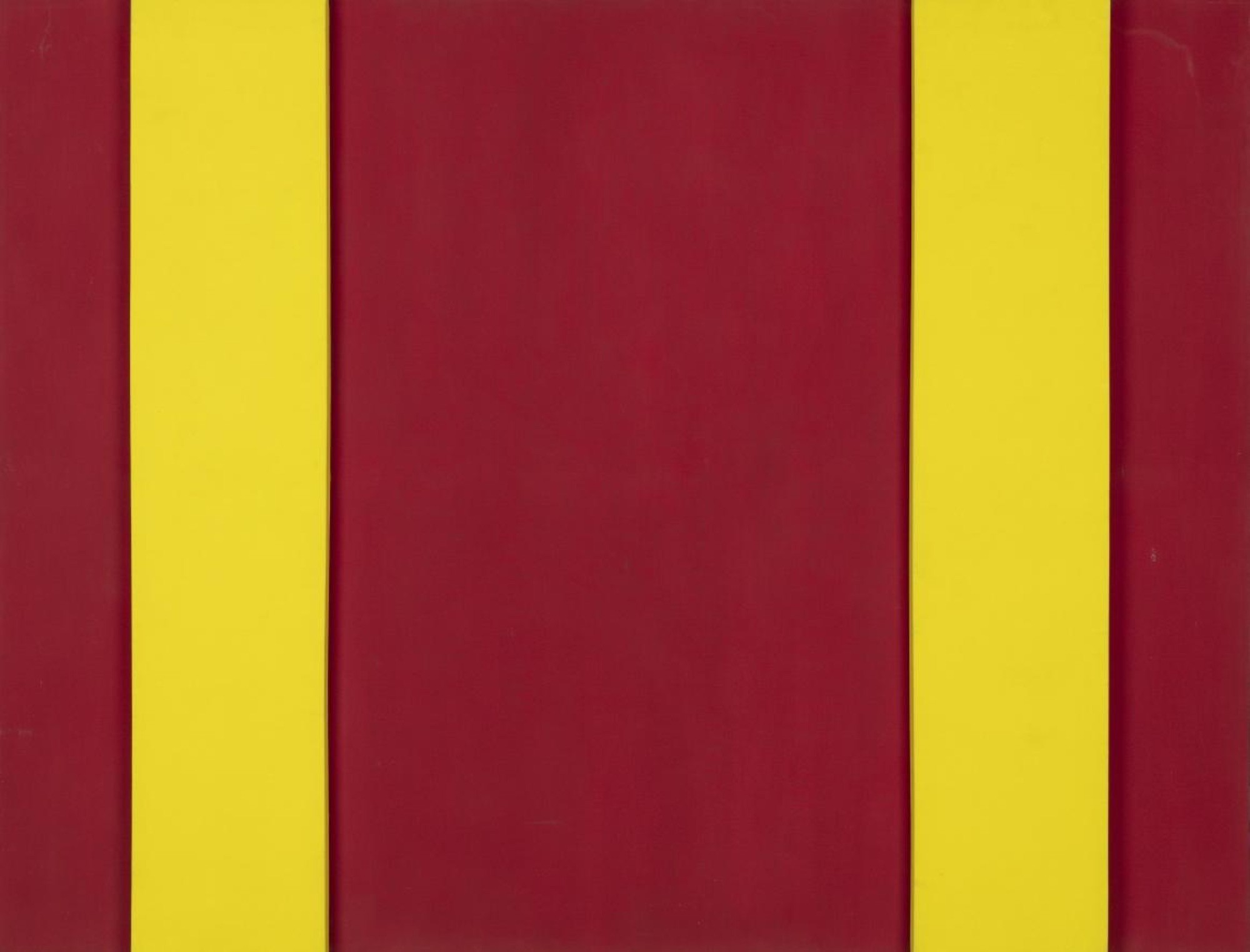
The individual character of each artist, and perhaps more so the distinctive nature of their projects, also mitigated against forming a colony. Michael Johnson, for example, avers that he had seen a lot of work by US artists in London and had already determined his distinctive direction before getting there. Works such as Insult (1969, fig. 1) are evidence. On arrival, he could see immediately that lyrical abstraction had run its course, and that Conceptual Art was setting the agenda for the future of art in general. But the trajectory of his work resisted this pull. Consequently, as he later recalled: “I walked around New York like a bloody ghost.”6 What he did get from American painting was the imperative of scale. This has remained with him ever since.
The situation for Australian artists in New York might be contrasted to that of artists from Latin America during the same period. Obviously, there are massive differences of scale, proximity and deep historical connection. Nevertheless, several nations in South America were, or were becoming, sub-imperial powers in relation to the United States, as was Australia.7 Cultural relations were significant within both overt diplomacy and covert connections. Aimé Iglesias Lukin describes Latin American artists in New York since the 1960s as “not a uniform group, but a network of overlapping ones, their constituents interacting and exchanging ideas.”8 Not surprising for a region consisting of several subregions, twenty-two nationalities and many languages (although Spanish and Portuguese predominated, reflecting their shared history of colonisation). Immigrant communities established themselves in the city during the early twentieth century, welcoming several significant artists from the region, such as Marius de Zayas, Joaquín Torres-García and Marisol Escobar, who worked there for long periods. During the 1960s and 1970s, artists were among the refugees from the dictatorships that spread through South America and the Caribbean. These artists favoured shared projects, exhibitions, spaces, publications and events, some of which—El Museo del Barrio, for example—became institutions. Their experience has impacted wider understandings of art historical development during this period. For example, Latin American perspectives were crucial to the argument advanced in landmark exhibitions such as Global Conceptualism: Points of Origin, 1950s to 1980s, curated by Luis Camnitzer, Jane Farver, and Rachel Weiss, at the Queens Museum, New York, in 1999.
In contrast, Australian artists in New York, less embedded in a large immigrant community located on a distinctive neighbourhood, have had a much more occasional relationships to the city. This did not, however, reduce their intensity.
The American Dream
In 1968, Brett Whiteley made three paintings entitled New York 1, 2, and 3 (fig. 2). They show that the city itself was a challenging, and consuming, environment in which to live. They picture NYC as it impacts on the artist/viewer, whom he always saw as engaged in an instantaneous, simultaneous, totalising act of looking/experiencing. Reflecting on this phenomenon, he made this astute general comment: “…anyone who sets foot off the plane in New York becomes an American and cannot remain indifferent or aloof by presuming he belongs elsewhere. The existential experience was so hungry that one quickly became possessed with the struggle to reconcile the forces at play just as obsessively as most Americans were doing…”9 The demand seemed, in its American way, to require even more wild individualism inside the pervasive social insanity, not a patient, collective struggle toward a better future. For all his need for others, for all that he doubtless gave them, Whiteley was always an individualist first. And a Romantic, to boot.
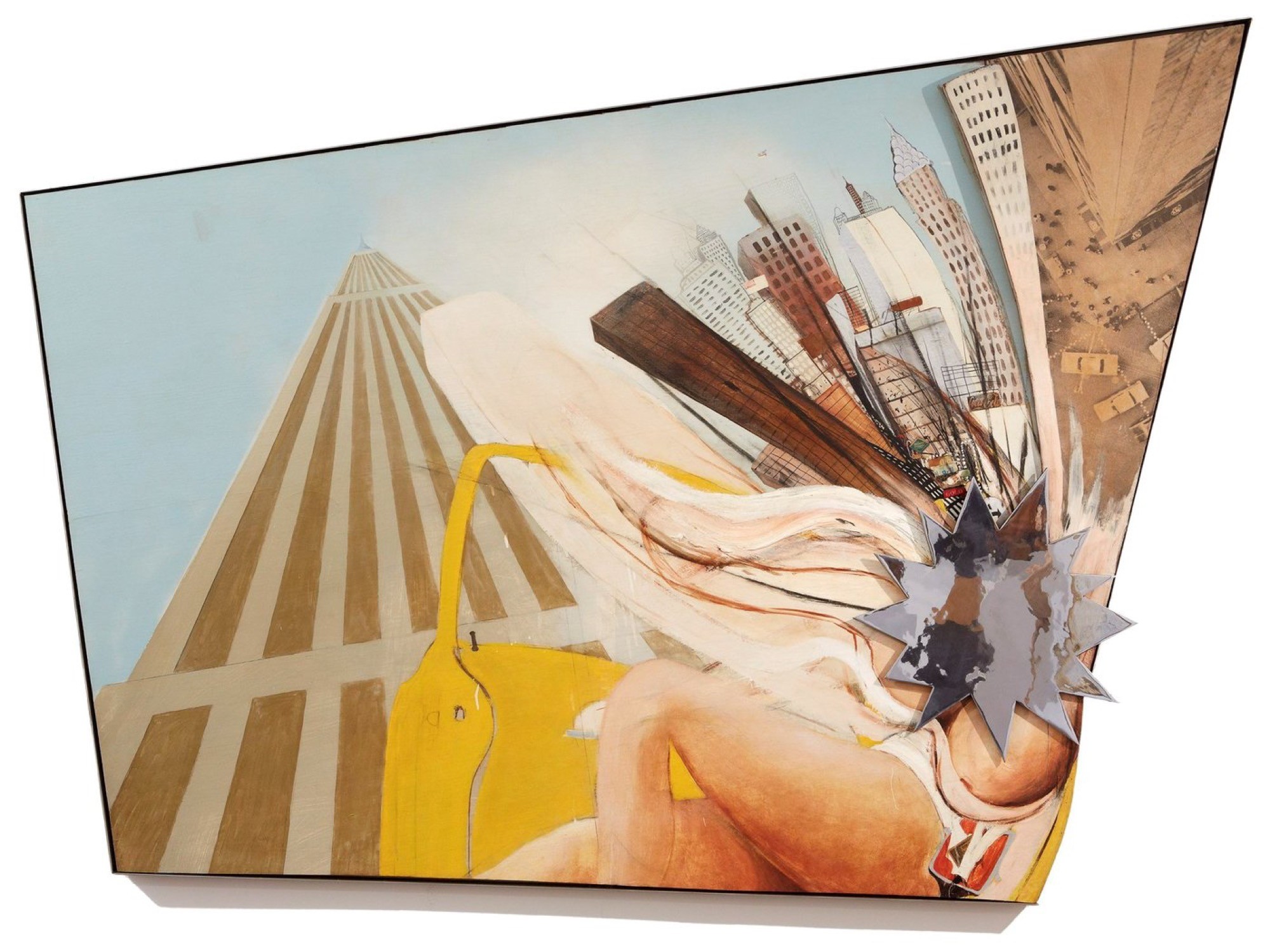
While this was also the default position of most Australian artists, including those in New York, the mood was changing, in the city as elsewhere. As noted, Whiteley had come to New York following a tremendous success in London, in anticipation of having a one-man show in the prestigious Midtown gallery Marlborough-Gerson in the Spring of 1968.10 At the Marlborough-Gerson he showed several surreal objects, the paintings New York 1, 2, and 3, and thirty recently completed works treating subjects such as van Gogh, Gauguin, Ravi Shankar, and especially Bob Dylan and the war in Vietnam.11 Whiteley painted to the sound of Dylan’s “The times they are a-changin’” at full volume.
As Dylan’s song made clear, the United States was undergoing its own full-bore identity crisis—not dissimilar to the one we witness today. To Whiteley’s credit, he took this face on, more so than any of the other Australian artists—indeed, more so than any of his local American-born peers. Warhol’s Death in America series from the early and mid-1960s; Rosenquist’s F-111 (1964–65); Rauschenberg’s mural-scale combine paintings from the same period—these are among the very few close parallels to Whiteley’s ambition and achievement at this time.
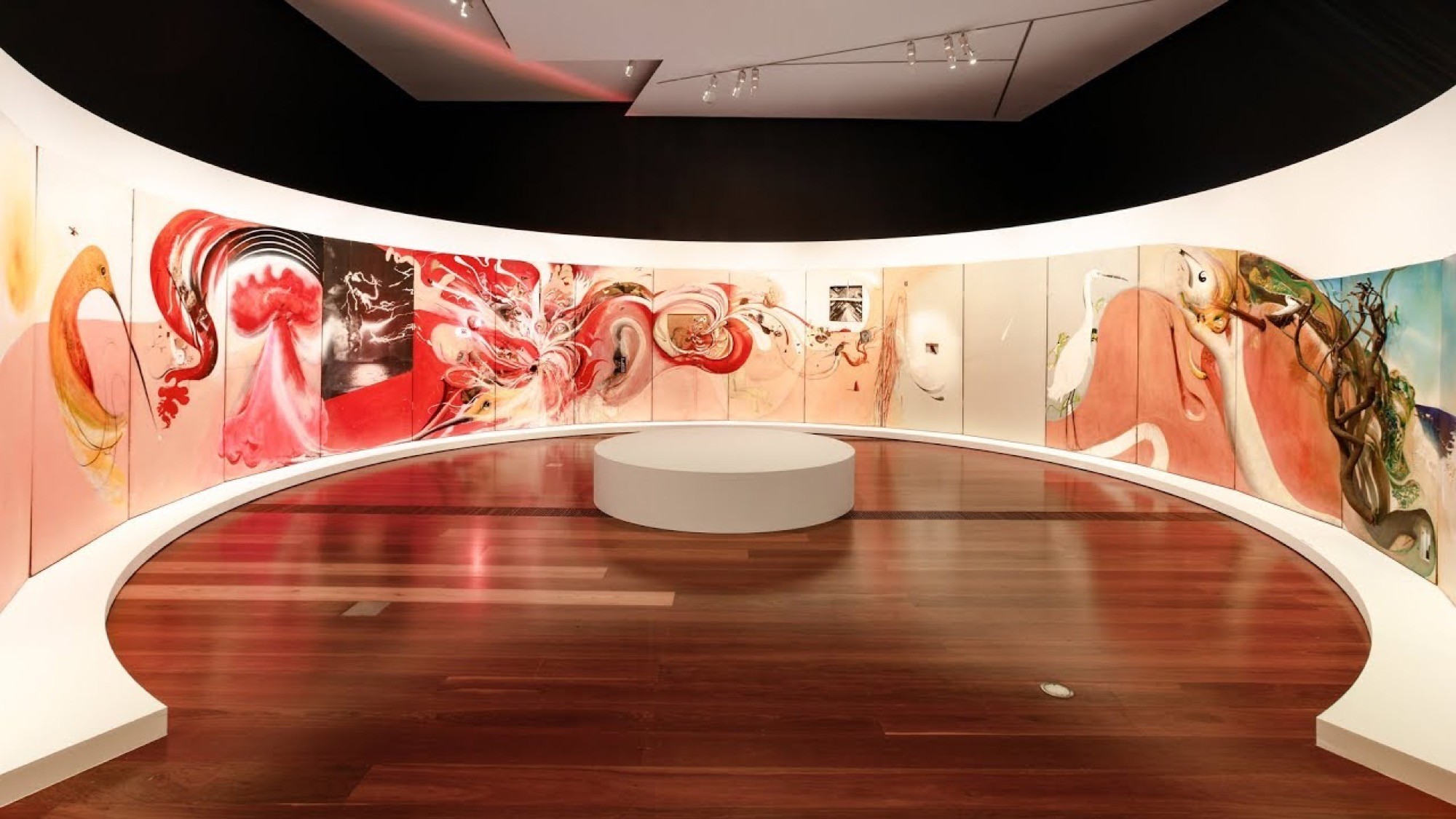
The American Dream (1968–9, fig. 3) consists of eighteen panels designed to be hung in an immersive semi-circle. Whiteley worked on it, almost exclusively, during the last nine or ten months of his time in the States. His commentary in his tract about this work (written for his Bonython Gallery show in June–July 1970 in Sydney) acutely transcribes its arc of gestation and the nature of its impacts: “By the second year I was determined myself to produce a monumental work of art that would summarize the sensation of the impending necessity for America to own up, analyse, and straighten out the immense and immediately seeable MADNESS that seemed to run through most facets of American life.” Then comes the passage cited above about everyone inevitably becoming an instant American the moment you step off the plane. But, “as the work progressed, it developed into a struggle within myself to own up, analyse and straighten out…” This, he avers, became increasingly difficult. “…the MADNESS was now itself upon me… This painting is a record of a struggle and my inability to resolve it, it is an admission of failure.”12 A later reflection on The American Dream is also relevant: “I want to become that [the abyss that was New York] and then transform that sensation into a monumentally sized painting… I couldn’t connect totally to the sensation of being American. I can’t be a black man. Perhaps I can get on to their cerebral time, but not their peculiar sting, the generational poison that’s in their head.”13
Interviewed by Graeme Blundell for his and Margot Hilton’s book, Brett Whiteley: An Unauthorised Life, I remarked that The American Dream could be seen as stage set, or environment, for a performance work, in which of course the artist was the major actor. At the same time, its mural-like scale “could have led him towards public political art.”14 This work was indeed Whiteley’s response to the overtly political aspect of US Pop (as manifest in the aforementioned massive combines of Rauschenberg as well as Warhol’s American Death repetitions and Rosenquist’s F-111). But he did not become a political artist in any of the senses that made sense at the time or thereafter. His broader career trajectory might more accurately parallel those of artists such as Ray Johnson in New York and Bruce Conner in San Francisco, both driven to tackle broad themes from within their self-focused sense of locality.
Robert Jacks’ comment has it right: although his ambitions were entirely contemporary, Whiteley was still working within the artistic languages of the earlier twentieth-century modernist avant-gardes, which were becoming rapidly outmoded.15 If Pollock pushed easel painting into mural scale, Whiteley is here reaching for a panorama that echoes Jack Kerouac’s On the Road, the Route 66 journey across the continent, from “sea to shining sea.” It does so on multiple metaphorical levels, not least by imagining the whole country as a heaving female body that extrudes excesses and must be constantly penetrated by Whiteley’s strange surrogates (mostly birds), until exhaustion is achieved and the only option left is to flee to a distant Pacific paradise. So, in July 1969, frustrated and stalemated, Whiteley literally took off for the remote place depicted in panel eighteen of The American Dream. Deserting everybody, he jumped into a taxi to the airport and went to Fiji, never to return to New York for any sustained period.
One outcome of Whiteley’s tenure was that the Harkness Fellowship administrators became very wary of awarding them to Australian artists. I recall the shock waves that still resounded in the Harkness offices when we went for our first meeting there in September 1972.16 They relented and awarded the Fellowship to Nigel Lendon in 1974. He soon gave up sculpture and joined the Art & Language group. Such total switch-arounds were common for Australian artists visiting the city during this period: Dale Hickey, Paul Partos… the list goes on.
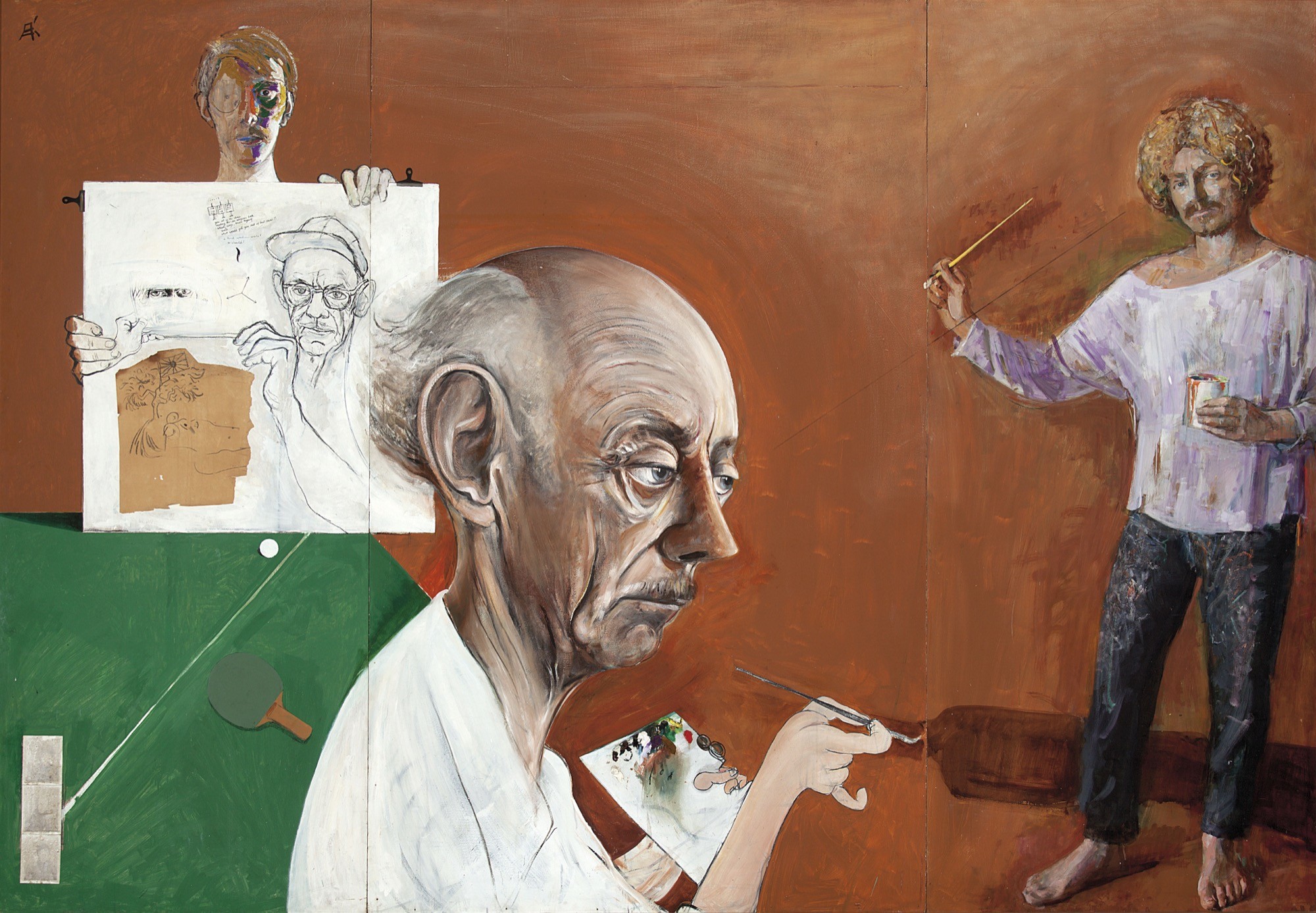
Among the Australian artists in New York, Tony Woods was Whiteley’s closest friend (fig. 4). An accomplished figurative painter from Hobart, Woods took up his Harkness Fellowship in 1968, moved into the Chelsea and found a studio nearby on West 23^rd^ and 7^th^ Avenue. He immediately surrendered his figurative approach to oil painting for an all-over abstraction based on staining cotton duck with pure acrylics. Only the colour sensibility continues through his oeuvre. Whiteley introduced him to Zen, which he fully embraced, matching its selflessness to his practice without being troubled by Whiteley’s rampant contradictions. Sociable, professional, he garnered interest in his work from some local galleries but three months before his Fellowship was due to end a fire engulfed his studio, destroying his work. He left the city in a similarly shattered state to Whiteley.17
Art & Language in NY, late 1960s to mid-1970s
Michael Johnson recalled that “when I arrived in New York, it was definitely conceptual art that had taken the ball out of the court.”18 Ian Burn was a central figure in the New York grouping of Art & Language, that had first taken form in England in 1968 in exchanges between Terry Atkinson, a teacher at the Coventry School of Art, and his student Michael Baldwin. The group quickly expanded to include artists based in towns throughout the UK: Terry Atkinson, Michael Baldwin, Graham Howard, Harold Hurrell, Phillip Pilkington, and David Rushton, as well as London-based art historian and critic Charles Harrison. Their initial network was the art school system in Great Britain, against which they rebelled while often continuing to teach within it.19 The journal Art-Language was founded in 1969, with New York-based conceptualist Joseph Kosuth becoming its American editor. Ian Burn and Mel Ramsden also joined the group in that year. By 1975, A&L NY had grown to include other American artists: Christine Kozloff, Michael Corris, Preston Heller, Andrew Menard, Michael Krugman, and Sarah Charlesworth, as well as Canadian artists Karl Beveridge and Carol Condé, and Australians Nigel Lendon and myself. In 1973, Mayo Thompson of the Red Crayola band joined, leading to the three Music-Language albums: Corrected Slogans (1976), Kangaroo? (1981) and Black Snakes (1983). During 1975, before the group’s implosion, it attracted several others, including Kathy Bigelow, Lizzie Borden, and Paula Ramsden.
Was this an artists’ colony in any of the senses envisaged in this volume? Art & Language, in both Britain and New York, was a collective modelled on an avant-garde art grouping, an academic research team, an ideological think tank, and a political cell—“modelled” in the sense of being deliberately antithetical to each of these. It was bound to such models in that it sought to oppose them as organizational forms as much, more so, than it mimicked them. The instinct was that this was the only way of taking on the challenge of reconceptualizing Art as such, to find the kind of revolutionary theory that would, in the words of Lenin’s famous formula, enable revolutionary artistic practice. “Revolutionary” in Thomas S. Kuhn’s sense of the paradigm-shifting breakthroughs that, while starting small, with a local conundrum, soon required the transformation of what he called “normal science,” that is, Science as such.20
In England in the mid– and later–1960s, in New York in the early through mid-1970s, and in its later iterations in Australia and England, the work of A&L was, by any definition, at the “cutting edge” of artistic practice. However grudgingly, it was acknowledged as such in New York and in artworlds throughout the world. So, in this sense A&L in the UK and NY cannot be seen as an artists’ colony: it was at the centre of world art discourse, albeit at its most critical core. Like most other artists in New York at the time, wherever one came from, we were all provincials, the children of settler colonials active in this centre of the international artworld. Unlike the members of artists’ colonies mentioned earlier, we did not seek an alternative space apart from but within reach of a centre. Rather, we were dedicated to disrupting, from the centre outwards, a world system that, in a deeply debilitating, intolerable paradox, made us—and everyone else in every artworld everywhere—provincials.21
These facts and considerations lead to the conclusion that neither the Australian artists who worked in New York during this period, nor the New York grouping of Art & Language, constituted an artists’ colony. Nonetheless, this review suggests that several Australian artists active in the city at the time underwent transformative experiences and produced remarkable art as a result.
-
The Commonwealth Fund was established in 1918 by heiress Anna Harkness to “do something for mankind.” Its focus was on improving public health care through subsidizing hospitals and training healthcare professionals. Beginning 1925, Fellowships were provided to bring young professionals from English-speaking countries who were active in various fields to the United States for extended study and travel. In recent years the focus has been entirely on healthcare provision. See https://www.commonwealthfund.org/about-us/foundation-history. ↩
-
Patrick McCaughey details his experiences in “The great awakening; New York 1969–71,” chapter seven of his The Bright Shapes and the True Names: A Memoir (Text Publishing, 2003). ↩
-
Denise Green, An Artist’s Odyssey (University of Minnesota Press, 2012). ↩
-
Green, An Artist’s Odyssey, 110. ↩
-
See Julie Ault, ed., Alternative Art, New York, 1965–1985: A Cultural Politics Book for the Social Text Collective (University of Minnesota Press, 2003). ↩
-
Michael Johnson, “Interview,” in Michael Johnson, ed. Barry Pearce (The Beagle Press, 2004), 148; 158; 166. ↩
-
For a compelling recent study of Australia in this role, see Clinton Fernandes, Sub-Imperial Power: Australia in the International Arena (Melbourne University Press, 2022). ↩
-
Amié Iglesias Lukin, “This Must Be the Place: Reimagining Community in New York City,” in This Must Be the Place: Latin American Artists in New York, 1965–1975 (New York: Americas Society, 2021), 20. See also This Must Be the Place: An Oral History of Latin American Artists in New York, 1965–1975 (New York: Americas Society and Institute for Studies on Latin American Art, 2022). For a mapping of responses by artists to being categorized as “Latin American” upon arrival in New York, see Amié Iglesias Lukin, “Contrabienal: Art, Politics, and Latin American Identity in 1970s New York,” [Guggenheim UBS Map | Latin America | Perspectives], 6 May 2015, https://www.guggenheim.org/articles/map/contrabienal-art-politics-and-latin-american-identity-in-1970s-new-york. An earlier study is Jacqueline Barnitz, Latin American Artists in New York Since 1970 (Huntington Art Gallery, University of Texas Austin, 1987). ↩
-
Brett Whiteley, cited in Sandra McGrath, Brett Whiteley (Bay Books, 1979, 2^nd^ ed. 1992), 86. ↩
-
Brett Whiteley: recent work, Marlborough-Gerson Gallery, 41 East 57^th^ Street, New York, May–June 1968. The afterparty was held at the Whiteley’s Chelsea Hotel apartment. ↩
-
Detailed in Michael Organ, “Brett Whiteley in New York: not quite the American dream,” 28 March 2017, [http://brettwhiteleynewyork.blogspot.com]http://brettwhiteleynewyork.blogspot.com/2017/03/november-1967-july-1969.html. ↩
-
Brett Whiteley, cited in McGrath, Brett Whiteley, 85–8. See also the artist talking to journalist Adrian Read, “He climbed into his own picture,” The Australian, 8 November 1969, cited in Margot Hilton and Graeme Blundell, Brett Whiteley: An Unauthorised Life (Macmillan, 1996), 79; and Wendy Whiteley’s comments about Brett believing that he could end American racism etc. in one picture, cited in Barry Dickens, Black + Whiteley: Barry Dickens in Search of Brett (Hardie Grant Books, 2002), 86–7. On Whiteley’s “ridiculous” ambition, see Barry Pearce, Brett Whiteley: Art & Life (Thames & Hudson in association with Art Gallery of New South Wales, 1995), 28–31. See also Ashleigh Wilson, “Fidgeting With Infinity,” in Sasha Grishin, et. al., Baldessin/Whiteley: Parallel Visions (National Gallery of Victoria, 2018), 53–58. For details and an extensive catalogue of works from the New York years, see Michael Organ, “Brett Whiteley in New York: Not Quite the American Dream,” 28 March 2017, [http://brettwhiteleynewyork.blogspot.com]http://brettwhiteleynewyork.blogspot.com/2017/03/november-1967-july-1969.html. ↩
-
Brett Whiteley, cited in Ashleigh Wilson, “Fidgeting With Infinity,” 57. ↩
-
Hilton and Blundell, Brett Whiteley: An Unauthorised Life, 78. The installation of The American Dream at the National Gallery of Victoria in 2018 was indeed an immerse-a-rama, a surround sound mural with circular seating in the centre of the space. See Sasha Grishin, “The American Dream: Brett Whiteley,” National Gallery of Victoria, 26 October 2018, video, 1.0 min., https://www.ngv.vic.gov.au/multimedia/the-american-dream/. ↩
-
Bob Jacks to me, New York, mid-1970s. ↩
-
Wilson cites some Harkness Foundation documents; see Ashleigh Wilson, Brett Whiteley: Art, Life and the Other Thing (Text Publishing, 2016), 129–131; 146; 424; 433. ↩
-
See Garry Willis, “Tony Woods – Harkness Fellow, New York 1968–69,” in Tony Woods: An Archive, ed. Andrew Gaynor (Australian Scholarly Publishing, 2013), 41–51. ↩
-
Michael Johnson, interview with Barry Pearce, in Pearce, Brett Whiteley: Art & Life, 148. ↩
-
See Charles Harrison, Essays on Art & Language (MIT Press, 2003), and Paul Wood, ed., Biting the Hand: Traces of Resistance in the Art & Language Diaspora (Rab-Rab Press, 2024). ↩
-
I advance this model in “Without revolutionary theory…,” Studio International 91, no. 980 (March/April 1976): 134–6; reprinted in C.A.S., Contemporary Art Society Bulletin 2, no. 5, (1976). ↩
-
Provincialism was a major topic for certain members of the group, see Ian Burn, “Provincialism,” Art Dialogue, no. 1 (October 1973): 3–11; reprinted as Burn, “Art is what we do, culture is what we do to other artists,” in Deurle 11.7.73, edited by Fernand Spillemaeckers (MTL Gallery in association with Museum Dhondt-Dhaenens, 1973), and in Ian Burn, Dialogue: Writings in Art History, ed. Geoffrey Batchen (Allen & Unwin, 1992), 131–9. See also my essay, “The Provincialism Problem,” Artforum 13, no. 1 (September 1974): 54–9, https://www.artforum.com/features/the-provincialism-problem-212755/, and in Malasartes (Rio de Janeiro), no. 1 (October—November 1975); and “Draft for an Anti-Textbook,” ed. Ian Burn, Mel Ramsden, Terry Smith, special issue, Art-Language 3, no. 1 (September 1974). ↩
Terry Smith is the Slade Professor of Fine Art, University of Cambridge, 2025–2026; the Andrew W. Mellon Emeritus Professor of Contemporary Art History and Theory, University of Pittsburgh; Professor in the Division of Philosophy, Art and Critical Thought, European Graduate School; and Faculty at Large, Curatorial Program, School of Visual Arts, New York. In 2010, he became Australia Council Visual Arts Laureate and received the Mather Award for art criticism from the College Art Association (USA), which named him its Distinguished Teacher of Art History in 2022. Books include What is contemporary art? (2009), Contemporary art: world currents (2011), Thinking contemporary curating (2012), Talking contemporary curating (2015), The contemporary composition (2016), One and five ideas: on conceptual art and conceptualism (2017), Art to come: histories of contemporary art (2019), Curating the complex & the open strike (2021), Iconomy: towards a political iconomy of images (2022) and, with Fred Myers, Six paintings from Papunya: a conversation (2024). He edited Okwui Enwezor, Selected writings, two volumes (2025).
Bibliography
- Ault, Julie, ed. Alternative Art, New York, 1965–1985: A Cultural Politics Book for the Social Text Collective. University of Minnesota Press, 2003.
- Barnitz, Jacqueline. Latin American Artists in New York Since 1970. Huntington Art Gallery, University of Texas Austin, 1987.
- Burn, Ian. Dialogue: Writings in Art History, edited by Geoffrey Batchen. Allen & Unwin, 1992.
- Burn, Ian. “Provincialism.” Art Dialogue, no. 1 (October 1973): 3–11.
- Burn, Ian. “Art is what we do, culture is what we do to other artists.” In Deurle 11.7.73, edited by Fernand Spillemaeckers. MTL Gallery in association with Museum Dhondt-Dhaenens, 1973.
- Burn, Ian, Mel Ramsden and Terry Smith, eds. “Draft for an Anti-Textbook.” Special issue, Art-Language 3, no. 1 (September 1974).
- Commonwealth Fund. “Foundation History.” The Commonwealth Fund, New York. https://www.commonwealthfund.org/about-us/foundation-history.
- Dickens, Barry. Black + Whiteley: Barry Dickens in Search of Brett. Hardie Grant Books, 2002.
- Fernandes, Clinton. Sub-Imperial Power: Australia in the International Arena. Melbourne University Press, 2022.
- Green, Denise. An Artist’s Odyssey. University of Minnesota Press, 2012.
- Grishin, Sasha. “The American Dream: Brett Whiteley”. National Gallery of Victoria, 26 October 2018. Video, 1.0 min. https://www.ngv.vic.gov.au/multimedia/the-american-dream/.
- Harrison, Charles. Essays on Art & Language. MIT Press, 2003.
- Hilton, Margot, and Graeme Blundell. Brett Whiteley: An Unauthorised Life. Macmillan, 1996.
- Lukin, Amié Iglesias. “Contrabienal: Art, Politics, and Latin American Identity in 1970s New York,” Guggenheim UBS Map | Latin America | Perspectives, 6 May 2015, https://www.guggenheim.org/articles/map/contrabienal-art-politics-and-latin-american-identity-in-1970s-new-york.
- Lukin, Amié Iglesias. This Must Be the Place: An Oral History of Latin American Artists in New York, 1965–1975. Americas Society and Institute for Studies on Latin American Art, 2022.
- McCaughey, Patrick. The Bright Shapes and the True Names: A Memoir. Text Publishing, 2003.
- McGrath, Sandra. Brett Whiteley. Bay Books, 1992, 2nd edition.
- Organ, Michael. “Brett Whiteley in New York: Not Quite the American Dream.” 28 March 2017. http://brettwhiteleynewyork.blogspot.com.
- Pearce, Barry. Brett Whiteley: Art & Life. Thames & Hudson in association with Art Gallery of New South Wales, 1995.
- Pearce, Barry, ed. Michael Johnson. The Beagle Press, 2004.
- Read, Adrian. “He climbed into his own picture.” The Australian, 8 November 1969.
- Smith, Terry. “The Provincialism Problem.” Artforum 13, no. 1 (September 1974): 54–9. https://www.artforum.com/features/the-provincialism-problem-212755/.
- Smith, Terry. “Without revolutionary theory…” Studio International 91, no. 980 (March/April 1976): 134–6.###
- Whiteley, Brett. Brett Whiteley: Recent Work. Marlborough-Gerson Gallery, May–June 1968.